Game tutorials that teach without telling: what works
A study of 45,000 players found tutorials only paid off in complex games. What research says about teaching through play, hints and the first hour.
Most of us have skipped a tutorial. Some of us have skipped a tutorial, got lost, and gone back for it. A few of us have deleted a game because its opening was ten screens of instructions before we were allowed to touch anything. Teaching a new player is one of the hardest jobs in game design: explain too little and they flounder; explain too much and they leave before the game begins. The good news is that this is one of the better-studied corners of game design, with experiments involving tens of thousands of players. The findings are surprisingly consistent, and they point towards games that teach mostly by letting you play.
In 2012 Erik Andersen and colleagues at the University of Washington ran one of the largest tutorial experiments ever published. They built eight tutorial designs into three games of varying complexity and gave them to more than 45,000 players online, measuring how long people played and whether they came back. The games were Refraction, a puzzle game about splitting beams of light; Hello Worlds, a platformer; and Foldit, a far more complex game about folding proteins. The results were blunt. In the most complex game, tutorials increased play time by as much as 29%. In the two simpler games, they did not significantly improve engagement at all.
The authors’ conclusion is worth quoting in spirit: investment in tutorials may not be justified for games whose mechanics can be discovered through experimentation. That is not an argument against teaching. It is an argument for making mechanics discoverable, so that the game itself does the teaching and the words can go.
Sources1Andersen, E., O’Rourke, E., Liu, Y.-E., Snider, R., Lowdermilk, J., Truong, D., Cooper, S., & Popović, Z. (2012). The impact of tutorials on games of varying complexity. Proceedings of the SIGCHI Conference on Human Factors in Computing Systems, 59–68.
Where instruction is needed, timing matters. Julian Frommel and colleagues compared two versions of a tutorial for a virtual reality game with 39 players: a traditional instruction screen at the start, and a context-sensitive tutorial that explained each mechanic as it became relevant in play. Performance and immersion were similar, but the context-sensitive version produced more positive emotion, less negative emotion and higher motivation. Their conclusion is one every designer should pin up. A tutorial is not a separate introduction to the game, it is part of the experience.
Apple’s own guidance for apps makes the same point from a different direction, advising that onboarding be fast, fun and optional, delivered as context-specific tips where possible, because people retain more when they perform a task than when they read about it; its Human Interface Guidelines on onboarding are a useful read for anyone designing a first run.
Sources2Frommel, J., Fahlbusch, K., Brich, J., & Weber, M. (2017). The effects of context-sensitive tutorials in virtual reality games. Proceedings of the Annual Symposium on Computer-Human Interaction in Play, 367–375.
Great puzzle games have long taught without words, and research has started to describe how. Conor Linehan and colleagues analysed play-through videos of Portal, Portal 2’s co-operative mode, Braid and Lemmings. In each, the main skills were introduced separately, through simple puzzles that needed only that skill. Players then practised combining the new skill with earlier ones, and the puzzles grew more complex until the next skill arrived.
That structure is a tutorial in disguise. Each introductory puzzle is a lesson with one correct inference, and solving it is the proof you learned it. Nothing needs to be said, because the board itself asks the question and checks the answer. It is the same principle we explored in how games teach curiosity without a lecture, and in the way Minecraft lets discovery build the next layer.
Sources3Linehan, C., Bellord, G., Kirman, B., Morford, Z. H., & Roche, B. (2014). Learning curves: Analysing pace and challenge in four successful puzzle games. Proceedings of the First ACM SIGCHI Annual Symposium on Computer-Human Interaction in Play, 181–190.
Hints feel like an obvious kindness, but the evidence is mixed. Eleanor O’Rourke, Christy Ballweber and Zoran Popović tested four hint systems, modelled on successful designs from tutoring software and commercial games, in an educational puzzle game played by 50,000 students. All four lowered performance compared with a version with no hints. The authors are careful to say this does not mean hints never work, only that designs imported from other contexts did not translate into a game.
One plausible reading is that a hint can interrupt the very thing that makes a puzzle worth doing: the moment you work it out. If a hint arrives before you have had a chance to struggle, it takes that moment away. If it arrives as a wall of text, it pulls you out of the board.
That does not mean leaving players alone in front of a wall. It suggests a few principles for help that respects the puzzle: offer it when asked rather than automatically; make the first hint small, a nudge towards where to look rather than what to do; and let the player decide whether they want the next one. Help that the player chooses keeps the solve theirs.
Sources4O’Rourke, E., Ballweber, C., & Popović, Z. (2014). Hint systems may negatively impact performance in educational games. Proceedings of the First ACM Conference on Learning @ Scale, 51–60.
Gifford Cheung, Thomas Zimmermann and Nachiappan Nagappan analysed more than 200 game reviews and interviewed industry professionals about the first hour of play. The common industry advice is to make a game fun from the first second. They argue that intrigue and information matter as much: the first session is when players decide whether a game is worth continuing, and a game that makes them curious about what comes next can hold them even when the opening is imperfect.
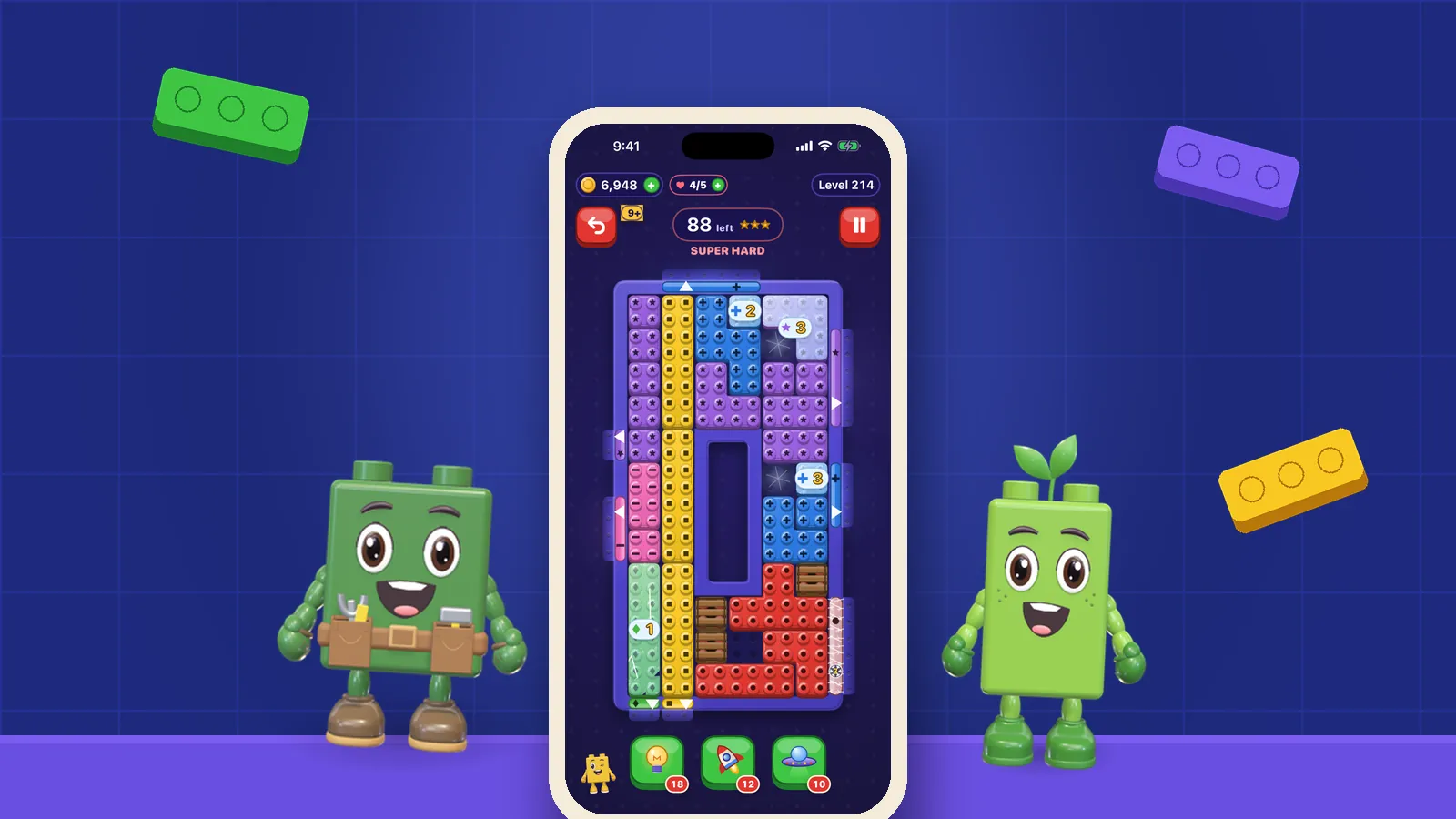
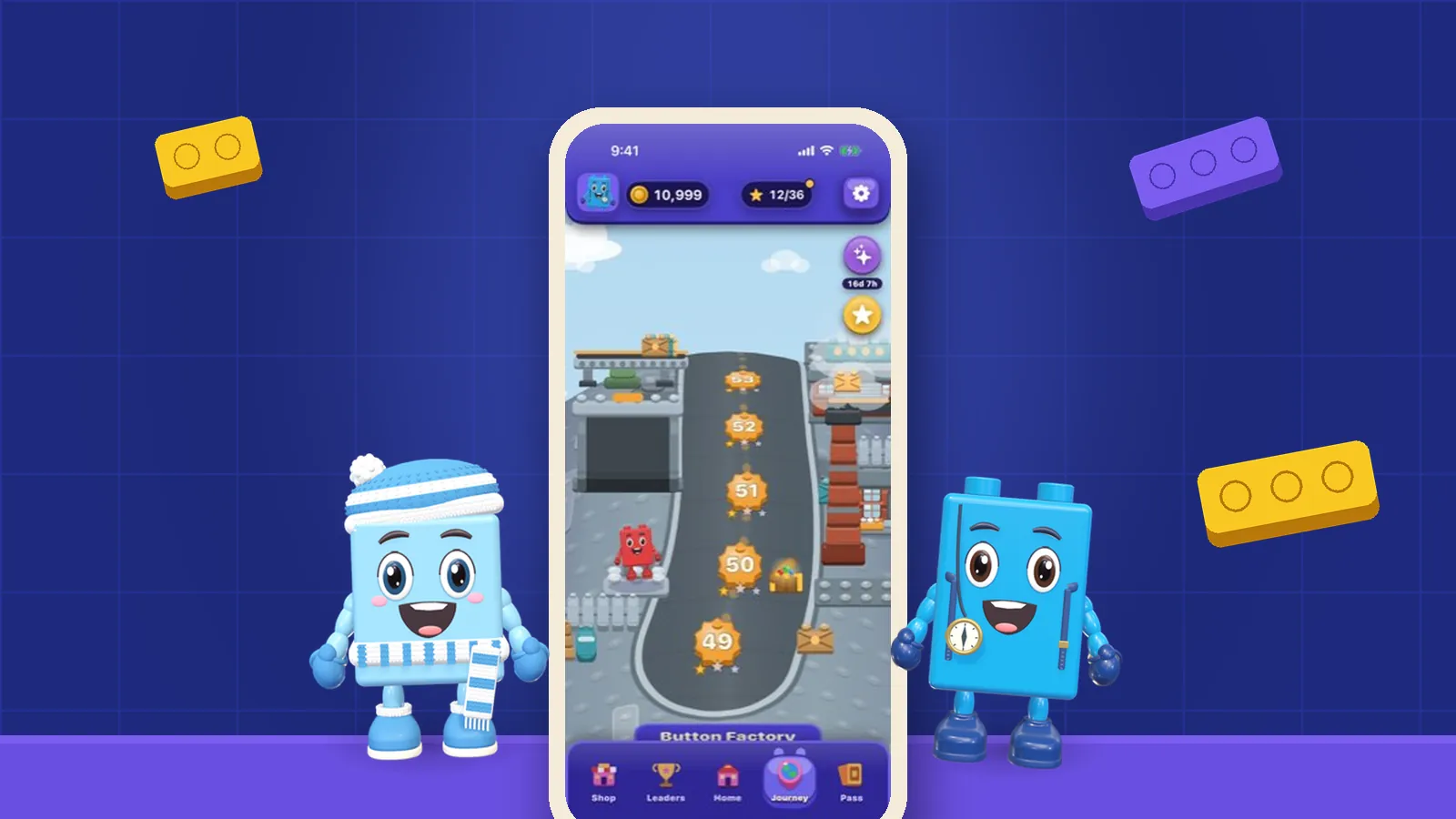
OutBrick is our own test of these ideas. Its rule fits in a sentence: slide a brick into the gate of its own colour and it goes home, or swipe it into a neighbour to swap them, and three or more of a colour in a line clear. That is the kind of mechanic Andersen’s study suggests people can discover by experimenting, since a slide or two shows you most of it. Crates, ice, locks, moss and counted gates appear on later boards, when the basic idea is already yours. You can judge how well a rule like that works by playing a classic board in your browser with no instructions at all, and if you want to go deeper afterwards, our guide on how to solve sliding block puzzles is there when you want it.
Sources5Cheung, G. K., Zimmermann, T., & Nagappan, N. (2014). The first hour experience: How the initial play can engage (or lose) new players. Proceedings of the First ACM SIGCHI Annual Symposium on Computer-Human Interaction in Play, 57–66.1Andersen, E., O’Rourke, E., Liu, Y.-E., Snider, R., Lowdermilk, J., Truong, D., Cooper, S., & Popović, Z. (2012). The impact of tutorials on games of varying complexity. Proceedings of the SIGCHI Conference on Human Factors in Computing Systems, 59–68.
Filed under
Questions, answered
A few useful answers
Do game tutorials work?
It depends on the game. A study of more than 45,000 players found tutorials increased play time by up to 29% in a complex game but made no significant difference in two simpler games whose mechanics could be learned by experimenting.
What is the best way to teach players a game?
Research favours teaching inside play: introduce one mechanic at a time through simple challenges, explain things at the moment they become relevant, and keep text short. Separate instruction screens tend to be less motivating.
Are hints good for puzzle games?
Not always. In a study of 50,000 students playing an educational puzzle game, four different hint systems all lowered performance compared with no hints, so hints need careful design and timing.
How do you learn to play OutBrick?
By swiping a brick. Slide it into the gate of its own colour and it goes home, or swipe it into a neighbour to swap them, and three or more of a colour in a line clear; crates, ice, locks, moss and counted gates appear on later boards. You can try a board in your browser before installing anything.
APA 7
References
Where a source is a studio’s own history or a news account rather than a study, the article says so beside the claim.
- Andersen, E., O’Rourke, E., Liu, Y.-E., Snider, R., Lowdermilk, J., Truong, D., Cooper, S., & Popović, Z. (2012). The impact of tutorials on games of varying complexity. Proceedings of the SIGCHI Conference on Human Factors in Computing Systems, 59–68. doi.org/10.1145/2207676.2207687 (opens in a new tab)
- Frommel, J., Fahlbusch, K., Brich, J., & Weber, M. (2017). The effects of context-sensitive tutorials in virtual reality games. Proceedings of the Annual Symposium on Computer-Human Interaction in Play, 367–375. doi.org/10.1145/3116595.3116610 (opens in a new tab)
- Linehan, C., Bellord, G., Kirman, B., Morford, Z. H., & Roche, B. (2014). Learning curves: Analysing pace and challenge in four successful puzzle games. Proceedings of the First ACM SIGCHI Annual Symposium on Computer-Human Interaction in Play, 181–190. doi.org/10.1145/2658537.2658695 (opens in a new tab)
- O’Rourke, E., Ballweber, C., & Popović, Z. (2014). Hint systems may negatively impact performance in educational games. Proceedings of the First ACM Conference on Learning @ Scale, 51–60. doi.org/10.1145/2556325.2566248 (opens in a new tab)
- Cheung, G. K., Zimmermann, T., & Nagappan, N. (2014). The first hour experience: How the initial play can engage (or lose) new players. Proceedings of the First ACM SIGCHI Annual Symposium on Computer-Human Interaction in Play, 57–66. doi.org/10.1145/2658537.2658540 (opens in a new tab)