What makes a puzzle feel fair? Difficulty, failure and trust
Hard is not the same as unfair. What research on challenge and failure says about the puzzles players trust, and the ones they quit in frustration.
Every puzzle player knows two very different kinds of stuck. One is the good kind: you can see every piece, you know the rules, and you simply have not found the idea yet. The other is the kind that makes you put the phone down: the answer depended on something you could not see, the game punished an experiment you had no way to avoid, or a single slip cost you ten minutes. Both are “hard”. Only one feels fair. Game researchers have spent the last fifteen years pulling those two apart, and what they have found is useful to anyone who makes puzzles, and to anyone deciding which ones deserve their evening.
Designers tend to talk about difficulty as a single dial, but players do not feel it that way. When Alena Denisova, Paul Cairns, Christian Guckelsberger and David Zendle built a questionnaire to measure perceived challenge in games, their surveys and validation studies pointed to four distinct kinds: performative challenge (can my hands do it?), emotional challenge (can I cope with how this makes me feel?), cognitive challenge (can I work it out?) and decision-making challenge (can I live with this choice?). A puzzle can be high on one and low on the others.
That split explains a lot of frustration. A logic puzzle that suddenly demands pixel-perfect timing has moved its challenge from the head to the hands without telling you. A puzzle whose solution depends on a rule you were never shown has not raised the cognitive challenge at all; it has removed the information you needed to meet it.
Megan Pusey, Kok Wai Wong and Natasha Anne Rappa make a related distinction in their Puzzle Challenge Analysis Tool, which they tested on The Witness, Untitled Goose Game and Baba Is You. They separate challenge, the demand a puzzle places on your thinking, from difficulty, how hard a particular player finds it. That distinction is the heart of fairness: a fair puzzle can be very difficult for you today, but its challenge is made of things you are able to reason about.
Sources1Denisova, A., Cairns, P., Guckelsberger, C., & Zendle, D. (2020). Measuring perceived challenge in digital games: Development & validation of the challenge originating from recent gameplay interaction scale (CORGIS). International Journal of Human-Computer Studies, 137, 102383.2Pusey, M., Wong, K. W., & Rappa, N. A. (2021). The Puzzle Challenge Analysis Tool: A tool for analysing the cognitive challenge level of puzzles in video games. Proceedings of the ACM on Human-Computer Interaction, 5(CHI PLAY), 1–27.
In older games with a fixed number of lives, you could measure difficulty by how often players failed. Jesper Juul, writing for the Foundations of Digital Games conference in 2010, argued that this stopped working once most games gave players unlimited retries. His proposal: measure the time a failure takes away from you. Losing a board and starting again at once is a very different experience from losing a board and replaying five minutes of set-up to get back to it.
This is why two puzzles of identical logical difficulty can feel completely different. If a mistake sends you back three moves, you experiment freely. If it sends you back to the start of a long sequence, you stop experimenting and start guessing cautiously, which is a worse way to solve anything.
For players, it gives a quick test when a puzzle game feels mean. Ask what the last failure actually cost you: seconds, minutes, or something scarcer? For designers, it is a reminder that the price of a mistake is a design choice, separate from the puzzle itself.
Sources3Juul, J. (2010). In search of lost time: On game goals and failure costs. Proceedings of the Fifth International Conference on the Foundations of Digital Games, 86–91.
None of this means a fair puzzle should never let you fail. Serge Petralito and colleagues surveyed 95 players right after the release of Dark Souls III, a game famous for how often it kills you. Players mostly reported positive experiences, and the moments they valued most, achievement and learning, were made possible by the negative ones: the difficulty and the repeated deaths.
The condition hidden in that finding is legibility. Failure turned into learning because players could see why they had died and what to try next. The same research tradition that celebrates hard-won victories is clear that failure without a readable cause is just frustration.
Puzzles are an especially clean case. The ideal failure in a puzzle is one where the moment it happens you think “of course”, because the board has just shown you something true about itself. A failure that leaves you thinking “how was I supposed to know?” teaches nothing except distrust.
Sources4Petralito, S., Brühlmann, F., Iten, G., Mekler, E. D., & Opwis, K. (2017). A good reason to die: How avatar death and high challenges enable positive experiences. Proceedings of the 2017 CHI Conference on Human Factors in Computing Systems, 5087–5097.
Conor Linehan and colleagues analysed play-through videos of four much-loved puzzle games, Portal, Portal 2’s co-operative mode, Braid and Lemmings, to see how they paced their challenges. The pattern was consistent: each new skill was introduced on its own, through simple puzzles that needed only that skill; players then practised combining it with what they already knew; and the puzzles grew more complex until the next new skill arrived. Fair puzzles, in other words, rarely ask you for something you have not been given a chance to learn.
Put that together with the research on challenge and failure, and you get a short list you can apply to any puzzle, whether you are making it or playing it:
- Everything you need to solve it is visible, or has been taught before.
- The rules do not change halfway through without warning.
- A solution definitely exists.
- The challenge is the kind the game promised: thinking, not reflexes, in a thinking game.
- A mistake costs a proportionate amount of time, and you can see what caused it.
- New ideas arrive one at a time, with room to practise before they combine.
Sources5Linehan, C., Bellord, G., Kirman, B., Morford, Z. H., & Roche, B. (2014). Learning curves: Analysing pace and challenge in four successful puzzle games. Proceedings of the First ACM SIGCHI Annual Symposium on Computer-Human Interaction in Play, 181–190.1Denisova, A., Cairns, P., Guckelsberger, C., & Zendle, D. (2020). Measuring perceived challenge in digital games: Development & validation of the challenge originating from recent gameplay interaction scale (CORGIS). International Journal of Human-Computer Studies, 137, 102383.
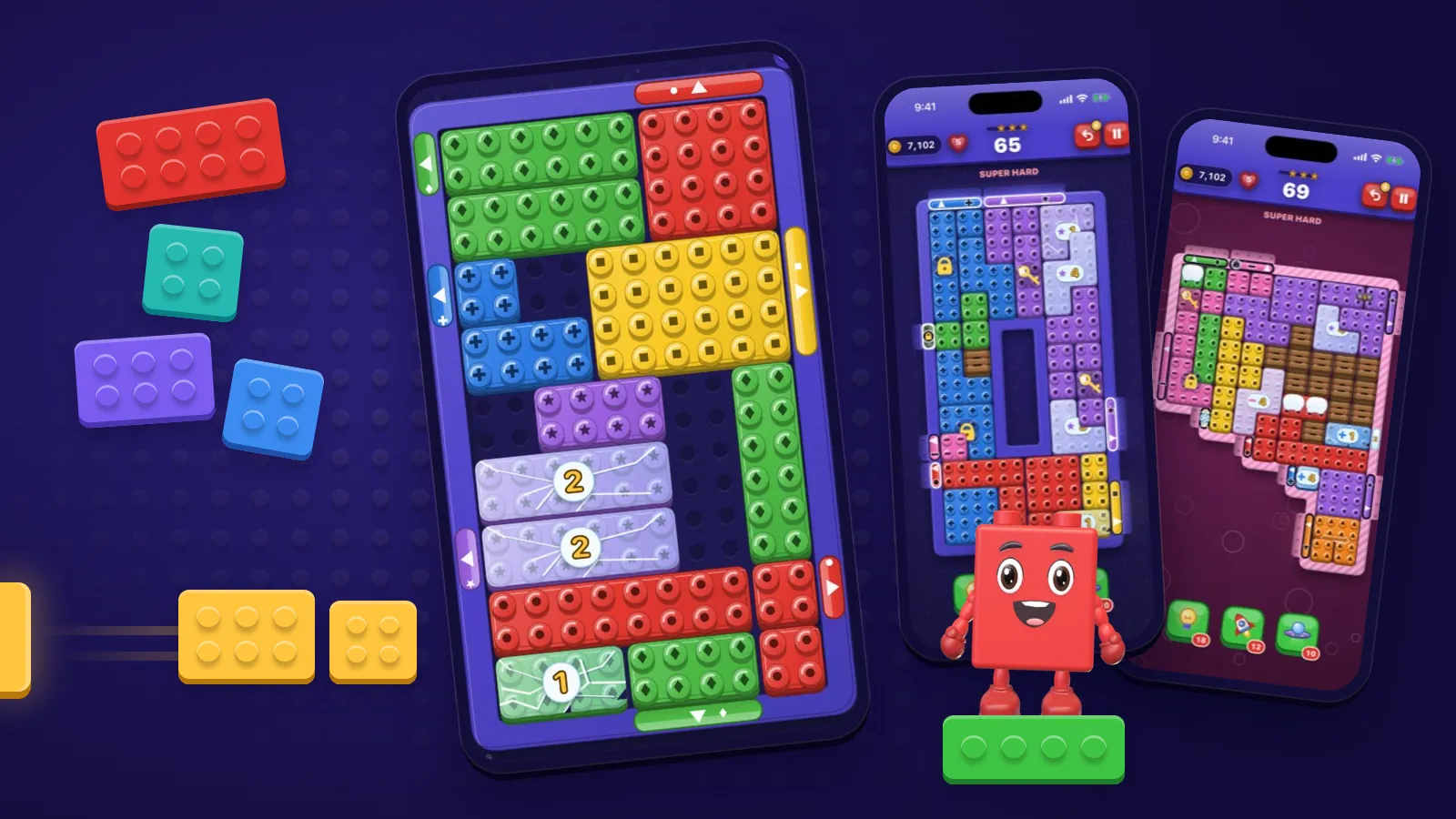
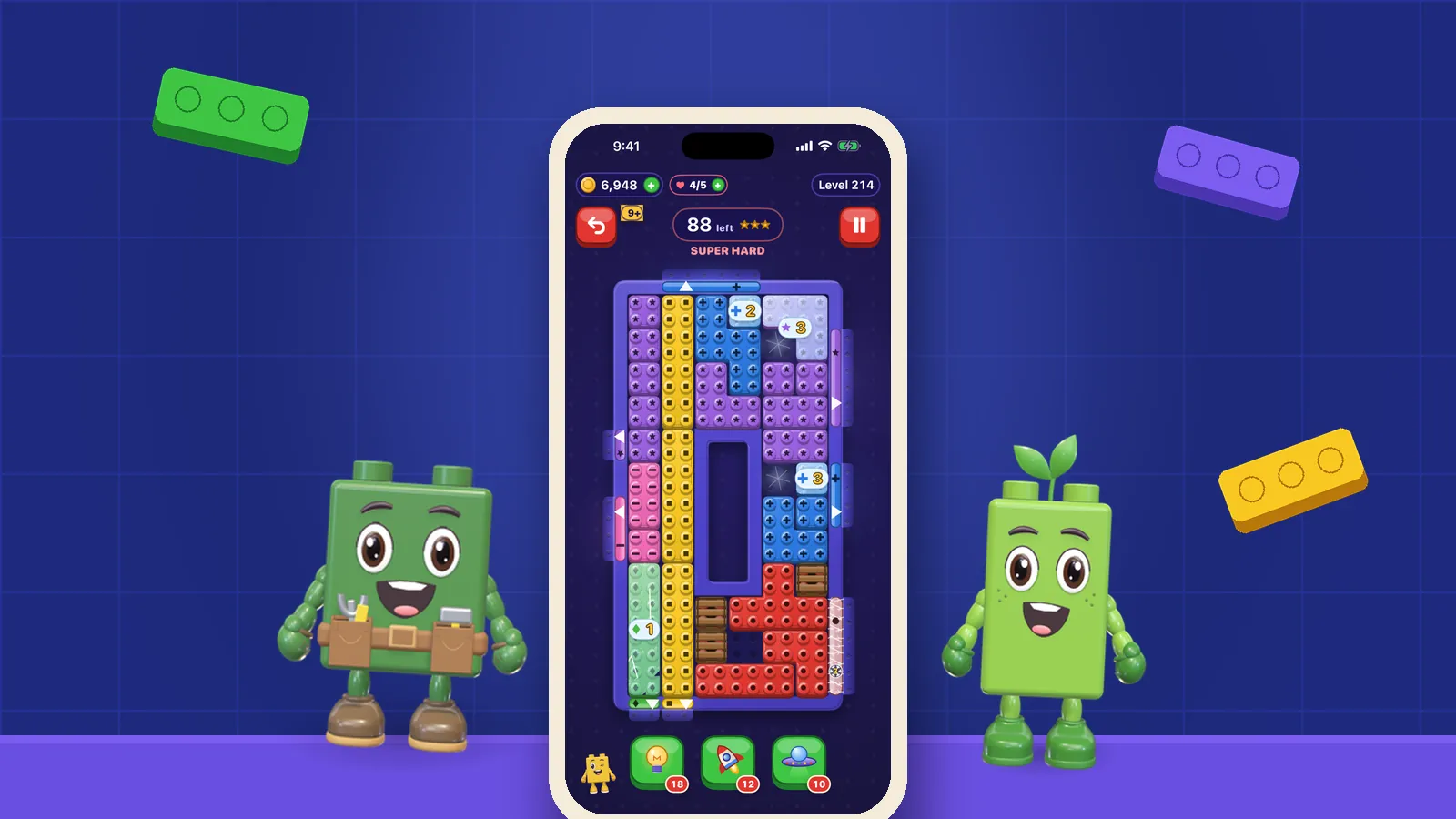
We make OutBrick, so here is how the checklist looks from our side. The rule is small and always the same: slide a brick into the gate of its own colour and it goes home, swipe it into a neighbour and they swap, and three or more of a colour in a line clear. Crates, ice, locks, moss and counted gates appear only on later boards, once the basic rule is familiar. Every one of the 2,000 boards was cleared by a solver and the clear replayed against the game’s own rules before release, a process we describe in how we verified 2,000 sliding-block boards, so no board asks for the impossible.
The price of a mistake is kept small and stated up front. Every board shows its goals and move limit from the first tap, and there is no clock. The first undo on every board is free, and a life goes only when an attempt ends without a clear. The home page sets out exactly what lives, undos and adverts cost. We have written more about the shape of challenge over time in how to build a kinder difficulty curve, and about friction that asks for thought in Papers, Please and meaningful friction.
The best test of fairness is still your own reaction. Play a board in your browser, fail it once on purpose, and notice whether you know why.
Filed under
Questions, answered
A few useful answers
What makes a puzzle feel unfair?
Usually one of three things: the solution depends on information the player could not see or had not been taught, the challenge shifts from thinking to reflexes without warning, or a small mistake costs a large amount of time. Difficulty on its own rarely feels unfair if the rules are clear.
Is it bad for a puzzle game to let you fail?
No. Research on hard games such as Dark Souls III found that failure can make achievement and learning more meaningful. What matters is that the player can see why they failed and that trying again is cheap.
What is the difference between challenge and difficulty?
Researchers often use challenge for the demand a puzzle places on the player, and difficulty for how hard a particular player finds it. A fair puzzle can be very difficult for one person while its challenge stays made of things anyone could reason about.
Are all OutBrick boards solvable?
Yes. Every one of the 2,000 boards was cleared by a solver and the clear replayed against the game’s own rules before release, and each board shows its goals and move limit from the first tap.
APA 7
References
Where a source is a studio’s own history or a news account rather than a study, the article says so beside the claim.
- Denisova, A., Cairns, P., Guckelsberger, C., & Zendle, D. (2020). Measuring perceived challenge in digital games: Development & validation of the challenge originating from recent gameplay interaction scale (CORGIS). International Journal of Human-Computer Studies, 137, 102383. doi.org/10.1016/j.ijhcs.2019.102383 (opens in a new tab)
- Pusey, M., Wong, K. W., & Rappa, N. A. (2021). The Puzzle Challenge Analysis Tool: A tool for analysing the cognitive challenge level of puzzles in video games. Proceedings of the ACM on Human-Computer Interaction, 5(CHI PLAY), 1–27. doi.org/10.1145/3474703 (opens in a new tab)
- Juul, J. (2010). In search of lost time: On game goals and failure costs. Proceedings of the Fifth International Conference on the Foundations of Digital Games, 86–91. doi.org/10.1145/1822348.1822360 (opens in a new tab)
- Petralito, S., Brühlmann, F., Iten, G., Mekler, E. D., & Opwis, K. (2017). A good reason to die: How avatar death and high challenges enable positive experiences. Proceedings of the 2017 CHI Conference on Human Factors in Computing Systems, 5087–5097. doi.org/10.1145/3025453.3026047 (opens in a new tab)
- Linehan, C., Bellord, G., Kirman, B., Morford, Z. H., & Roche, B. (2014). Learning curves: Analysing pace and challenge in four successful puzzle games. Proceedings of the First ACM SIGCHI Annual Symposium on Computer-Human Interaction in Play, 181–190. doi.org/10.1145/2658537.2658695 (opens in a new tab)