Game feel and juice: why a satisfying slide matters
Juice is the extra feedback that makes a tap feel good. Studies with thousands of players show it helps, up to a point, and then starts to hurt.
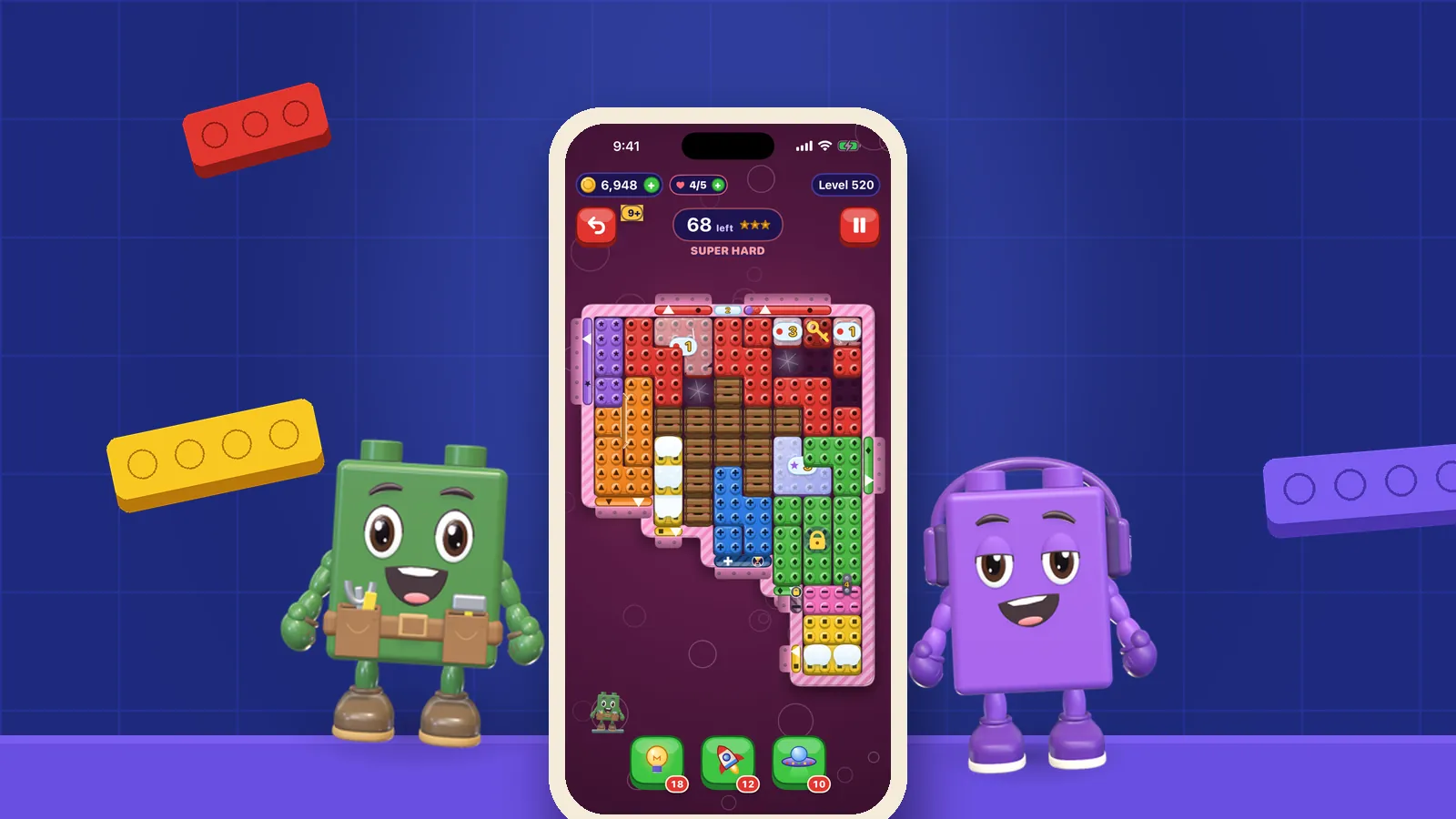
Pick up two versions of the same game. In one, a brick slides across the board and stops. In the other, it slides, eases into place, gives the faintest bump against the wall, and a little dust lifts from the gate as it leaves. The rules are identical. One of them feels like a spreadsheet and the other feels like a toy. Designers call that difference game feel, and the extra, non-essential feedback that produces it is known as “juice”. It is one of the most discussed ideas in game development, and until recently one of the least tested. The research that now exists has a clear message for anyone who makes games: juice is real, and so is too much of it.
Kieran Hicks, Kathrin Gerling, Patrick Dickinson and Vero Vanden Abeele give a tidy definition: juiciness is redundant feedback, where a single player action triggers several reactions that carry no new information. The screen shakes, the score pops, particles fly, a sound plays. None of it is necessary to know what happened. All of it changes how it felt.
Martin Pichlmair and Mads Johansen went further in a survey of more than 200 academic and practitioner sources on game feel. They sort the craft into three domains. Tuning is about physicality: how an object accelerates, how heavy it seems, how predictably it moves. Juicing is amplification: the extra signals that make an action feel powerful and its result clear. Streamlining is support: the game acting on what the player meant, such as forgiving a tap that was slightly early. Juice, in their framing, is only one of three tools, and the other two are quieter.
Sources1Hicks, K., Gerling, K., Dickinson, P., & Vanden Abeele, V. (2019). Juicy game design: Understanding the impact of visual embellishments on player experience. Proceedings of the Annual Symposium on Computer-Human Interaction in Play, 185–197.2Pichlmair, M., & Johansen, M. (2022). Designing game feel: A survey. IEEE Transactions on Games, 14(2), 138–152.
Hicks and colleagues ran two studies: one with 40 participants playing two research games, and one with 32 participants playing a modified Quake 3 Arena, each with and without visual embellishments. The extra effects reliably made the games more visually appealing. Effects on how competent players felt appeared only in some circumstances. Juice made the game look better; it did not automatically make players feel better at it.
The largest study so far came from Dominic Kao, who gave 3,018 players one of four versions of the same action role-playing game: no juice, medium, high or extreme. The middle two won. Both the no-juice and the extreme versions led to significantly shorter play, worse player experience, lower intrinsic motivation and even worse performance than medium or high. Too little feedback leaves a game feeling dead; too much buries the information the player needs under noise.
That inverted-U shape is the most practical result in this whole literature. Juice is a dose, not a virtue.
The limits are worth stating. Both studies used action games, where fast feedback is part of the fun, and the “right” dose will differ in a slow, thoughtful genre. Kao’s four versions also sat at fixed points on a scale, so the study shows that the extremes lose, not exactly where the best amount lies for any particular game. For puzzle games, the honest summary is that the direction of the finding probably holds and the exact dose has to be found by testing with players.
Sources1Hicks, K., Gerling, K., Dickinson, P., & Vanden Abeele, V. (2019). Juicy game design: Understanding the impact of visual embellishments on player experience. Proceedings of the Annual Symposium on Computer-Human Interaction in Play, 185–197.3Kao, D. (2020). The effects of juiciness in an action RPG. Entertainment Computing, 34, 100359.
On a phone, feel is not only visual. Tanay Singhal and Oliver Schneider borrowed the idea of juice for vibration, defining “haptic embellishments” as vibration that reinforces what the screen already shows. In two studies with people using their own phones, juicy haptics improved how enjoyable, attractive, immersive and meaningful a game felt. A well-timed tick under the thumb can do some of the work that a screen shake does, without adding anything to look at.
The opposite end is decoration that does not react at all. Anna-Lena Meiners and colleagues call this “lushness”: background detail and objects you cannot interact with. In a study with 31 participants playing four versions of a platformer, more lushness made the game more visually appealing and attractive, but did not change how competent players felt or how much mental effort they reported. Decoration is pleasant. It is not feel.
Consistency matters as much as intensity. Apple’s Human Interface Guidelines on playing haptics ask developers to use haptics consistently and to build a clear, causal relationship between each vibration and the action that triggers it. The same is true of every channel of feedback. A response the player can predict becomes part of how they understand the game; a response that varies at random is just noise.
Sources4Singhal, T., & Schneider, O. (2021). Juicy haptic design: Vibrotactile embellishments can improve player experience in games. Proceedings of the 2021 CHI Conference on Human Factors in Computing Systems, 1–11.5Meiners, A.-L., Reich, D., Hicks, K., Alexandrovsky, D., & Gerling, K. (2025). Lushness in game design: The role of non-interactive visual embellishments in player experience. Proceedings of the 20th International Conference on the Foundations of Digital Games, 1–11.
Most writing about juice comes from action games, where more energy is usually the point. A calm puzzle game has a different job. Its feedback has to confirm what happened without raising the player’s pulse, and it has to stay readable on the hundredth board as well as the first. That pushes the balance towards tuning and streamlining, with juice used sparingly for the moments that deserve it.
Some rules we use when we judge feedback in a puzzle:
- Motion should explain the rule. A brick that eases into its stop tells you it stopped because something was there.
- Save the biggest effects for the rarest events. A clear deserves more than a move.
- Never let an effect cover the part of the board you need to read next.
- Respect the system’s Reduce Motion setting, and make sure the game still reads without the flourishes.
- If an effect is fun the first time and tiring the fiftieth, it is too much.
Sources3Kao, D. (2020). The effects of juiciness in an action RPG. Entertainment Computing, 34, 100359.2Pichlmair, M., & Johansen, M. (2022). Designing game feel: A survey. IEEE Transactions on Games, 14(2), 138–152.
OutBrick is built on one verb: swipe a brick, and it slides to where you let go or swaps with the neighbour you pushed it into. Because that verb happens hundreds of times in a session, its feel matters more than any celebration. The slide has to be quick enough never to make you wait, and legible enough that you can see where the brick is going before it gets there. We honour Reduce Motion everywhere, so the board still reads when effects are turned down. The bigger moments belong to the clear, where the brick friends each have a victory move of their own.
Feel is also why short sessions can be satisfying: a tidy action with a tidy response is a small reward in itself, which we explore in why a two-minute puzzle can feel like a proper reset. If you want to test your own sense of it, play a board in your browser and pay attention to the moment a brick stops. The same restraint runs through Tetris, where much of the pleasure comes from rhythm rather than spectacle. For how sound contributes to the same feeling, see our piece on audio feedback and player experience, and for what keeps a game restful rather than frantic, what actually makes a puzzle game calm.
Filed under
Questions, answered
A few useful answers
What is juice in game design?
Juice is extra feedback that reinforces something the player already knows happened: screen shake, particles, sounds, vibration or bouncy animation. It does not change the rules, but it changes how an action feels.
Does juicy feedback make games better?
Up to a point. In a study of 3,018 players, versions with medium or high juice outperformed both no juice and extreme juice on play time, player experience, motivation and performance.
What is the difference between game feel and juice?
Game feel is the whole moment-to-moment sensation of interacting with a game. Juice is one ingredient of it; others include tuning how objects move and streamlining controls so the game does what the player meant.
Can I turn down animations in OutBrick?
Yes. OutBrick honours the system Reduce Motion setting everywhere, and the board stays readable with effects turned down.
APA 7
References
Where a source is a studio’s own history or a news account rather than a study, the article says so beside the claim.
- Hicks, K., Gerling, K., Dickinson, P., & Vanden Abeele, V. (2019). Juicy game design: Understanding the impact of visual embellishments on player experience. Proceedings of the Annual Symposium on Computer-Human Interaction in Play, 185–197. doi.org/10.1145/3311350.3347171 (opens in a new tab)
- Pichlmair, M., & Johansen, M. (2022). Designing game feel: A survey. IEEE Transactions on Games, 14(2), 138–152. doi.org/10.1109/tg.2021.3072241 (opens in a new tab)
- Kao, D. (2020). The effects of juiciness in an action RPG. Entertainment Computing, 34, 100359. doi.org/10.1016/j.entcom.2020.100359 (opens in a new tab)
- Singhal, T., & Schneider, O. (2021). Juicy haptic design: Vibrotactile embellishments can improve player experience in games. Proceedings of the 2021 CHI Conference on Human Factors in Computing Systems, 1–11. doi.org/10.1145/3411764.3445463 (opens in a new tab)
- Meiners, A.-L., Reich, D., Hicks, K., Alexandrovsky, D., & Gerling, K. (2025). Lushness in game design: The role of non-interactive visual embellishments in player experience. Proceedings of the 20th International Conference on the Foundations of Digital Games, 1–11. doi.org/10.1145/3723498.3723720 (opens in a new tab)