


Respect the pause
Sessions have natural edges. Being interrupted costs nothing, the clear card is a real ending, and nothing interrupts a board.
About OutBrick
OutBrick is a calm directional sliding-brick puzzle for the moments between things. Its maker is Mourad Hamdi. This site brings the game, the thinking behind it and the journal together.
The game, plainly
Everything on this list matches the home page, which is where the game is described in full.
See the gameWorking principles
Sessions have natural edges. Being interrupted costs nothing, the clear card is a real ending, and nothing interrupts a board.
Challenge should come from the puzzle’s idea, not from unclear controls. A board with a move limit shows its goals and move budget from the first tap.
Colour-blind glyphs are on by default, every brick is a VoiceOver element, and Reduce Motion is honoured everywhere.
Lives and rewarded videos exist, and the home page says exactly how both work, with nothing rounded in our favour.
The workshop
The game and the writing grow together. A new board can prompt a design note, and a research paper can change the question we ask of a feature. Publishing both keeps us honest about why the game works the way it does.
When a story makes a research claim, it cites the source in APA 7 and says whether that source is a study, a standard, a news account or a studio’s own history. Conclusions stay the size the evidence supports.
On the App Store · iOS 5.5
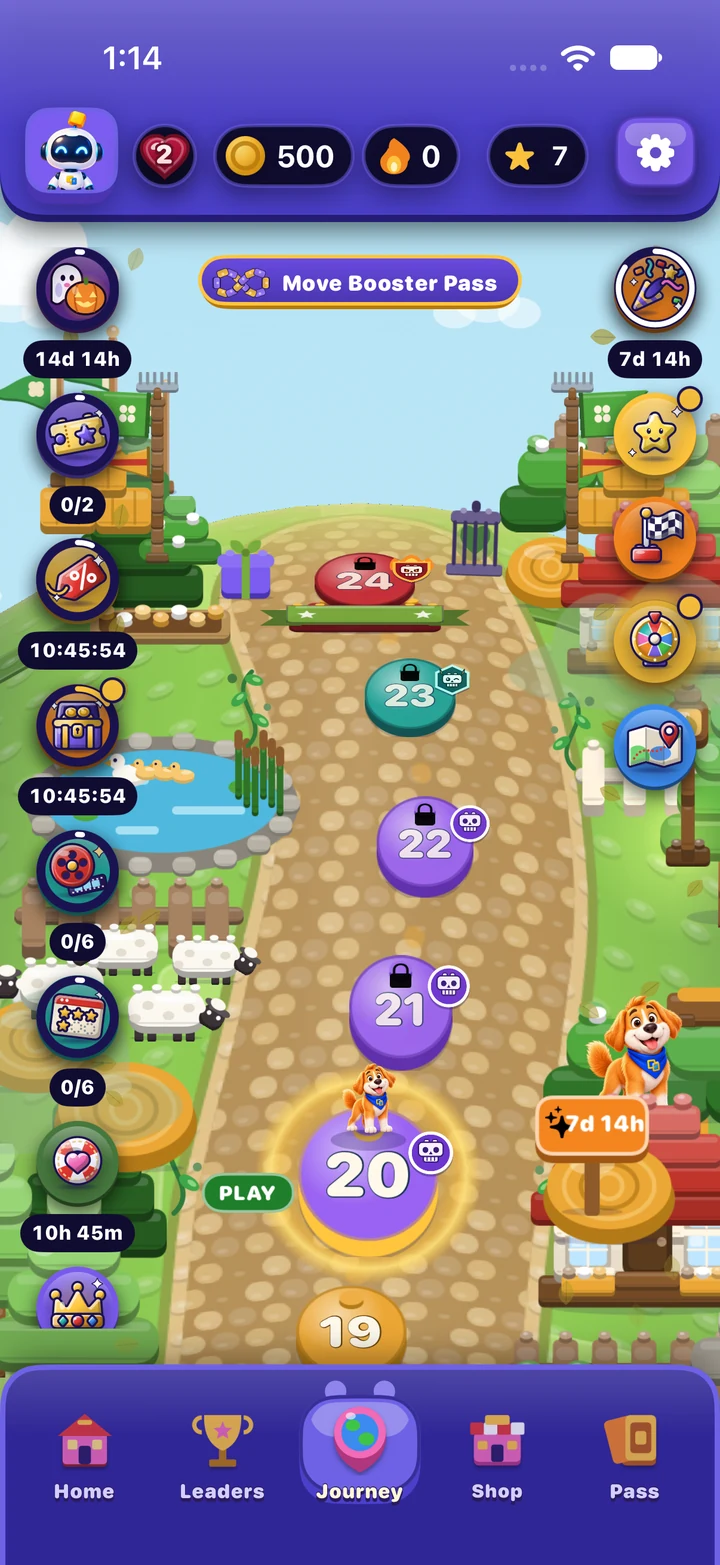
A calm sliding-brick puzzle with 2,000 levels across 167 brick-built villages and five current friends: Pix, Luna, Brix, Nova and Max. Slide one brick along its lane and route it through an open gate that accepts its colour. There is no timer, and the game can be played offline.
Drag one brick in a direction. It moves along its legal lane, stopping where you release it or at an obstacle, gate or lane end. Send it through an open gate that accepts its colour. Each valid push uses one move; there are no neighbour swaps or colour-match lines.
Bricks have different movement rules: when a key exits, it opens a locked brick and locked gates; ice counters drop as other bricks leave; connected pairs split after the set number of other bricks exit; a multilayer brick sheds its top colour at a gate that accepts it; arrow bricks move on one axis; and a snow cap comes off when another brick slides past. Crates also block lanes.
The Journey has 2,000 levels in 167 villages. Each village has twelve levels except the final village, which has eight; its 100 chapters are separate groups of twenty. Standard boards ask you to route every brick through a gate that accepts its colour. Layouts and feature combinations vary rather than following a fixed twelve-board sequence. Hidden bricks begin at level 21; sealed rooms begin at level 30. The eight gate behaviours are plain, locked, iced, counted, cycling, wildcard, paired and timed. Generators feed queued bricks onto the board, and conveyors can carry bricks after a move. The tiers are Normal, Hard, Super Hard, Boss and Night; Night changes the palette while keeping the movement rules.
VoiceOver names a brick by its kind, colour and position and offers directional slide actions, including whether a route exits through a gate. It announces where a brick stops and what leaves the board. Hidden bricks never reveal their colour through labels or hints. A two-finger double tap asks for a hint; rotors navigate goals, blockers and gates.
Siri can answer about lives, refill time, the Daily Brick and village stars. Widgets, Live Activities, Spotlight, Shortcuts and Focus filters bring the game into Apple’s system features; supported Apple Intelligence features depend on your device and system. iCloud keeps progress across your devices.
Community and Report a bug in the app’s Settings open the OutBrick Community: ask for help, report a bug, suggest an idea and vote on what comes next. A report from the app arrives with your device, versions and level filled in. Read without signing in; use email, Google or Apple to join the conversation.
Version 5.5 adds more Hard, Super Hard and Boss levels across the Journey, with more colours, gates and sealed rooms; many villages now end with a Boss. “Stuck?” and the Rescue Pack return after a lost try. The out-of-moves screen is simpler, with extra moves for coins, a free video that awards one Hint, not extra moves, and a warning when your win streak is at risk. Move Booster Pass now lasts seven days instead of 48 hours, and new sounds and haptics accompany bricks as they slide, cross gates and fill them.