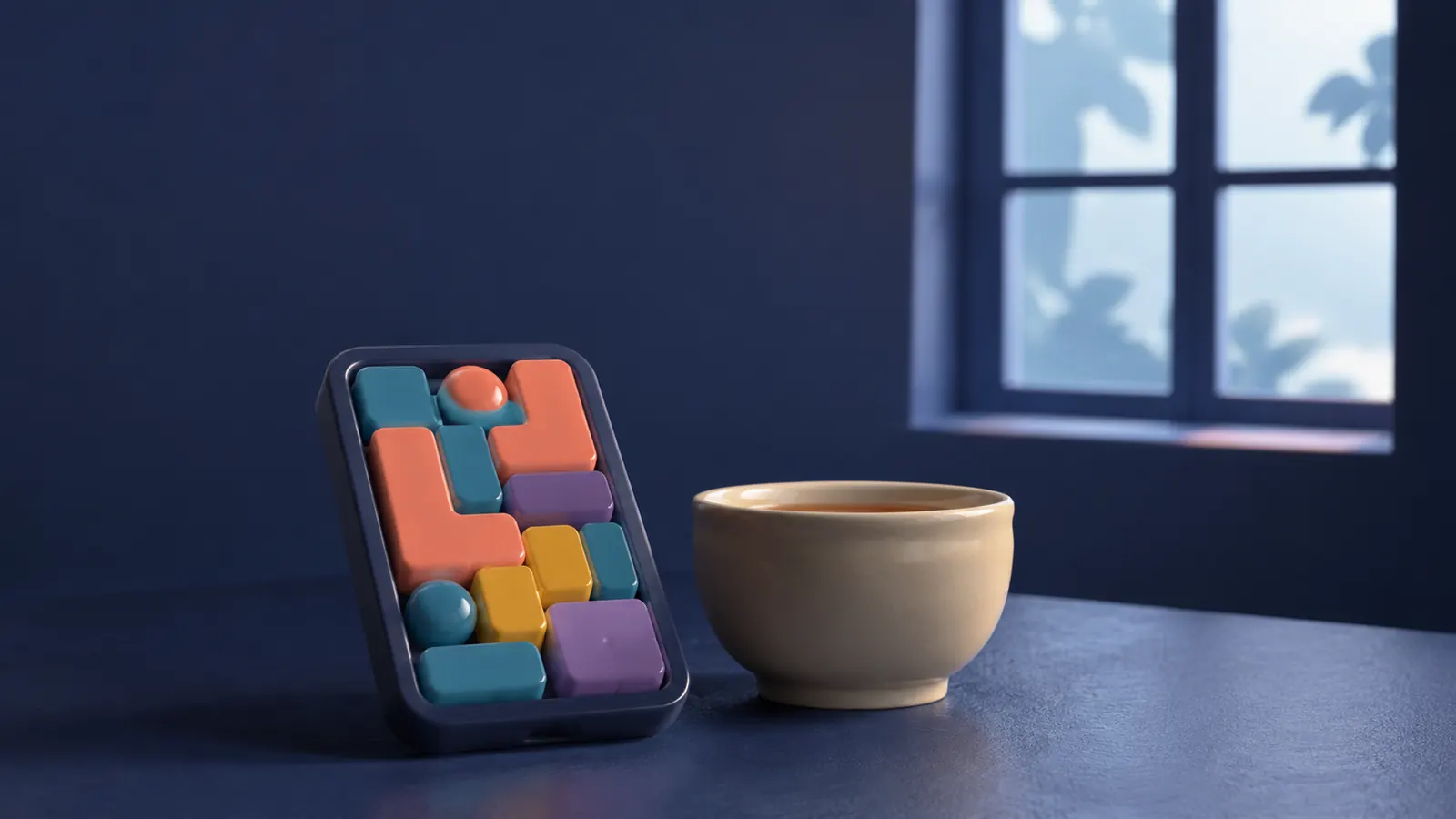
Relaxing puzzle games: what actually makes one calm
Soft colours are not enough. Move limits versus clocks, fair lives, and games that never interrupt you: how to tell if a puzzle game will stay calm.
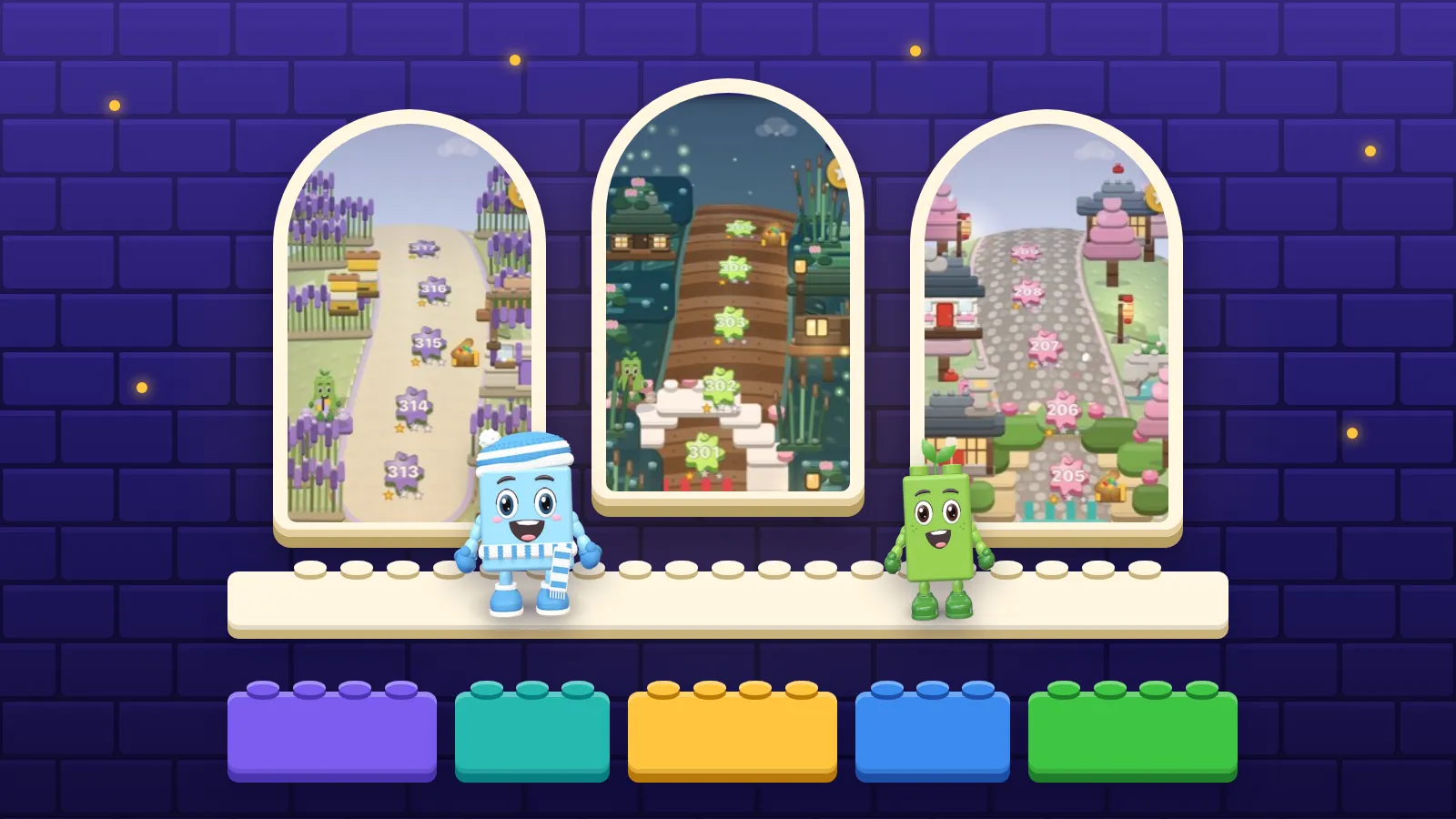
A lot of app store pages call their puzzle game “relaxing”. Some games earn the word. Others put pastel colours and soft music over the same pressure you get everywhere else: a countdown in the corner, a lives system that runs dry just as you get going, an advert between every level. Here is what we look at when we judge whether a puzzle game is calm, and where OutBrick stands on each point, including the places where it asks something of you.
A puzzle is supposed to be a bit hard, and a hard board can still be restful. The pressure that makes a game feel frantic usually comes from outside the puzzle, and it tends to come from four places: time (a countdown, a shrinking bar), scarcity (lives, energy, tokens), interruption (adverts, pop-up offers, prompts between levels) and comparison (streaks that break, leaderboards pushed at you).
None of these is automatically wrong. A timed mode can be great fun when you choose it. The test for a calm game is simpler: can you see every constraint before you start, and did you agree to it? A board that tells you its rules up front and then leaves you alone feels very different from one that changes the terms halfway through.
The last of the four is the easiest to miss. A streak counter or a leaderboard can be a pleasant extra when you go looking for it. It becomes pressure when the game puts it in front of you at the moment you meant to stop, or frames a missed day as something lost. Notice where a game shows you those numbers, and whether it lets you ignore them.
A clock punishes thinking. Every second you spend reading the board is a second you lose, so the game rewards reflex and guessing. A move limit punishes waste instead. You can look at a board for as long as you like, and the only thing that costs you is a careless slide. For a puzzle game that wants to be restful, that difference matters more than any colour palette.
OutBrick has no clock anywhere. The rope on each board is a move limit. Every board shows its goals and its move limit from the first tap, so the budget is known before you spend any of it. When you run low, you are offered five more moves before anything else happens.
There is an accessibility argument too. The web’s accessibility guidelines ask that time limits be possible to turn off, adjust or extend, because some people need more time to complete a task. A game without a clock has nothing to adjust. And the wider research on time pressure points the same way: in a study of interrupted office work, Mark, Gudith and Klocke found people compensated by working faster, and reported more stress, frustration and time pressure as they did.
Sources1World Wide Web Consortium. (n.d.). Understanding Success Criterion 2.2.1: Timing adjustable. Web Accessibility Initiative.2Mark, G., Gudith, D., & Klocke, U. (2008). The cost of interrupted work: More speed and stress. In Proceedings of the SIGCHI Conference on Human Factors in Computing Systems (CHI ’08) (pp. 107–110). ACM.
Plenty of calm games have lives, including ours, so the useful question is how they work. A fair lives system tells you exactly what costs a life, gives you enough of them to play a proper session, refills them without asking for money, and never takes one for simply trying.
OutBrick used to ship with no lives and no adverts, and both of those changed, which is why the home page sets out exactly what lives, undos and adverts cost. Opening a board needs a life and spends none. Clearing a board costs nothing at all. A life goes only when an attempt ends without a clear. You hold five, eight with the Brick Pass, and one comes back every thirty minutes. Undo works the same way: the first one on every board is free and cannot run out, then a tank of five refills one every twenty-five minutes, and a board with no move left reshuffles itself for free.
Watch what happens when you run out, too. In a fair system, running out is a pause with a known length. In OutBrick you can wait for the next life, or, if you choose, watch a rewarded video for one; both routes are stated before you ever need them. A game that greets an empty tank with a purchase screen and no clear refill time is using scarcity as a sales tool, and that rarely feels calm.
- What exactly costs a life: starting, failing, or quitting?
- How many can you hold, and how long does one take to come back?
- Can you keep playing something while you wait?
- Is the refill ever used as a reason to show you an offer?
The quickest way to break a relaxing game is to interrupt it. A full-screen advert after every third level teaches you to brace before you tap “next”. A pop-up offer at the moment you fail turns a small disappointment into a sales pitch. Neither has anything to do with the puzzle, and both are where many puzzle games lose the calm they advertise.
Here is how OutBrick handles it. There are eight rewarded video placements: a life, two undos, extra moves, a free Hint, the clear card’s coins paid again, a second spin of the Brick Wheel, a gift balloon on the map and Brick Cinema. Every one is opt-in and carries its own daily cap, with 39 views a day at most across all of them. There are no banners and no interstitials, nothing plays that you did not press a button to see, and nothing interrupts a board. Remove Ads switches advertising off for good.
Why it matters is partly our opinion and partly the evidence. Studies of casual play have found short-term benefits to mood after a demanding task, and one found reduced stress after a casual game, though a mindfulness exercise did better on self-reported stress. Those effects depend on the player getting a spell of uninterrupted play. An advert every few minutes is a poor way to protect that.
Sources3Rupp, M. A., Sweetman, R., Sosa, A. E., Smither, J. A., & McConnell, D. S. (2017). Searching for affective and cognitive restoration: Examining the restorative effects of casual video game play. Human Factors, 59(7), 1096–1107.4Desai, V., Gupta, A., Andersen, L., Ronnestrand, B., & Wong, M. (2021). Stress-reducing effects of playing a casual video game among undergraduate students. Trends in Psychology, 29(3), 563–579.
Before you settle on a puzzle game to wind down with, spend five minutes checking it against the list below. Most games will pass some of these and fail others, and that is fine. (We have written separately about when to play and when to pause.) What matters is that you know which is which before it is eleven at night and a countdown has appeared.
Calm also has a sensory side that store pages rarely mention. Screens full of flashing rewards and shaking buttons are tiring even when nothing is timed. OutBrick honours the system’s Reduce Motion setting everywhere, and its nine brick friends speak in text bubbles rather than voices, so a late-night board can be a quiet one.
- No countdown on normal levels, or a timed mode you can ignore.
- The rules and limits of each level are visible before your first move.
- The cost of failing is stated plainly and is small.
- No advert plays unless you press a button to see it.
- Stopping between levels costs nothing.
- It plays offline, so a weak signal never stalls a level.
- Accessibility options such as colour-blind support and Reduce Motion are there and honoured.
Filed under
Questions, answered
A few useful answers
What makes a puzzle game relaxing?
Mostly the absence of pressure from outside the puzzle: no countdown, clear limits shown before you start, a small and stated cost for failing, and nothing that interrupts play without your say-so. A hard puzzle can still be relaxing if it leaves you alone to think.
Are there puzzle games without timers?
Yes. Many puzzle games use a move limit or no limit at all. OutBrick has no clock anywhere; each board has a move limit, shown as a rope, alongside its goals.
Does OutBrick have lives and adverts?
Yes. You hold five lives, eight with the Brick Pass, and one comes back every thirty minutes; a life goes only when an attempt ends without a clear. Adverts are rewarded videos you choose to watch, each with a daily cap, and there are no banners or interstitials.
Is a move limit stressful?
Usually less than a clock, because thinking is free and only careless moves cost you. In OutBrick you are also offered five more moves when you run low, before anything else happens.
APA 7
References
Where a source is a studio’s own history or a news account rather than a study, the article says so beside the claim.
- World Wide Web Consortium. (n.d.). Understanding Success Criterion 2.2.1: Timing adjustable. Web Accessibility Initiative. www.w3.org/WAI/WCAG22/Understanding/timing-adjustable (opens in a new tab)
- Mark, G., Gudith, D., & Klocke, U. (2008). The cost of interrupted work: More speed and stress. In Proceedings of the SIGCHI Conference on Human Factors in Computing Systems (CHI ’08) (pp. 107–110). ACM. doi.org/10.1145/1357054.1357072 (opens in a new tab)
- Rupp, M. A., Sweetman, R., Sosa, A. E., Smither, J. A., & McConnell, D. S. (2017). Searching for affective and cognitive restoration: Examining the restorative effects of casual video game play. Human Factors, 59(7), 1096–1107. doi.org/10.1177/0018720817715360 (opens in a new tab)
- Desai, V., Gupta, A., Andersen, L., Ronnestrand, B., & Wong, M. (2021). Stress-reducing effects of playing a casual video game among undergraduate students. Trends in Psychology, 29(3), 563–579. doi.org/10.1007/s43076-021-00062-6 (opens in a new tab)