Dynamic difficulty adjustment: should games adapt to you?
Many games quietly tune themselves to your skill. What studies say about adaptive difficulty, why it can leave players overconfident, and the case for asking.
You die three times on the same stretch of a game and, on the fourth try, it seems a little easier. Were the enemies slower, or did you finally get it? Often you cannot tell, and that is by design. Dynamic difficulty adjustment, or DDA, is the practice of changing a game’s challenge while you play, based on how you are doing. It promises every player a game pitched just right. It also raises awkward questions about honesty, about who gets to decide how hard a game should be, and about what a victory means when the game helped. Here is what the research says, and where we have landed for our own puzzles.
Traditional games fix their difficulty in advance: you choose Easy, Normal or Hard at the start, or the game follows a set curve. As Mohammad Zohaib’s review of the field puts it, the problem is that players then have to map themselves onto a learning curve somebody else decided. DDA changes features of the game in real time, such as how often enemies appear, how accurate they are or how many resources you find, to keep the player between boredom and frustration.
You have probably met it without knowing. Racing games have long been accused of “rubber-banding”, where rivals slow down when you fall behind and speed up when you pull ahead. Some action games quietly hand out more health or ammunition when you are struggling. Some puzzle games offer an easier version of a level after several failures. The techniques differ, but the logic is the same: watch the player, estimate their skill, and move the challenge to meet them.
Robin Hunicke’s 2005 paper, “The case for dynamic difficulty adjustment in games”, is the usual starting point. Conventional wisdom, she noted, held that players enjoy surprise but feel cheated if they notice a game changing to suit them. Her system, Hamlet, adjusted supply and demand in a first-person shooter behind the scenes, and her preliminary results challenged some of those assumptions about how players would react. The tension she named has never gone away: adaptation is meant to help, but only if it does not spoil the experience it is protecting.
Sources2Zohaib, M. (2018). Dynamic difficulty adjustment (DDA) in computer games: A review. Advances in Human-Computer Interaction, 2018, 5681652.1Hunicke, R. (2005). The case for dynamic difficulty adjustment in games. Proceedings of the 2005 ACM SIGCHI International Conference on Advances in Computer Entertainment Technology, 429–433.
Often, yes, with caveats. Dennis Ang and Alex Mitchell compared three versions of a game: no adaptation, a system-oriented version that ramped difficulty automatically, and a player-oriented version in which players made the adjustment decisions. Both adaptive versions produced better overall experiences than no adaptation. But they differed in texture. Players with the automatic system felt less self-conscious and lost track of time more, and they also reported a lower sense of control than players who chose for themselves.
That trade-off is the core of the debate. Hidden adaptation can smooth out the rough edges that break immersion. It also takes a decision away from the player, and control is one of the ingredients of a satisfying game. The right answer depends on what the game is for: a story game that wants you swept along may accept the trade; a puzzle game whose pleasure is working something out yourself may not.
Sources3Ang, D., & Mitchell, A. (2017). Comparing effects of dynamic difficulty adjustment systems on video game experience. Proceedings of the Annual Symposium on Computer-Human Interaction in Play, 317–327.
Two lines of research complicate the story. Thomas Constant and Guillaume Levieux measured player confidence with an in-game betting system across three games that tested logical, motor and sensory skill. Players whose difficulty was adapted by an algorithm tended to become overconfident, overestimating their chances of success. The authors suggest that this confidence boost may be part of why DDA feels good, which is exactly why it deserves a second look: a game that feels good partly because it misleads you about your ability is doing something subtle.
Alena Denisova and Paul Cairns found the mirror image. In two studies with two different games, players who were told the game adapted to them reported more immersion, whether or not the game actually adapted. Belief shaped the experience independently of the mechanism. The authors read this reassuringly for developers: telling players about adaptation does not seem to backfire. It also shows how much of “this game gets me” lives in the player’s expectations.
Sources4Constant, T., & Levieux, G. (2019). Dynamic difficulty adjustment impact on players’ confidence. Proceedings of the 2019 CHI Conference on Human Factors in Computing Systems, 1–12.5Denisova, A., & Cairns, P. (2019). Player experience and deceptive expectations of difficulty adaptation in digital games. Entertainment Computing, 29, 56–68.
If control matters, why not simply ask players? Ang and Mitchell tested that too, with 84 participants. They varied how difficulty choices were presented, either built into the game’s mechanics or as a direct setting, and how often they were offered: once, periodically or constantly. Choices integrated into the game improved some aspects of experience, and periodic choices beat both a single choice at the start and a constant stream of them. Asking once is too rigid; asking all the time turns play into administration.
Put together, the evidence suggests a middle path that many well-loved games already follow. Offer help at natural moments, make it visible, let players refuse it, and do not pretend a helped victory is something else. Celeste’s Assist Mode is a celebrated example, which we discuss in Celeste’s Assist Mode: accessibility as better design.
- Is the game changing difficulty without telling you?
- Can you see and switch off any help it gives?
- Are choices offered at natural pauses rather than at the start only, or constantly?
- Does a helped clear still count, without shame?
Sources6Ang, D., & Mitchell, A. (2019). Representation and frequency of player choice in player-oriented dynamic difficulty adjustment systems. Proceedings of the Annual Symposium on Computer-Human Interaction in Play, 589–600.3Ang, D., & Mitchell, A. (2017). Comparing effects of dynamic difficulty adjustment systems on video game experience. Proceedings of the Annual Symposium on Computer-Human Interaction in Play, 317–327.
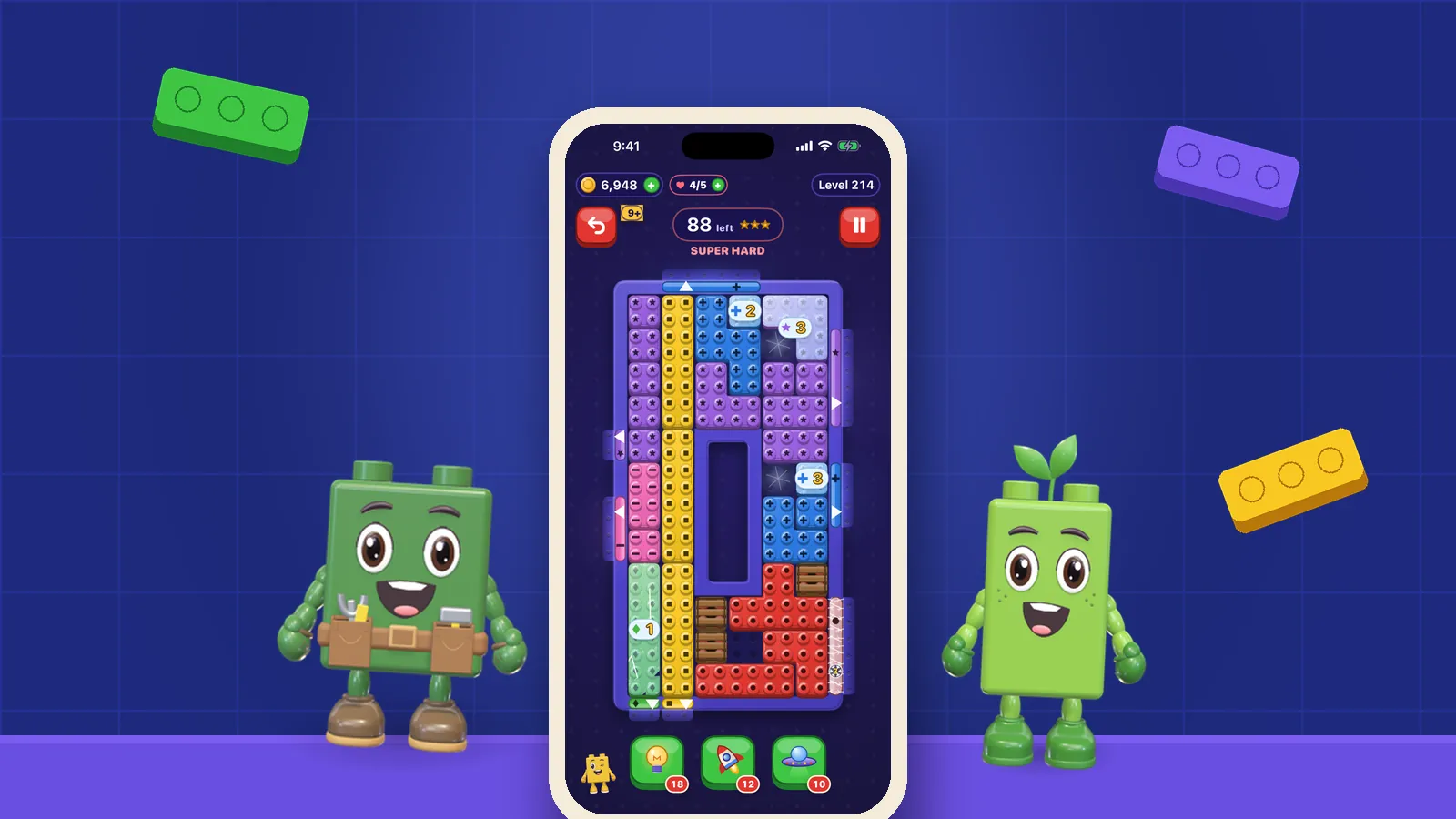
For a sliding-brick puzzle we chose visible help over hidden adaptation. Each of OutBrick’s 2,000 boards is fixed and was solver-verified before release, and every board shows its goals and move limit from the first tap, so the puzzle you face is the puzzle everyone faces. A clear means you found a route through that board.
Help exists, but you ask for it and you can see it. The first undo on every board is free. When a board is left with no move, it reshuffles itself for free. When you run low on moves you are offered five more before anything else happens, paid for with coins or, if you choose, a rewarded video. The home page lists exactly what lives, undos and adverts cost. None of it changes the board behind your back.
That is a choice suited to a puzzle game, not a verdict on DDA everywhere. For more on shaping challenge over a whole game, see how to build a kinder difficulty curve and what makes a puzzle feel fair.
Filed under
Questions, answered
A few useful answers
What is dynamic difficulty adjustment?
Dynamic difficulty adjustment (DDA) is when a game changes its challenge during play based on how the player is doing, for example by making enemies weaker after repeated failures. The aim is to keep players between boredom and frustration.
Is dynamic difficulty adjustment good or bad?
Studies often find it improves player experience, but hidden adaptation can reduce players’ sense of control and has been linked to overconfidence. Visible, optional help offered at natural moments tends to avoid those drawbacks.
How can I tell if a game is adjusting its difficulty?
It is often hard to tell, which is part of the debate. Look for settings or store descriptions that mention adaptive or assisted difficulty, and notice whether the game offers help openly or seems to change without saying so.
Does OutBrick adjust difficulty to the player?
No. Every board is fixed and solver-verified, with its goals and move limit shown from the first tap. Help such as the free first undo or five more moves is offered openly, and you choose whether to take it.
APA 7
References
Where a source is a studio’s own history or a news account rather than a study, the article says so beside the claim.
- Hunicke, R. (2005). The case for dynamic difficulty adjustment in games. Proceedings of the 2005 ACM SIGCHI International Conference on Advances in Computer Entertainment Technology, 429–433. doi.org/10.1145/1178477.1178573 (opens in a new tab)
- Zohaib, M. (2018). Dynamic difficulty adjustment (DDA) in computer games: A review. Advances in Human-Computer Interaction, 2018, 5681652. doi.org/10.1155/2018/5681652 (opens in a new tab)
- Ang, D., & Mitchell, A. (2017). Comparing effects of dynamic difficulty adjustment systems on video game experience. Proceedings of the Annual Symposium on Computer-Human Interaction in Play, 317–327. doi.org/10.1145/3116595.3116623 (opens in a new tab)
- Constant, T., & Levieux, G. (2019). Dynamic difficulty adjustment impact on players’ confidence. Proceedings of the 2019 CHI Conference on Human Factors in Computing Systems, 1–12. doi.org/10.1145/3290605.3300693 (opens in a new tab)
- Denisova, A., & Cairns, P. (2019). Player experience and deceptive expectations of difficulty adaptation in digital games. Entertainment Computing, 29, 56–68. doi.org/10.1016/j.entcom.2018.12.001 (opens in a new tab)
- Ang, D., & Mitchell, A. (2019). Representation and frequency of player choice in player-oriented dynamic difficulty adjustment systems. Proceedings of the Annual Symposium on Computer-Human Interaction in Play, 589–600. doi.org/10.1145/3311350.3347165 (opens in a new tab)