

Celeste’s Assist Mode: accessibility as better design
Optional support can preserve the heart of a challenge while giving more players a route into it.

Accessibility is not a promise that every player will experience a game in exactly the same way. It is the practice of making the core invitation reachable through more than one route.
Celeste’s Assist Mode is compelling because it does not require the team to pretend that difficulty is meaningless. It gives players optional ways to change the conditions of play, so the mountain can remain a place of attention and discovery even when the default timing or speed is not a good fit.
The design distinction matters. A support option is not a second-class version of the game. It lets the player choose the conditions under which they take part in the idea the game cares about.
Sources3Microsoft. (n.d.). Making games accessible. Microsoft Learn.1Martinez, J. J., Froehlich, J. E., & Fogarty, J. (2024). Playing on hard mode: Accessibility, difficulty, and joy in video game adoption for gamers with disabilities. In Proceedings of the CHI Conference on Human Factors in Computing Systems (CHI ’24). ACM. https://doi.org/10.1145/3613904.3642804
Martinez, Froehlich, and Fogarty interviewed 13 gamers with disabilities about game adoption and described phases including discovery, evaluation, and adaptation. Their recommendations include stronger community resources, socially created access, customizable experiences, and support for unconventional play. The sample is small and qualitative, but its specificity is exactly the point: access needs show up in real decisions, not only in a checklist.
The research also challenges a narrow idea of mastery. A player may be deeply engaged while using a control remap, a slower speed, a visual cue, a guide, or a movement pattern the designer never imagined. The goal is participation with agency, not performance of the designer’s preferred route.
Sources1Martinez, J. J., Froehlich, J. E., & Fogarty, J. (2024). Playing on hard mode: Accessibility, difficulty, and joy in video game adoption for gamers with disabilities. In Proceedings of the CHI Conference on Human Factors in Computing Systems (CHI ’24). ACM. https://doi.org/10.1145/3613904.3642804
The W3C advises that colour should not be the only visual means of conveying information. Microsoft’s game accessibility guidance makes a related case for pairing signals and considering play without sound, on a monochrome display, or after a long break.
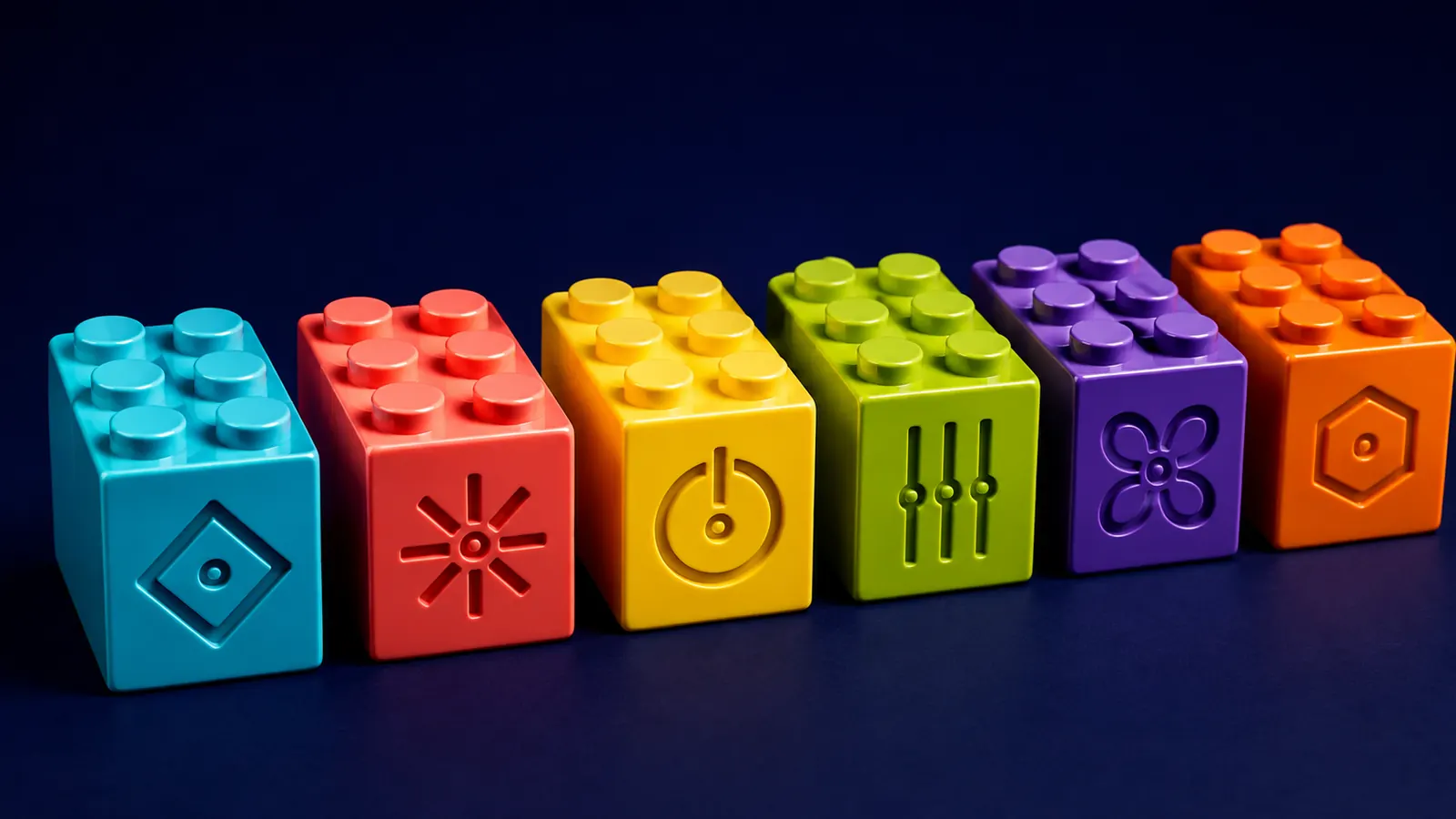
In OutBrick, shapes, studs, spacing, contrast, and motion reinforce the colour language. The result is better for players who cannot use hue reliably, but it is also better for everyone when the board explains itself at a glance.
Sources2World Wide Web Consortium. (n.d.). Understanding Success Criterion 1.4.1: Use of color. Web Accessibility Initiative.3Microsoft. (n.d.). Making games accessible. Microsoft Learn.
The most useful accessibility options are discoverable, reversible, and free of shame. They sit near the decision they affect, explain what they change, and allow the player to tune the experience as their context changes.
That is the standard OutBrick is aiming for. A kinder difficulty curve, a clear recovery path, and a colour-blind mode that is on from the first launch are not decorations around the puzzle. They help the puzzle remain the puzzle for more people.
- Pair colour with shape and pattern
- Keep support options reversible and visible
- Test with players who use the options
- Treat unconventional play as valid play
Sources1Martinez, J. J., Froehlich, J. E., & Fogarty, J. (2024). Playing on hard mode: Accessibility, difficulty, and joy in video game adoption for gamers with disabilities. In Proceedings of the CHI Conference on Human Factors in Computing Systems (CHI ’24). ACM. https://doi.org/10.1145/3613904.36428042World Wide Web Consortium. (n.d.). Understanding Success Criterion 1.4.1: Use of color. Web Accessibility Initiative.
Filed under
Questions, answered
A few useful answers
Does Assist Mode make Celeste easier?
It lets the player adjust selected conditions of play. The important design idea is that the player chooses the route, rather than accessibility being treated as a separate game.
What accessibility options does OutBrick have?
Colour-blind mode is on by default and puts a glyph on every brick and gate. Every brick is a VoiceOver element, Larger Text scales throughout, Reduce Motion is honoured, and there is no clock anywhere. The accessibility page has the full list.
APA 7
References
Where a source is a studio’s own history or a news account rather than a study, the article says so beside the claim.
- Martinez, J. J., Froehlich, J. E., & Fogarty, J. (2024). Playing on hard mode: Accessibility, difficulty, and joy in video game adoption for gamers with disabilities. In Proceedings of the CHI Conference on Human Factors in Computing Systems (CHI ’24). ACM. https://doi.org/10.1145/3613904.3642804 doi.org/10.1145/3613904.3642804 (opens in a new tab)
- World Wide Web Consortium. (n.d.). Understanding Success Criterion 1.4.1: Use of color. Web Accessibility Initiative. www.w3.org/WAI/WCAG22/Understanding/use-of-color (opens in a new tab)
- Microsoft. (n.d.). Making games accessible. Microsoft Learn. learn.microsoft.com/en-us/windows/uwp/gaming/accessibility-for-games (opens in a new tab)