

Hades and the run that keeps learning
What Supergiant’s Early Access success teaches about iteration, narrative momentum, and making another attempt feel meaningfully different.

A repeat attempt is only exciting when it carries information forward. Hades made that principle visible: a run could end, but the player’s relationship with the world, the story, and their own decisions kept developing.
Supergiant’s Hades FAQ says the team designed the game from the ground up for Early Access. The studio describes a goal of making the game in partnership with its community, and connects the modular structure of the game and its narrative to that approach. That is a first-party account, but it is valuable precisely because it explains the production intention behind the finished experience.
The loop is easy to translate: release a coherent slice, listen to what players can actually understand, then make the next slice answer a better question. Feedback is evidence about where the design is communicating and where it is asking players to guess, rather than a vote on every detail.
Sources1Supergiant Games. (n.d.). Hades FAQ. Retrieved September 4, 2026, from https://www.supergiantgames.com/blog/hades-faq/2Supergiant Games. (2020, September 17). Hades: Now out of Early Access! Supergiant Games.
Hades turns failure into a change of context. A run can reveal a weapon interaction, a character beat, a resource choice, or a route that changes what the next attempt means. The player is not merely rolling the same dice again; they are carrying a better model of the system.
That is why “random” is not enough. Variation becomes satisfying when a player can connect it to a growing vocabulary. A small puzzle can do this with a new gate arrangement, a revealed bottleneck, or a solution that only becomes obvious after the first attempt.
Sources1Supergiant Games. (n.d.). Hades FAQ. Retrieved September 4, 2026, from https://www.supergiantgames.com/blog/hades-faq/3Przybylski, A. K., Rigby, C. S., & Ryan, R. M. (2010). A motivational model of video game engagement. Review of General Psychology, 14(2), 154–166.
The official Hades materials describe a story that could be delivered serially through Early Access. Story became a gentle answer to the question “why return?” It gave the next run an emotional horizon even when the mechanical outcome was uncertain.
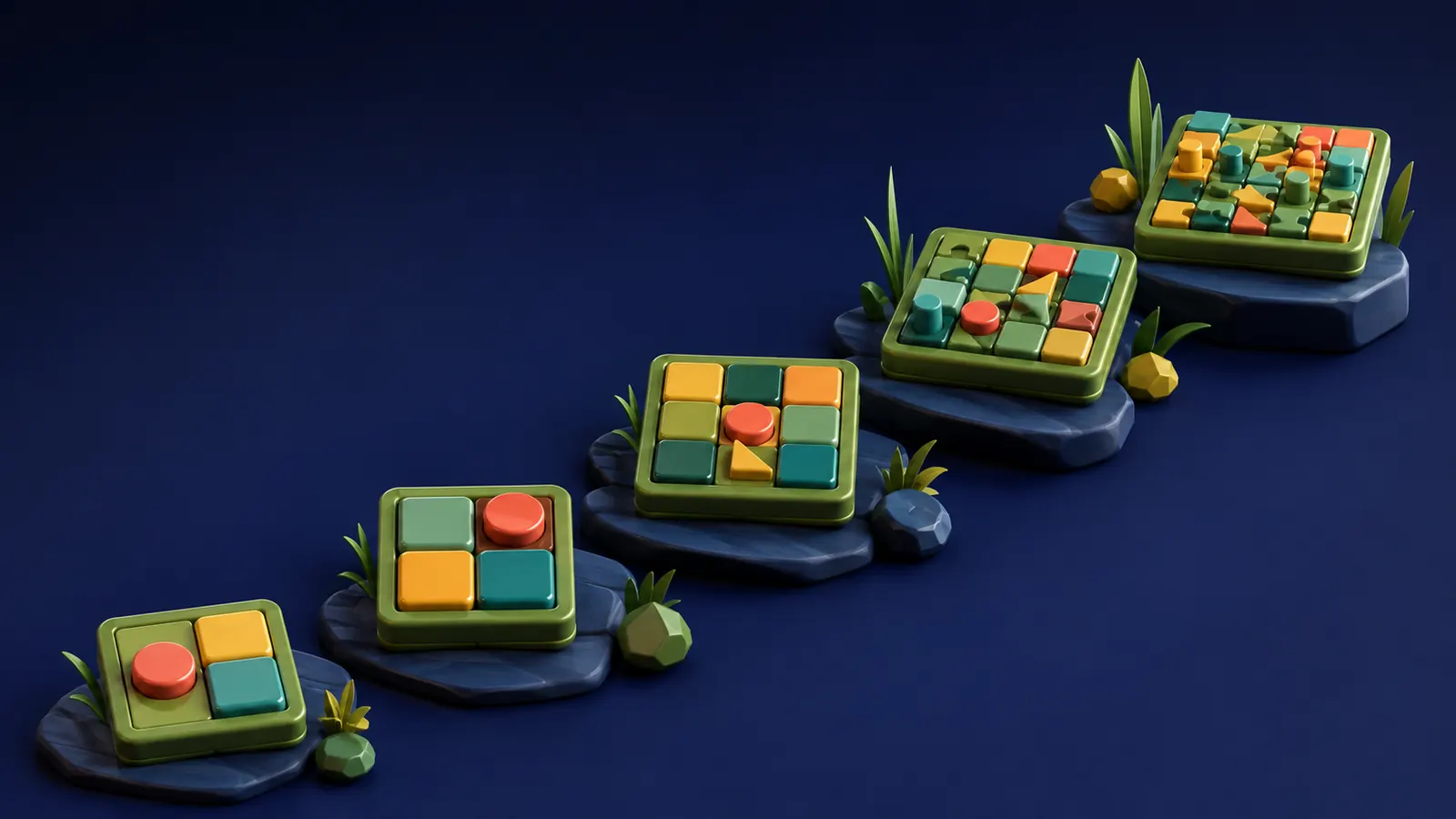
OutBrick is not a narrative roguelike, and it should not pretend to be. Its version of a return is quieter: the board lets you notice a rule, the next board gives the rule another angle, and the completion state stays understandable enough that learning can survive a short session.
Sources2Supergiant Games. (2020, September 17). Hades: Now out of Early Access! Supergiant Games.4Ma, S. L. L. L., Bechard-Evans, M., et al. (2019). The use and effect of video game design theory in the creation of game-based systems for upper limb stroke rehabilitation. JMIR Serious Games, 7(2), e12131.
A repeatable game should answer three questions after a miss: what changed, what did I learn, and what can I try next? If the only answer is “grind until the numbers improve,” the loop is borrowing time rather than earning attention.
The OutBrick board is small enough for the player to hold in memory. A failed line can become a clue rather than a scar. A compact loop leaves less to forget and puts more meaning in the decision that remains. When an attempt does end without a clear, it costs one life, and the home page says exactly how lives work.
- Make the result of an attempt legible
- Carry knowledge forward even when the board resets
- Offer a specific next experiment
- Let the player stop with the loop complete
Sources1Supergiant Games. (n.d.). Hades FAQ. Retrieved September 4, 2026, from https://www.supergiantgames.com/blog/hades-faq/3Przybylski, A. K., Rigby, C. S., & Ryan, R. M. (2010). A motivational model of video game engagement. Review of General Psychology, 14(2), 154–166.
Filed under
APA 7
References
Where a source is a studio’s own history or a news account rather than a study, the article says so beside the claim.
- Supergiant Games. (n.d.). Hades FAQ. Retrieved September 4, 2026, from https://www.supergiantgames.com/blog/hades-faq/ www.supergiantgames.com/blog/hades-faq (opens in a new tab)
- Supergiant Games. (2020, September 17). Hades: Now out of Early Access! Supergiant Games. www.supergiantgames.com/blog/hades-now-out-of-early-access (opens in a new tab)
- Przybylski, A. K., Rigby, C. S., & Ryan, R. M. (2010). A motivational model of video game engagement. Review of General Psychology, 14(2), 154–166. doi.org/10.1037/a0019440 (opens in a new tab)
- Ma, S. L. L. L., Bechard-Evans, M., et al. (2019). The use and effect of video game design theory in the creation of game-based systems for upper limb stroke rehabilitation. JMIR Serious Games, 7(2), e12131. pmc.ncbi.nlm.nih.gov/articles/PMC6453078 (opens in a new tab)