


How to build a kinder difficulty curve
Challenge should stretch the player’s attention without making the relationship with the game feel brittle.
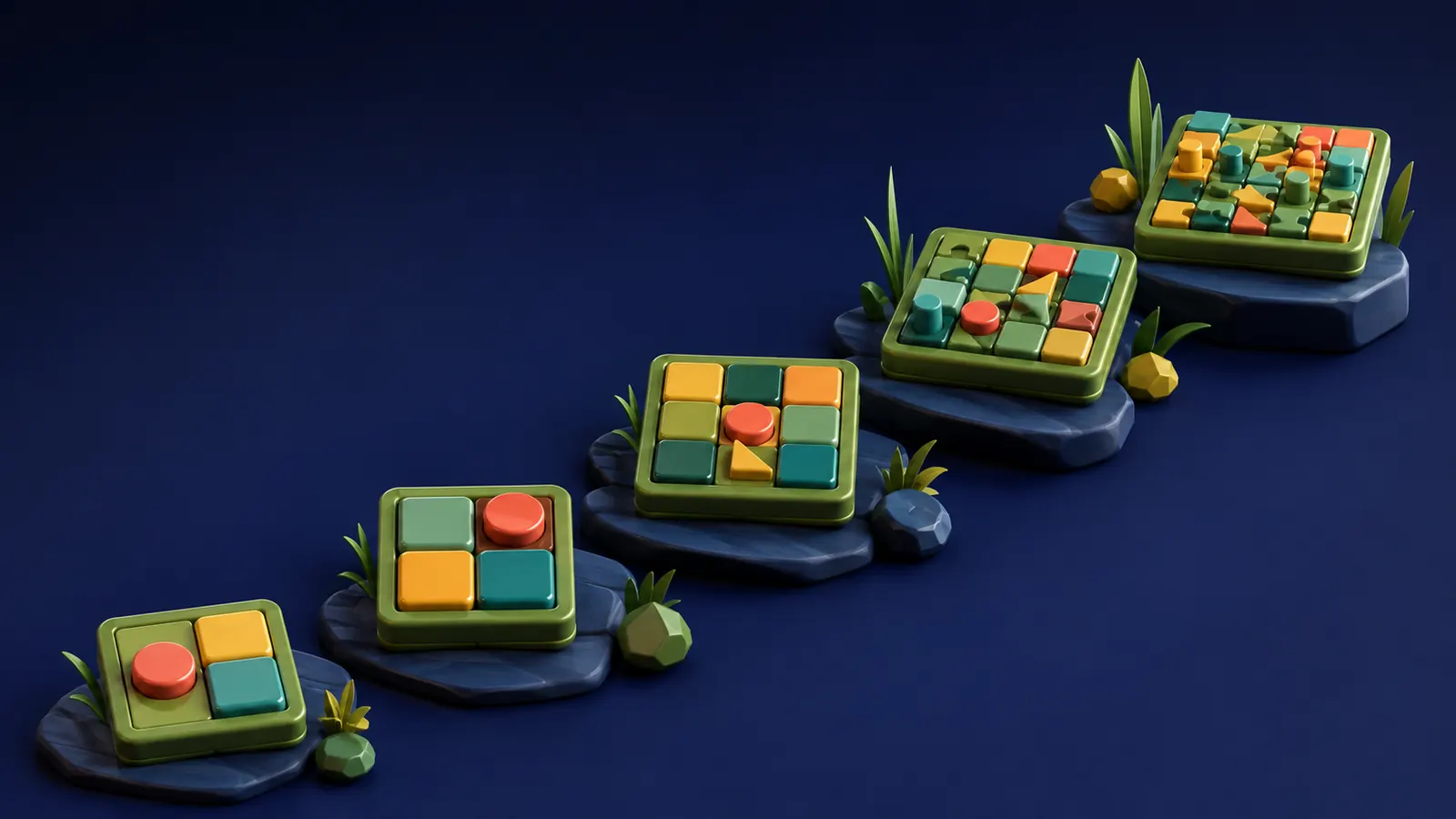
Difficulty is not a staircase that only goes up. It is a conversation between a player’s current skill, the game’s next question, and the feedback that explains what happened.
A review of game-based rehabilitation systems uses GameFlow as a design lens: concentration, challenge, skill, control, clear goals, feedback, immersion, and social interaction. It describes adaptive difficulty as a way to keep a task from becoming so easy that it is boring or so hard that it becomes anxious.
The idea is useful beyond rehabilitation. A player does not experience “level 20 difficulty” in the abstract. They experience a relationship between what the board asks and what the interface has taught them to notice.
Sources1Ma, S. L. L. L., Bechard-Evans, M., et al. (2019). The use and effect of video game design theory in the creation of game-based systems for upper limb stroke rehabilitation. JMIR Serious Games, 7(2), e12131.
A 2025 cross-sectional study of a Kinect-based rehabilitation task found lower overall flow among older participants than younger participants, with the largest difference in sense of control. The task and sample were specific, so the study does not justify age-based assumptions about all players.
It does support a broader design principle: familiarity, motor ability, confidence, processing speed, and access needs can change how the same challenge feels. A good curve makes room for those differences instead of treating them as player failure.
Sources2Wang, J., et al. (2025). Age differences in flow experience during body movement–controlled video game rehabilitation tasks: Cross-sectional study. JMIR Serious Games.
A solver cleared all 2,000 of OutBrick’s boards before any of them shipped, so the game can ask for planning without accidentally asking for the impossible. For boards with a move limit, the limit is checked against the route the solver actually found, so none ships with a rope shorter than its own proven solution. If no legal move remains outside sealed rooms, the Wedged sheet offers one free undo outside the undo tank. Some boards use a move limit; none uses a clock. The optional Rush timer was withdrawn, and there is no countdown anywhere in the game.
None of this removes challenge. It separates useful friction from accidental friction, so the player spends their attention on the puzzle’s idea instead of defending themselves from the interface.
- Verified solvability before a board ships
- Undo that teaches instead of scolds
- A free way out when the state is genuinely stuck
- Pressure from a move limit, never from a clock
Sources1Ma, S. L. L. L., Bechard-Evans, M., et al. (2019). The use and effect of video game design theory in the creation of game-based systems for upper limb stroke rehabilitation. JMIR Serious Games, 7(2), e12131.2Wang, J., et al. (2025). Age differences in flow experience during body movement–controlled video game rehabilitation tasks: Cross-sectional study. JMIR Serious Games.
The fairest difficulty curve gives the player a reason to try again that is specific enough to feel actionable. “I almost had the lane” is a better invitation than “the game wants me to grind.” Feedback should turn a miss into information.
That is the curve we want: boards that get more expressive, tools that keep the player in control, and a world that celebrates the attempt as much as the clear.
Sources1Ma, S. L. L. L., Bechard-Evans, M., et al. (2019). The use and effect of video game design theory in the creation of game-based systems for upper limb stroke rehabilitation. JMIR Serious Games, 7(2), e12131.3Przybylski, A. K., Rigby, C. S., & Ryan, R. M. (2010). A motivational model of video game engagement. Review of General Psychology, 14(2), 154–166.
Filed under
APA 7
References
Where a source is a studio’s own history or a news account rather than a study, the article says so beside the claim.
- Ma, S. L. L. L., Bechard-Evans, M., et al. (2019). The use and effect of video game design theory in the creation of game-based systems for upper limb stroke rehabilitation. JMIR Serious Games, 7(2), e12131. pmc.ncbi.nlm.nih.gov/articles/PMC6453078 (opens in a new tab)
- Wang, J., et al. (2025). Age differences in flow experience during body movement–controlled video game rehabilitation tasks: Cross-sectional study. JMIR Serious Games. pmc.ncbi.nlm.nih.gov/articles/PMC12571201 (opens in a new tab)
- Przybylski, A. K., Rigby, C. S., & Ryan, R. M. (2010). A motivational model of video game engagement. Review of General Psychology, 14(2), 154–166. doi.org/10.1037/a0019440 (opens in a new tab)