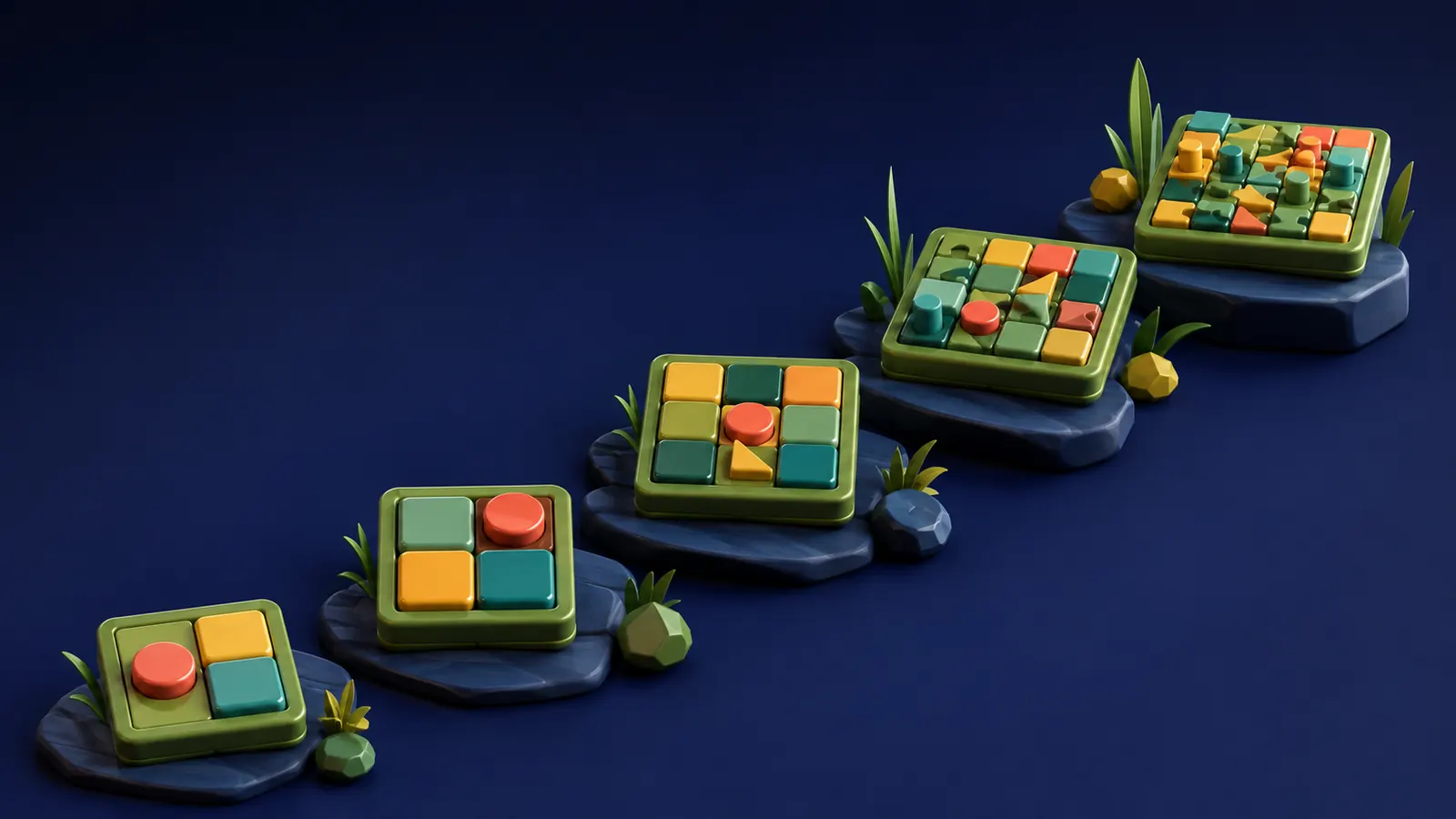
How to solve sliding block puzzles: a practical guide
Work backwards from the exit, find the move that makes space, count before you commit. A designer’s method for sliding block puzzles that look impossible.
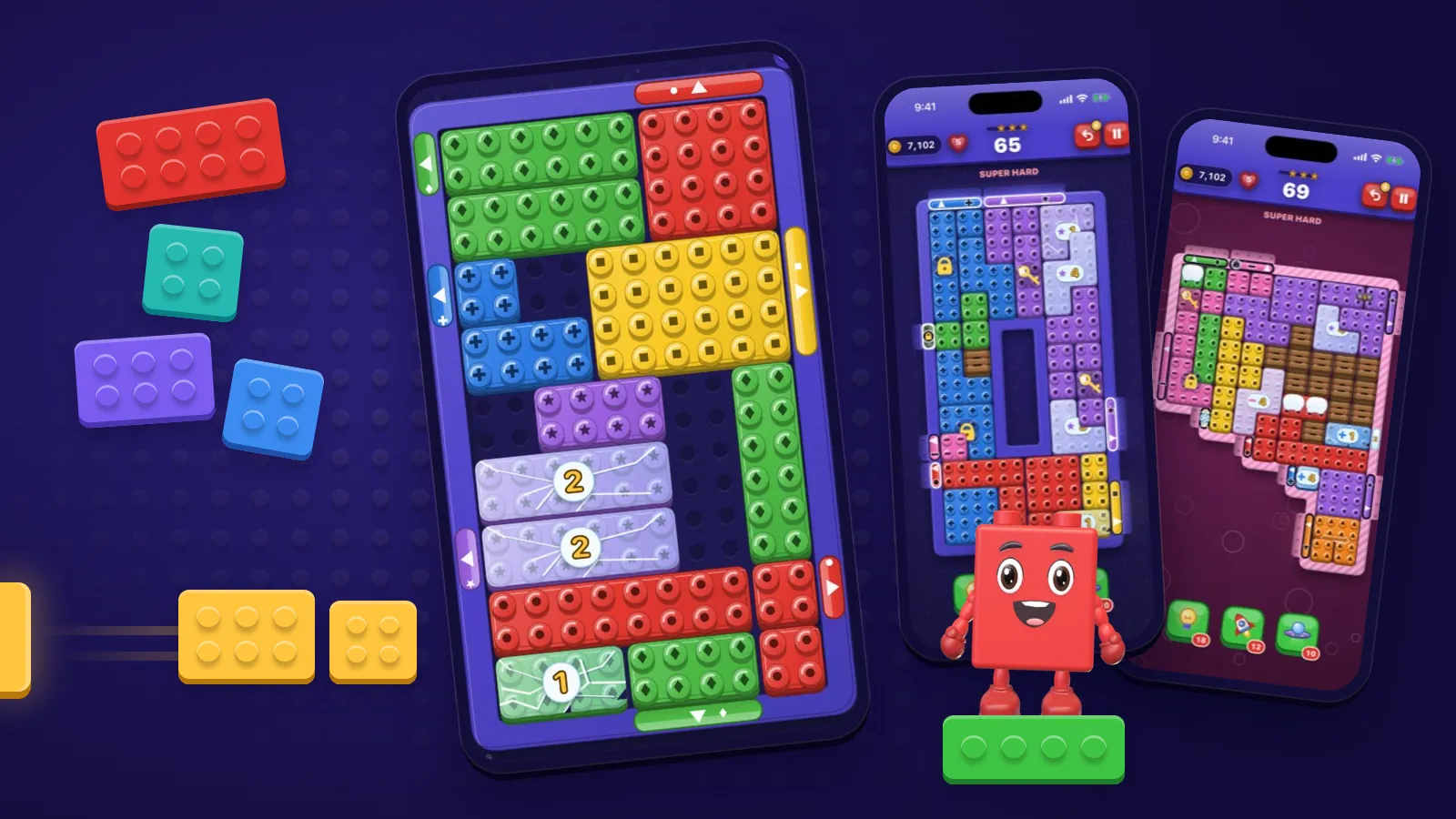
A good sliding block puzzle is built to look hopeless. Every cell is taken, every block seems to sit in somebody else’s way, and the exit is on the wrong side. I build and test boards like that for OutBrick, and the same five habits get me through almost all of them, whatever the puzzle. None of them is a trick. They are ways of looking that turn a wall of blocks into a short list of questions.
The natural instinct on a full board is to move whatever can move. Resist it for ten seconds. Pick one block that has to leave, look at its exit, and ask a single question: what is between this block and the way out? Whatever answers that question is your real problem. Then ask the same question of each of those blockers, and keep going until you reach a block that can already move.
What you end up with is a chain of dependencies, read backwards from the goal: the exit needs the yellow block, the yellow block needs the green one out of its lane, the green one needs a gap on the left. Psychologists call this kind of reasoning means–ends analysis, and there is good evidence that how you frame a puzzle changes how hard it feels. Kotovsky, Hayes and Simon gave people versions of the Tower of Hanoi with identical structure but different surface rules, and found some versions took far longer than others. Much of the difficulty lay in holding the rules and the current state in mind at once. A named chain takes some of that weight off.
In OutBrick the exits are colour gates, and a brick leaves only through the gate that matches its colour. That gives the backwards read a useful extra rule: a gate that refuses a brick is as much a wall as the frame is. So when you pick your first brick, pick the colour whose gate has the shortest chain in front of it.
- Choose one block that must leave.
- List what stands between it and its exit.
- Repeat for each blocker until you reach one that can already move.
- Play the chain forwards from that end.
Sources1Kotovsky, K., Hayes, J. R., & Simon, H. A. (1985). Why are some problems hard? Evidence from Tower of Hanoi. Cognitive Psychology, 17(2), 248–294.
A packed board has far fewer legal moves than it looks. Before you commit, count them. On a tightly packed board there may be only a few, and one of them is usually the move the board was built around: the slide that opens a pocket of space and lets the pile come apart section by section. Empty cells are the currency of a sliding puzzle. The best opening move usually buys room for the moves after it, and it rarely clears anything by itself.
Where you leave a block matters as much as which block you move. In OutBrick a brick slides as far as you drag it and stops where you let go, short of a wall or a gate that refuses its colour; swipe it into a neighbour and the two swap places. A block parked halfway down a lane may be fine now and in the way in four moves. Before letting go, check that you have not sealed a lane you will need later.
There is a mathematical reason these puzzles resist shortcuts. Hearn and Demaine proved that generalised sliding-block puzzles are PSPACE-complete, which in plain terms means no known method solves every large board efficiently. Human solvers get by on heuristics like the ones in this guide. It also means a well-made puzzle has to be designed so that there is a way in. OutBrick checks that the hard way: a solver cleared all 2,000 boards before any of them shipped, so if you feel stuck, the knot is in the position you have made, not in the board.
Sources2Hearn, R. A., & Demaine, E. D. (2005). PSPACE-completeness of sliding-block puzzles and other problems through the nondeterministic constraint logic model of computation. Theoretical Computer Science, 343(1–2), 72–96.
Plan in short chains. Working memory holds only a handful of items at once (Cowan’s review of the evidence puts the figure at around four chunks), so trying to see ten moves ahead usually means seeing four clearly and guessing the rest. Group moves into intentions instead: “open the left column” is one chunk, even if it takes three slides. Plan two or three chunks, play them, then look again.
If your puzzle has a move limit, this is where it pays off. OutBrick has no clock anywhere; the rope on each board is a move limit, and the limit and the board’s goals are both shown from the first tap. That changes what is scarce. Moves cost you, and thinking costs you nothing, so spend time freely and moves carefully. Before each slide, run through a short check.
- What does this move make possible?
- What does it close off, now or in two moves?
- Is there one longer slide that does the work of two shorter ones?
- Does it move me along the chain I built from the exit?
Sources3Cowan, N. (2001). The magical number 4 in short-term memory: A reconsideration of mental storage capacity. Behavioral and Brain Sciences, 24(1), 87–114.
Undo works best as an experiment. When two moves look equally good, play one, look at what it opens, and take it back. You have learned something about the board that no amount of staring would have shown you, at the cost of one undo. Players who treat undo as an admission of failure tend to stare longer and learn less.
OutBrick is built around that idea. The first undo on every board is free and cannot run out. Beyond that, undos come from a tank of five that refills one every twenty-five minutes, and a board with no move left reshuffles itself for free. So spend the free one early and on purpose, on the move you are least sure of, rather than saving it for an emergency.
There is one thing to know about stars. Stars on an OutBrick board follow its score rather than an undo count, and every move you still have when the goals are met becomes a blaster for a bigger score. If you are playing for a clear, experiment freely. If you are playing for three stars, spend moves carefully and do the experimenting in your head first.
Undo fixes a move. A reset fixes a plan. The signs that you need the second are easy to spot once you know them: you have undone the same move three times, you are sliding one block back and forth, you cannot say what your next two chunks are for, or the area you need has been sealed by bricks you parked yourself. At that point more undos only walk you back along a path that was never going to work.
Be honest about what a restart costs in the game you are playing. In OutBrick, opening a board needs a life and spends none, clearing a board costs nothing, and a life goes only when an attempt ends without a clear. Lives come back one every thirty minutes. That is a good reason to use undo for small corrections and keep a fresh attempt for when your whole reading of the board was wrong.
And sometimes the best reset is to put the phone down. A board that looked like a wall at the end of a long day often opens in the first thirty seconds the next morning. Nothing on an OutBrick board is timed, so it will wait. For habits specific to sorting by colour, there is a companion piece on colour sort puzzle tips. If you want to practise the method first, the play guide has a board you can try in the browser, from easy to a proper knot.
Filed under
Questions, answered
A few useful answers
What is the trick to solving sliding block puzzles?
There is no single trick, but one habit does most of the work: start from the exit and work backwards. List what blocks the piece you need to move, then what blocks those, until you reach a piece that can already move. Then look for the one move that opens the most space.
Are all sliding block puzzles solvable?
No. Some arrangements of classic sliding puzzles have no solution at all; half the possible starting positions of the 15 puzzle are unsolvable, for example. Designed puzzles should be checked before release. Every one of OutBrick’s 2,000 boards was cleared by a solver before it shipped.
How many moves ahead should I plan?
Two or three small goals, each a few moves long, is plenty for most people. Working memory holds only a handful of items at once, so plan in chunks such as “free the left lane”, play them, and then look at the board again.
Is using undo cheating?
No. Undo is one of the best ways to learn how a board behaves. In OutBrick the first undo on every board is free, and stars follow the board’s score, not an undo count.
APA 7
References
Where a source is a studio’s own history or a news account rather than a study, the article says so beside the claim.
- Kotovsky, K., Hayes, J. R., & Simon, H. A. (1985). Why are some problems hard? Evidence from Tower of Hanoi. Cognitive Psychology, 17(2), 248–294. doi.org/10.1016/0010-0285(85)90009-X (opens in a new tab)
- Hearn, R. A., & Demaine, E. D. (2005). PSPACE-completeness of sliding-block puzzles and other problems through the nondeterministic constraint logic model of computation. Theoretical Computer Science, 343(1–2), 72–96. doi.org/10.1016/j.tcs.2005.05.008 (opens in a new tab)
- Cowan, N. (2001). The magical number 4 in short-term memory: A reconsideration of mental storage capacity. Behavioral and Brain Sciences, 24(1), 87–114. doi.org/10.1017/S0140525X01003922 (opens in a new tab)