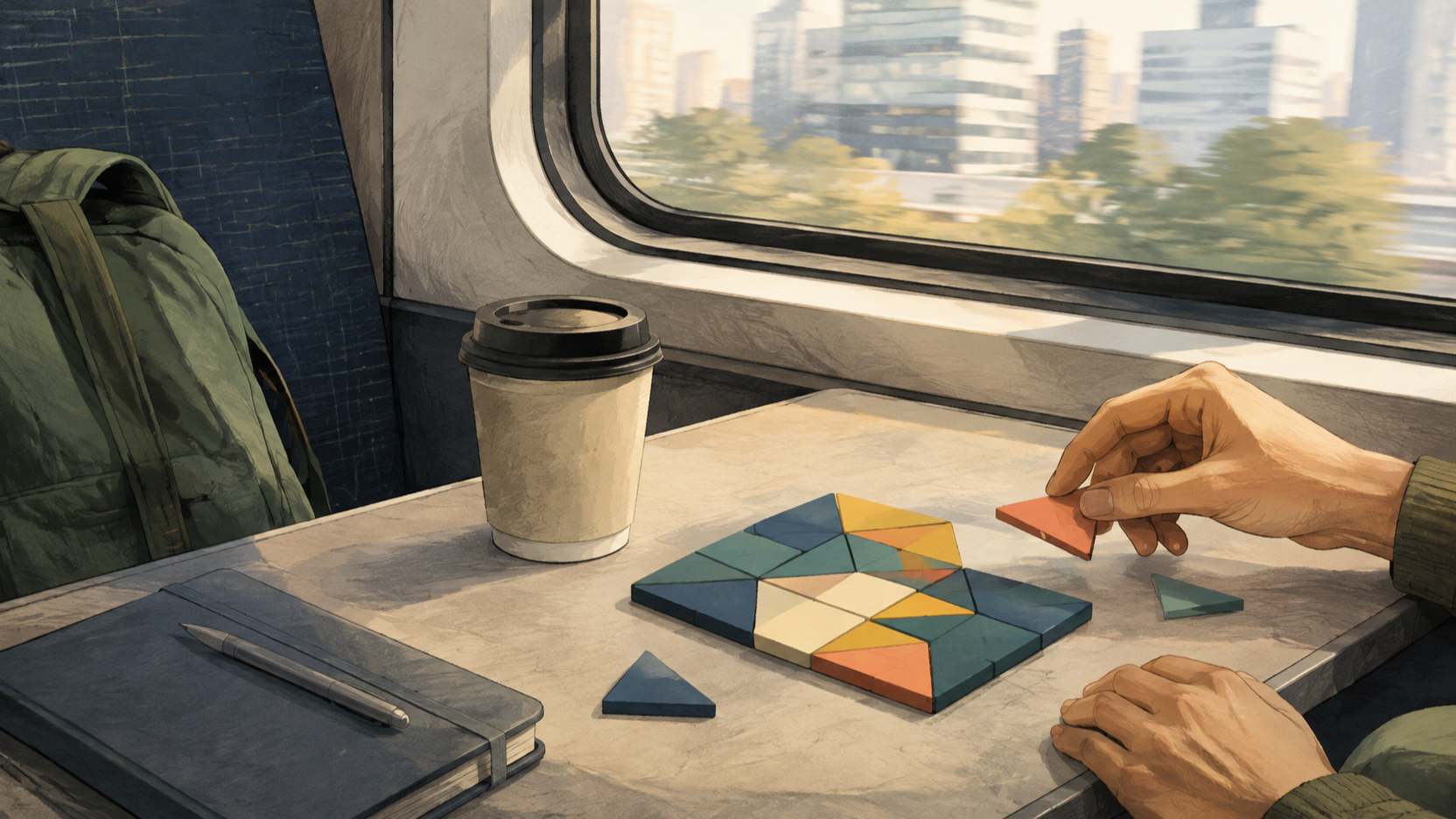
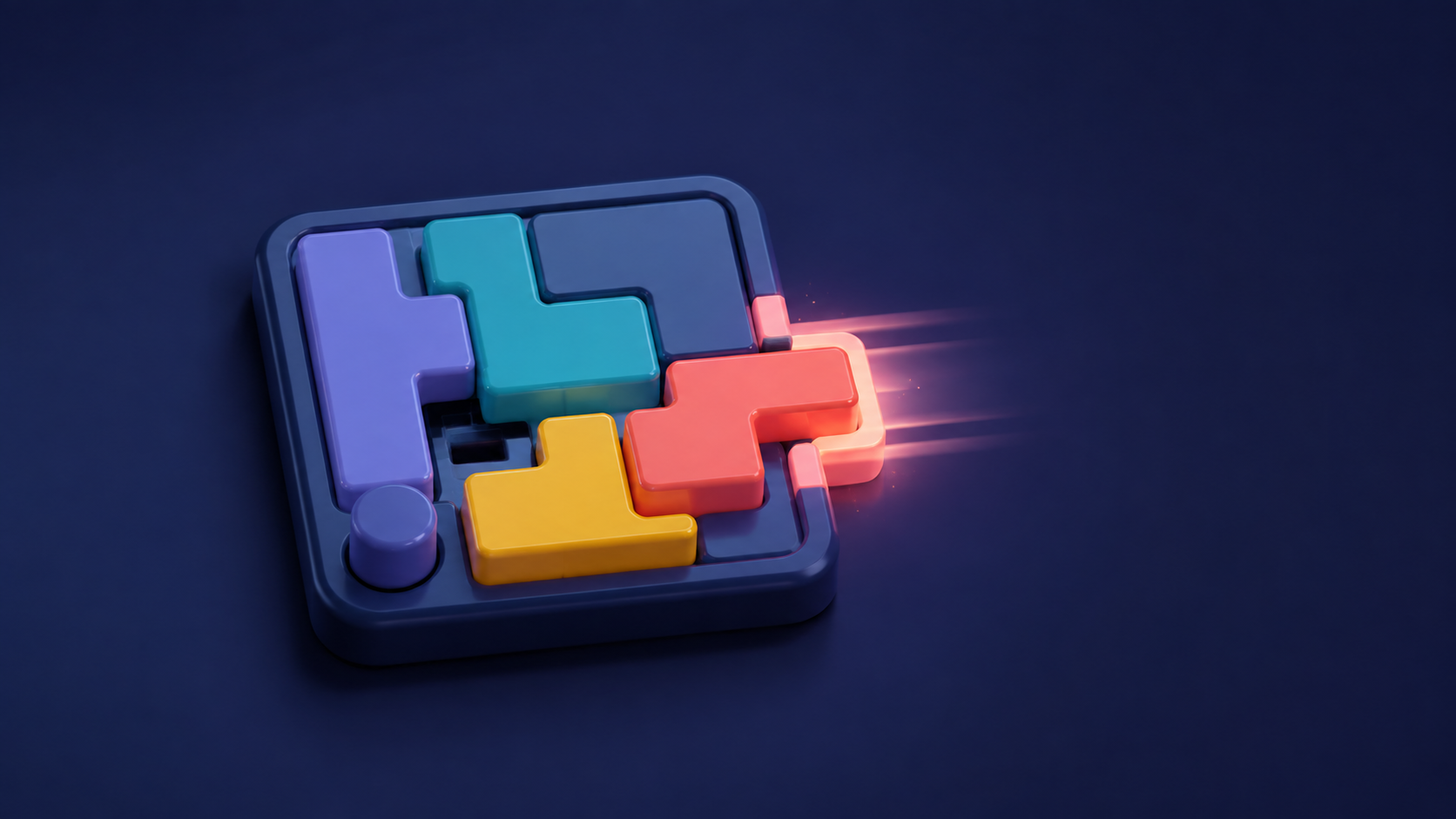
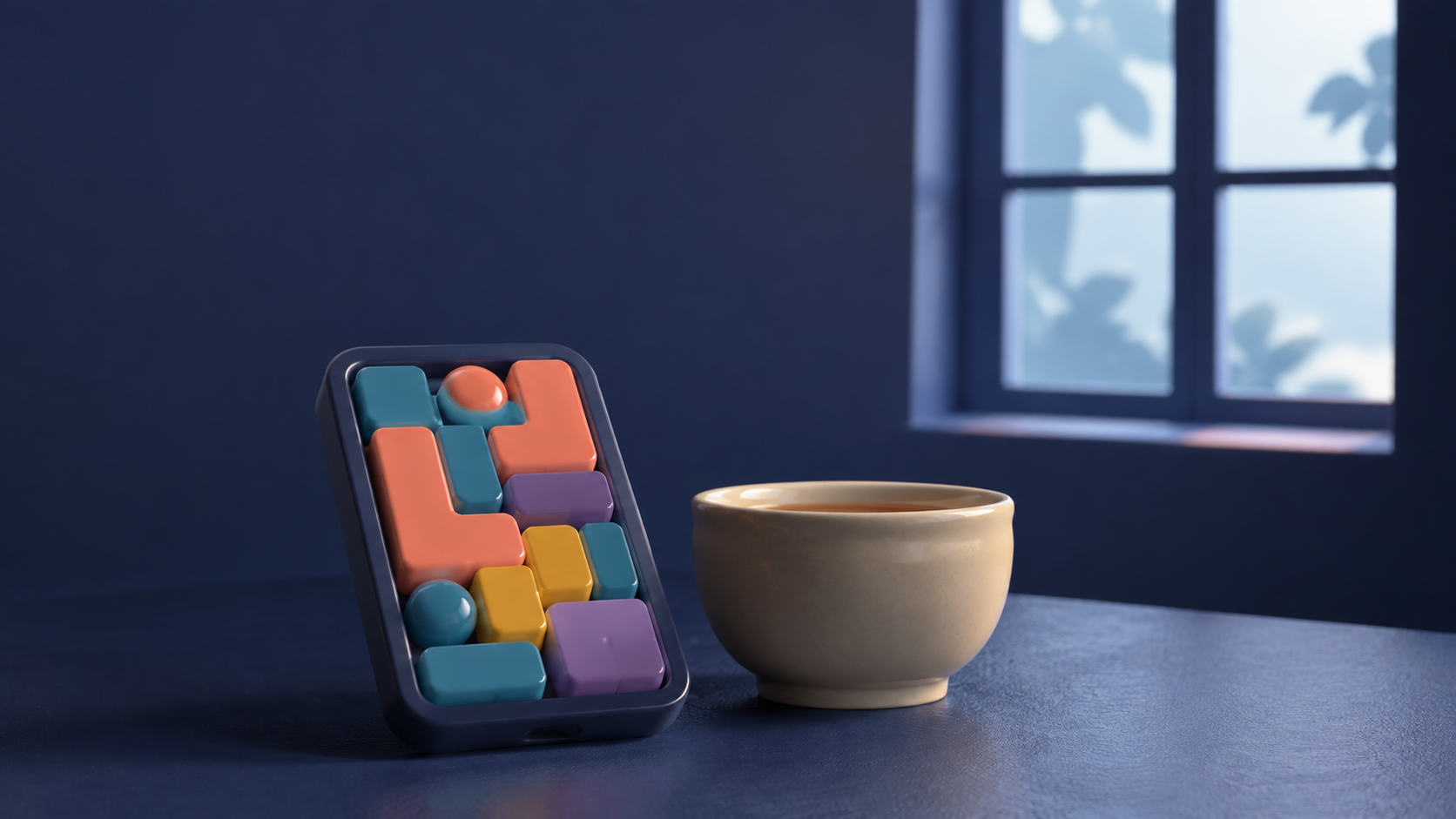
A compact geometric puzzle beside a calm commuter window with a short pause in the day. Original OutBrick journal artwork.
The commuter puzzle is not a smaller console game. It has a different contract with attention: make the state clear quickly, respect interruption, and make two minutes feel complete rather than unfinished.
Design for the interruption
A commuter game is played around announcements, doors, messages, and the simple fact that the player may need to look up. The first design question is therefore not “how do we maximize immersion?” but “can the player understand where they are when attention returns?”
Readable state is a form of care. A clear board, stable controls, and a visible pause point reduce the memory tax that comes with being interrupted.
A short session should have a beginning, a middle, and an end. The beginning is recognition: what is the puzzle asking? The middle is a choice: which relationship should I test? The end is a result: what changed, and do I want to continue?
That shape is why the game can feel substantial without being long. The player receives a complete unit of attention instead of a fragment cut out of a larger obligation.
Urwyler and colleagues studied a tablet-based puzzle-game intervention in a pilot feasibility randomized controlled trial with healthy adults. A pilot can help researchers understand recruitment, adherence, measurement, and whether a larger study is practical. It cannot establish that every short puzzle improves cognition or well-being.
That distinction is useful for product teams. We can borrow a research question—does the experience fit the day, and can players use it consistently?—without borrowing a conclusion the study did not make.
OutBrick is built for the gap between obligations. The board can be read quickly, the first undo on it is free, and completion does not require a long chain of setup. If the train arrives or the coffee is ready, locking the phone leaves the board exactly as it stands — the interruption itself is never the thing that costs you anything.
The result is not productivity disguised as play. It is simply a small game that understands the shape of a real day—and gives the player permission to enjoy the gap without asking the gap to become something bigger.
The core is designed to fit a short pause, but completion time varies with the board and the player. There is no timer in the main journey — what a board limits is moves, not minutes, so thinking for as long as you like is free.
Can I leave a board unfinished?
Yes, and being interrupted is free — lock the phone or switch apps and the board is waiting as you left it. Backing all the way out to the map is the one case that costs something: a board you have already moved on takes one life, which the game warns you about first, and a life comes back every thirty minutes on its own. A cleared board never costs anything to walk away from.
APA 7 reference trail
References
The claims in this story are grounded in the sources below. External links open the source in a new tab; first-party histories and editorial explainers are labelled by context in the article.
Urwyler, P., Gupta, R. K., Falkner, M., Niklaus, J., Müri, R. M., & Nef, T. (2023). Tablet-based puzzle game intervention for cognitive function and well-being in healthy adults: Pilot feasibility randomized controlled trial. JMIR Aging, 6, e46177.Read source
Przybylski, A. K., Rigby, C. S., & Ryan, R. M. (2010). A motivational model of video game engagement. Review of General Psychology, 14(2), 154–166.Read source
Rupp, M. A., Sweetman, R., Sosa, A. E., Smither, J. A., & McConnell, D. S. (2017). Searching for affective and cognitive restoration: Examining the restorative effects of casual video game play. Human Factors, 59(7), 1096–1107.Read source
Vuorre, M., Johannes, N., Magnusson, K., & Przybylski, A. K. (2022). Time spent playing video games is unlikely to impact well-being. Royal Society Open Science, 9(7), 220411.Read source
Ballou, N., Vuorre, M., Hakman, T., Magnusson, K., & Przybylski, A. K. (2025). Perceived value of video games, but not hours played, predicts mental well-being in casual adult Nintendo players. Royal Society Open Science, 12(3).Read source
Keep exploring
Another good thread.
Follow the idea into another corner of OutBrick: a success story, a design question, or a player habit worth noticing.