


How games become habits: cue, choice, closure
A practical, research-aware look at the loops that bring players back—and the design choices that keep returning voluntary.
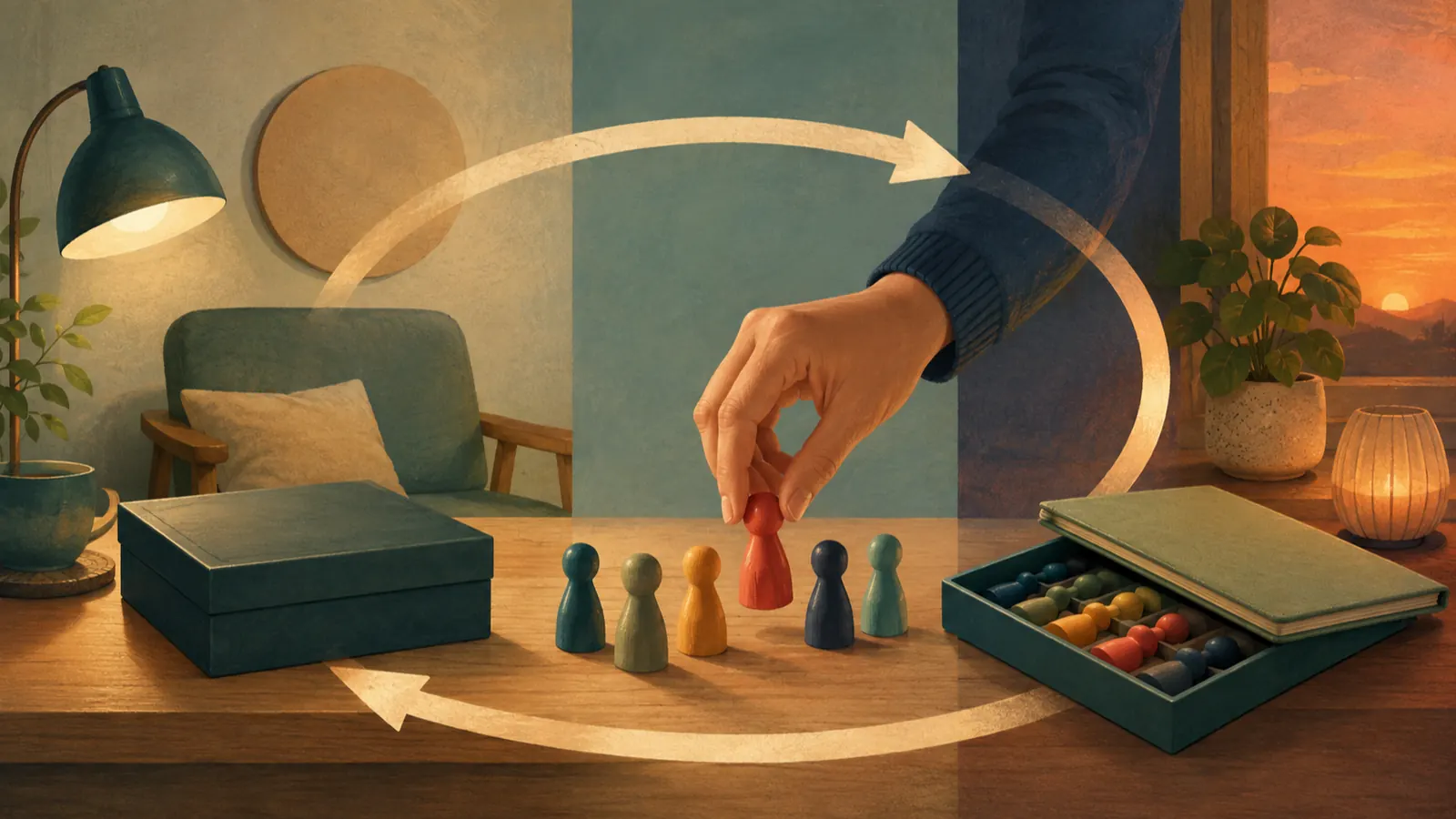
A habit is not the same thing as an addiction, and a return is not the same thing as a compulsion. Understanding the difference helps designers build invitations that are easy to accept—and equally easy to decline.
A cue is the context that makes an action available: a quiet train ride, a daily tile, a familiar icon, or the moment after finishing a task. A PubMed-indexed study of MMORPG players examined sensitivity to situational cues alongside excessive and problematic gaming. Its result is a warning against treating every repeatable loop as neutral, but it is not evidence that all games or all players develop the same pattern.
Designers should therefore ask what the cue is promising. Is it a bounded moment of play, or is it opening a chain of unfinished obligations? The answer lives in the surrounding system as much as in the reward.
Sources1Lukavská, K., Hrabec, O., & Chrz, V. (2016). The role of habits in massive multiplayer online role-playing game usage: Predicting excessive and problematic gaming through players’ sensitivity to situational cues. Cyberpsychology, Behavior, and Social Networking, 19(4), 277–282. https://doi.org/10.1089/cyber.2015.04953World Health Organization. (2020, October 22). Addictive behaviours: Gaming disorder.
A healthy-feeling loop gives the player a reason to choose, not just a reason to comply. Clear goals and immediate feedback can support competence, while optional routes preserve autonomy. Relatedness may come from a shared ritual, but it should not require public performance from everyone.
This is why OutBrick keeps the next board visible without making it urgent. The invitation is clear; the decision remains yours.
Sources4Przybylski, A. K., Rigby, C. S., & Ryan, R. M. (2010). A motivational model of video game engagement. Review of General Psychology, 14(2), 154–166.5Ballou, N., Vuorre, M., Hakman, T., Magnusson, K., & Przybylski, A. K. (2025). Perceived value of video games, but not hours played, predicts mental well-being in casual adult Nintendo players. Royal Society Open Science, 12(3).
Closure is the part many retention systems deliberately avoid. A clear end state tells the player that the session is complete, the progress is safe, and the next return can start cleanly. Without closure, the player may keep going simply because the system never says that a good stopping point has arrived.
Research on rewarding elements and problematic gaming examines how different reward types relate to adolescents’ gaming behaviour. The study should not be used to claim that rewards cause harm for every player. It does support a more careful design question: what does this reward do to the player’s ability to choose when enough is enough?
Sources2Pirrone, D., van den Eijnden, R. J. J. M., & Peeters, M. (2024). Why we can’t stop: The impact of rewarding elements in videogames on adolescents’ problematic gaming behavior. Media Psychology, 27(3), 379–400. https://doi.org/10.1080/15213269.2023.22422603World Health Organization. (2020, October 22). Addictive behaviours: Gaming disorder.
OutBrick’s intended loop is deliberately plain. A familiar context opens the app, a board presents one question, the player makes a move, and the clear card provides a natural pause. The Journey keeps generating boards past its two-thousandth for a player who wants more, but that does not swallow the meaning of the chapters behind it. The daily coin bonus is a hundred coins for your first clear of the day, not a streak that resets.
The measure of success is not “did the player stay?” It is “did the player feel able to decide?” A game earns another session when the first session ended with trust intact.
- A cue that explains what is available
- A choice with visible consequences
- A reward that does not hide the finish line
- A return path without a penalty for absence
Sources1Lukavská, K., Hrabec, O., & Chrz, V. (2016). The role of habits in massive multiplayer online role-playing game usage: Predicting excessive and problematic gaming through players’ sensitivity to situational cues. Cyberpsychology, Behavior, and Social Networking, 19(4), 277–282. https://doi.org/10.1089/cyber.2015.04952Pirrone, D., van den Eijnden, R. J. J. M., & Peeters, M. (2024). Why we can’t stop: The impact of rewarding elements in videogames on adolescents’ problematic gaming behavior. Media Psychology, 27(3), 379–400. https://doi.org/10.1080/15213269.2023.22422605Ballou, N., Vuorre, M., Hakman, T., Magnusson, K., & Przybylski, A. K. (2025). Perceived value of video games, but not hours played, predicts mental well-being in casual adult Nintendo players. Royal Society Open Science, 12(3).
Filed under
Questions, answered
A few useful answers
Is a daily game automatically a bad habit?
No. A daily ritual can be voluntary and enjoyable. The important questions are whether you remain in control and whether play is interfering with sleep, responsibilities, relationships, or other valued activities.
Why does OutBrick use daily play at all?
A daily coin bonus gives the game a small, optional rhythm. It is an invitation with a clear endpoint, not a streak that turns absence into failure.
APA 7
References
Where a source is a studio’s own history or a news account rather than a study, the article says so beside the claim.
- Lukavská, K., Hrabec, O., & Chrz, V. (2016). The role of habits in massive multiplayer online role-playing game usage: Predicting excessive and problematic gaming through players’ sensitivity to situational cues. Cyberpsychology, Behavior, and Social Networking, 19(4), 277–282. https://doi.org/10.1089/cyber.2015.0495 pubmed.ncbi.nlm.nih.gov/27057594 (opens in a new tab)
- Pirrone, D., van den Eijnden, R. J. J. M., & Peeters, M. (2024). Why we can’t stop: The impact of rewarding elements in videogames on adolescents’ problematic gaming behavior. Media Psychology, 27(3), 379–400. https://doi.org/10.1080/15213269.2023.2242260 doi.org/10.1080/15213269.2023.2242260 (opens in a new tab)
- World Health Organization. (2020, October 22). Addictive behaviours: Gaming disorder. www.who.int/news-room/questions-and-answers/item/addictive-behaviours-gaming-disorder (opens in a new tab)
- Przybylski, A. K., Rigby, C. S., & Ryan, R. M. (2010). A motivational model of video game engagement. Review of General Psychology, 14(2), 154–166. doi.org/10.1037/a0019440 (opens in a new tab)
- Ballou, N., Vuorre, M., Hakman, T., Magnusson, K., & Przybylski, A. K. (2025). Perceived value of video games, but not hours played, predicts mental well-being in casual adult Nintendo players. Royal Society Open Science, 12(3). doi.org/10.1098/rsos.241174 (opens in a new tab)