Micro-breaks at work: can a short game help you recharge?
A meta-analysis says ten-minute breaks lift energy but barely touch output. Where a short game fits, where it does not, and how to take a better break.
Somewhere around three in the afternoon, attention starts to fray. You reread the same paragraph, you open a tab and forget why. Many people reach for a phone at that moment, and a quick game is one of the things they reach for. Is that a real break or just a different way of using up attention? Research on micro-breaks, the short pauses people take between work tasks, gives a more useful answer than either “games are a waste of time” or “games refresh the brain”.
A micro-break is a pause of up to about ten minutes taken during work, rather than a lunch hour or an evening off. The most thorough summary of the evidence is a 2022 systematic review and meta-analysis by Albulescu and colleagues in PLOS ONE. They pooled 22 samples from experimental and quasi-experimental studies, covering 2,335 people.
The results were consistent but modest. Micro-breaks raised vigour, the feeling of having energy, and reduced fatigue, with small effects of about a third of a standard deviation in each case. The effect on overall performance was smaller and not statistically reliable. When the authors split tasks by type, breaks helped performance only on tasks that made fewer cognitive demands. Longer breaks tended to help performance more, and the authors suggest that recovering from highly draining work may take more than ten minutes.
To put the size of those effects in context: an effect of about a third of a standard deviation is the kind of difference you might notice in yourself on some afternoons and not on others. It is real, and it is not a transformation. The studies were also varied, from office workers to students in laboratories, and most measured how people felt straight after the break rather than at the end of the day.
That gives a sensible expectation for any break, game or not. You will probably come back feeling a little better. You should not expect to come back noticeably sharper at difficult work.
Sources1Albulescu, P., Macsinga, I., Rusu, A., Sulea, C., Bodnaru, A., & Tulbure, B. T. (2022). “Give me a break!” A systematic review and meta-analysis on the efficacy of micro-breaks for increasing well-being and performance. PLOS ONE, 17(8), e0272460.
What you do with the break seems to matter. Kim, Park and Niu followed 86 South Korean office workers for ten working days, asking about their afternoon workload, their micro-break activities and how they felt at the end of the day. Relaxation and social activities, such as talking with colleagues, softened the link between a heavy workload and end-of-day bad mood. Caffeinated drinks did too.
The surprise was the category the researchers called cognitive activities: things done on a break that keep the mind busy. On heavy days, these made the link between workload and bad mood stronger, not weaker. The study did not test games, and a puzzle is not the same as an inbox. It is still a fair warning: a break that asks your attention to keep working may not feel like a break by five o’clock.
Sources2Kim, S., Park, Y., & Niu, Q. (2017). Micro-break activities at work to recover from daily work demands. Journal of Organizational Behavior, 38(1), 28–44.
A popular idea is that a brief switch to something different resets attention. Ariga and Lleras gave people a long, monotonous vigilance task. Those who had to break off occasionally to recall a set of digits did not show the usual drop in performance over time. The paper is widely quoted as proof that brief breaks keep you focused.
The trouble is that a much larger follow-up did not find the same thing. Helton and Russell tested 498 people with brief task switches, content-free cues and control conditions. Every group showed the same steady decline, and the statistics favoured no effect at all. The honest summary is that the mechanism is disputed, and a quick switch of task is not a reliable fix for flagging concentration.
Sources3Ariga, A., & Lleras, A. (2011). Brief and rare mental “breaks” keep you focused: Deactivation and reactivation of task goals preempt vigilance decrements. Cognition, 118(3), 439–443.4Helton, W. S., & Russell, P. N. (2012). Brief mental breaks and content-free cues may not keep you focused. Experimental Brain Research, 219(1), 37–46.
The best direct test of a game as a break is a lab study by Rupp and colleagues. After a draining vigilance task, participants took a short passive break, did a guided relaxation exercise or played a casual video game. The game group reported greater engagement and a bigger recovery in mood than the relaxation group, while the plain break slightly worsened mood. None of the conditions restored performance on a working-memory test.
People seem to use games this way already. In a survey of 833 employed players of online casual games, Reinecke found that the recovery they felt while playing was the strongest predictor of playing at work, and that more tired workers played more often. The sample chose to answer a survey about games, so it tells us how some players use them, not how well it works.
The research, put together, says this much. A short game is a plausible mood break, not a concentration tonic. It works best when it stays short and ends cleanly. If it turns ten minutes into forty, the arithmetic of the afternoon goes the wrong way. We looked at why a two-minute puzzle can feel like a proper reset and at how to fit a game into a commute.
Sources5Rupp, M. A., Sweetman, R., Sosa, A. E., Smither, J. A., & McConnell, D. S. (2017). Searching for affective and cognitive restoration: Examining the restorative effects of casual video game play. Human Factors, 59(7), 1096–1107.6Reinecke, L. (2009). Games at work: The recreational use of computer games during working hours. CyberPsychology & Behavior, 12(4), 461–465.
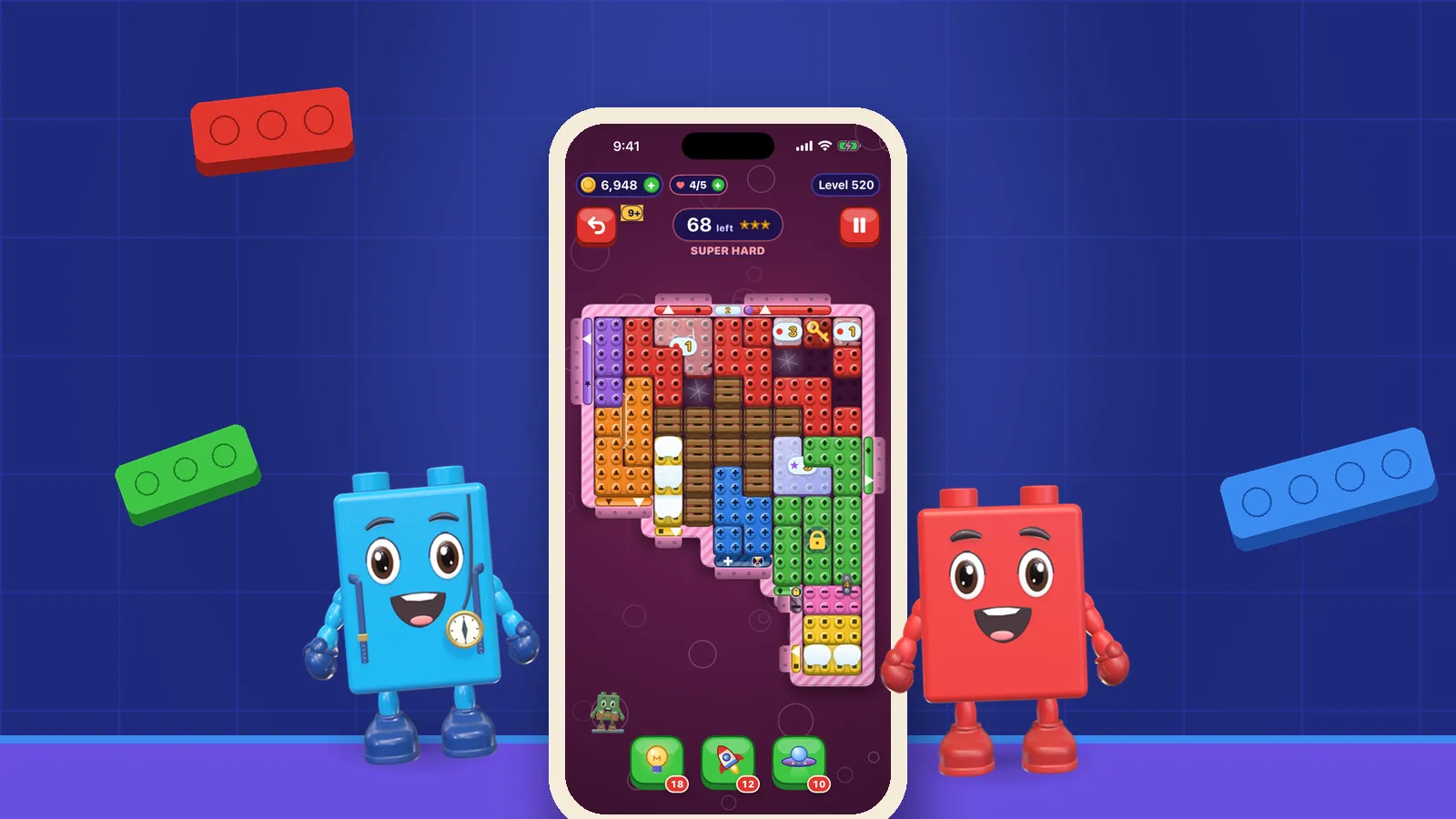
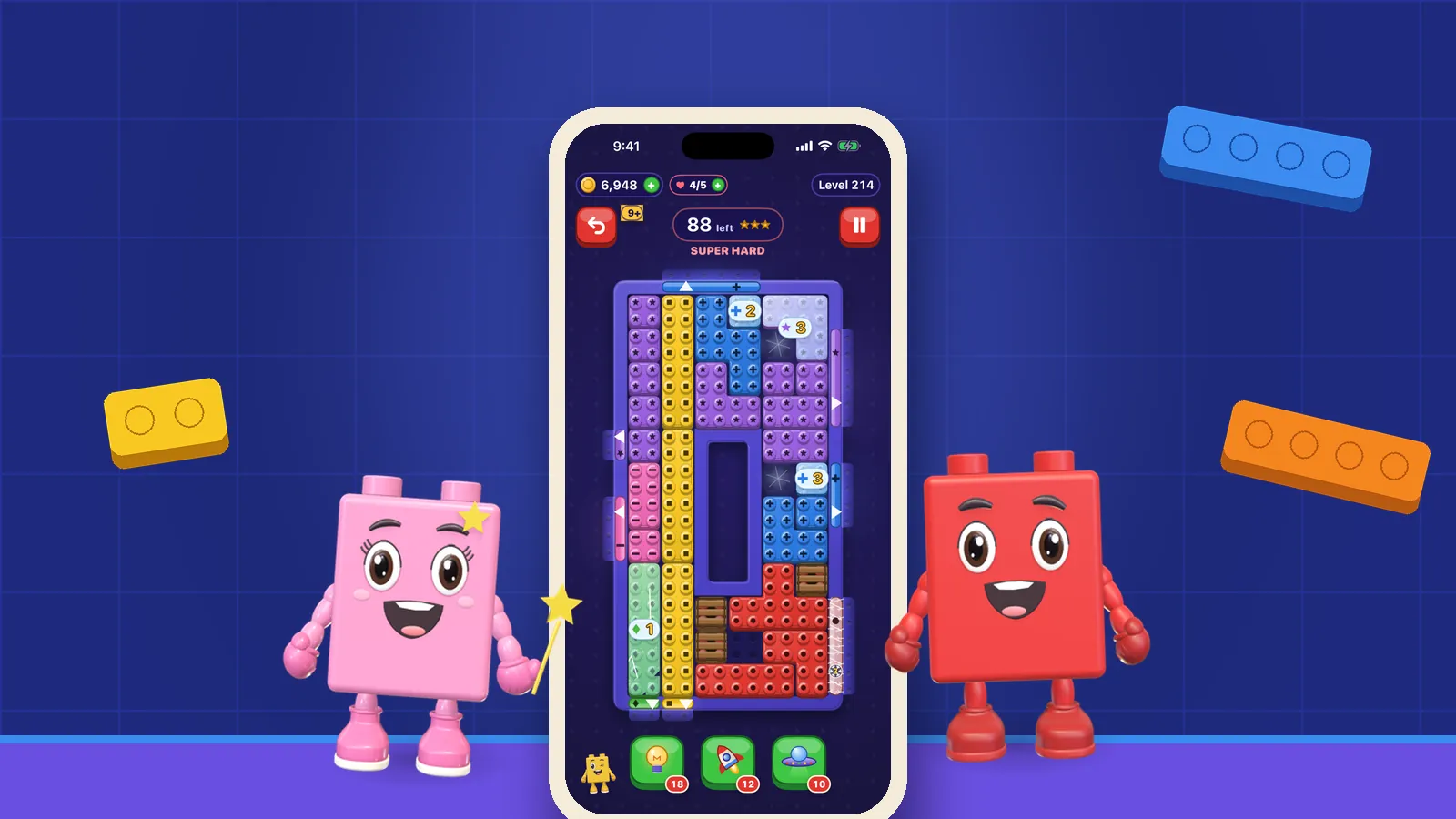
The research points to a mixed diet rather than a single trick. If you do reach for a game, choose one with a clear end so the break has an edge. An OutBrick board has its goals and a move limit, no clock, and a clear card that works as a natural stopping point. You can also play a board in your browser without installing anything. Treat it as one option alongside the ones with stronger evidence.
Where you take the break may matter as much as what you do in it. A few minutes outside or by a window may do more for a tired mind than anything on a screen, for reasons we explore in attention restoration and calm scenes. And a micro-break is not a substitute for proper rest after work, which we cover in playing to unwind after work.
- Get up and move, or talk to someone: relaxation and social breaks had the clearest benefits for mood.
- Keep it short and decide the length first; one board or one round, then back.
- Expect to feel better rather than think faster, especially after demanding work.
- After very draining tasks, take a longer break instead of several tiny ones.
- If your break is just more reading and scrolling, notice whether it is actually restful.
Sources1Albulescu, P., Macsinga, I., Rusu, A., Sulea, C., Bodnaru, A., & Tulbure, B. T. (2022). “Give me a break!” A systematic review and meta-analysis on the efficacy of micro-breaks for increasing well-being and performance. PLOS ONE, 17(8), e0272460.2Kim, S., Park, Y., & Niu, Q. (2017). Micro-break activities at work to recover from daily work demands. Journal of Organizational Behavior, 38(1), 28–44.
Filed under
Questions, answered
A few useful answers
How long should a micro-break be?
Micro-breaks are usually defined as ten minutes or less. A 2022 meta-analysis found they raise energy and reduce fatigue, and that longer breaks tended to help performance more, so very draining work may need more than ten minutes.
Is playing a game on a break good for productivity?
The evidence is stronger for mood than for output. One lab study found a casual game lifted mood and engagement after a demanding task, but it did not restore working-memory performance.
What is the best thing to do on a short break?
In a ten-day study of office workers, relaxation and social breaks did most to protect end-of-day mood, while mentally busy activities made things worse. Moving, chatting or a short, bounded game are all reasonable choices.
APA 7
References
Where a source is a studio’s own history or a news account rather than a study, the article says so beside the claim.
- Albulescu, P., Macsinga, I., Rusu, A., Sulea, C., Bodnaru, A., & Tulbure, B. T. (2022). “Give me a break!” A systematic review and meta-analysis on the efficacy of micro-breaks for increasing well-being and performance. PLOS ONE, 17(8), e0272460. doi.org/10.1371/journal.pone.0272460 (opens in a new tab)
- Kim, S., Park, Y., & Niu, Q. (2017). Micro-break activities at work to recover from daily work demands. Journal of Organizational Behavior, 38(1), 28–44. doi.org/10.1002/job.2109 (opens in a new tab)
- Ariga, A., & Lleras, A. (2011). Brief and rare mental “breaks” keep you focused: Deactivation and reactivation of task goals preempt vigilance decrements. Cognition, 118(3), 439–443. doi.org/10.1016/j.cognition.2010.12.007 (opens in a new tab)
- Helton, W. S., & Russell, P. N. (2012). Brief mental breaks and content-free cues may not keep you focused. Experimental Brain Research, 219(1), 37–46. doi.org/10.1007/s00221-012-3065-0 (opens in a new tab)
- Rupp, M. A., Sweetman, R., Sosa, A. E., Smither, J. A., & McConnell, D. S. (2017). Searching for affective and cognitive restoration: Examining the restorative effects of casual video game play. Human Factors, 59(7), 1096–1107. doi.org/10.1177/0018720817715360 (opens in a new tab)
- Reinecke, L. (2009). Games at work: The recreational use of computer games during working hours. CyberPsychology & Behavior, 12(4), 461–465. doi.org/10.1089/cpb.2009.0010 (opens in a new tab)