Playing to unwind: casual games and recovery after work
Detachment, relaxation, mastery and control: what recovery research says about unwinding after work, and where a casual game fits in.
You get home, drop your bag and pick up a game before you have taken your coat off. It can feel like the first moment of the day that belongs to you. Is that recovering, or just more screen? Occupational psychologists have spent twenty years studying how people recover from work in their free time, and games researchers have borrowed their tools to ask where play fits. The answer is encouraging, with conditions.
The most influential framework comes from Sonnentag and Fritz, who developed the Recovery Experience Questionnaire. Across studies with 930 working people, they found four distinct experiences that help people recuperate. Psychological detachment means not thinking about work. Relaxation means low activation and calm. Mastery means challenging, absorbing activities that build a sense of competence, like learning something new. Control means deciding for yourself what to do with your time.
A later meta-analysis by Bennett, Bakker and Field pooled 54 samples and 26,592 people. Detachment had the strongest link with lower fatigue, while a sense of control had the strongest link with feeling energetic. Recovery experiences explained differences in well-being over and above the demands of people’s jobs. It is not only about how hard your day was; what you do afterwards counts too.
The four ingredients are also useful because they do not require any particular activity. A run can provide detachment and mastery; a bath can provide relaxation; choosing to do nothing at all can provide control. The same activity can recover one person and drain another, depending on which of the four it delivers for them. That is the lens worth bringing to games.
Sources1Sonnentag, S., & Fritz, C. (2007). The Recovery Experience Questionnaire: Development and validation of a measure for assessing recuperation and unwinding from work. Journal of Occupational Health Psychology, 12(3), 204–221.2Bennett, A. A., Bakker, A. B., & Field, J. G. (2018). Recovery from work-related effort: A meta-analysis. Journal of Organizational Behavior, 39(3), 262–275.
In an online survey of 1,614 players, Reinecke found that people systematically turned to games after stressful or tiring situations. The more fatigued they were by work and daily hassles, the more they used games for recovery, and this link was stronger for people with less social support. Recovery experience was a core part of what players valued in games.
Collins and Cox surveyed 491 people and found that hours spent playing per week correlated with overall recovery. The link was strongest for immersive genres such as first-person shooters and action games, and for players who had built social support through online relationships. Gaming did not reduce the extent to which work spilled into home life.
Both are surveys of people who play, so they show how games are used and what goes with that use, not that games cause recovery.
Sources3Reinecke, L. (2009). Games and recovery: The use of video and computer games to recuperate from stress and strain. Journal of Media Psychology, 21(3), 126–142.4Collins, E., & Cox, A. L. (2014). Switch on to games: Can digital games aid post-work recovery? International Journal of Human-Computer Studies, 72(8–9), 654–662.
Experiments give a closer look. Reinecke, Klatt and Krämer first gave 160 people a draining work task, then randomly assigned them to play a video game, watch a recording of the same game, watch an animated clip or do nothing. The interactive and passive options produced different patterns of recovery experience. Recovery experience, in turn, went with more enjoyment, feeling more energised and doing better on a later cognitive test.
Collins and colleagues compared a block puzzle game with a mindfulness app. In the lab, 45 people did a tiring task and then played the game, used the app or fiddled with a fidget spinner. Only the game raised energy levels; the other two lowered them, although how recovered people said they felt did not differ between the three. In a small field study, 20 working professionals used the game or the app at home after work for five days. Recovery experience rose over the week for the game players and fell for the app users. The authors suggest the benefit of play may build up over days rather than arriving all at once, though with samples this small, treat that as a lead.
Sources5Reinecke, L., Klatt, J., & Krämer, N. C. (2011). Entertaining media use and the satisfaction of recovery needs: Recovery outcomes associated with the use of interactive and noninteractive entertaining media. Media Psychology, 14(2), 192–215.6Collins, E., Cox, A., Wilcock, C., & Sethu-Jones, G. (2019). Digital games and mindfulness apps: Comparison of effects on post work recovery. JMIR Mental Health, 6(7), e12853.
A good puzzle can touch all four experiences, though not always at once. It fills attention enough that work thoughts fade, which is detachment. Solving a board that looked impossible a minute ago is mastery. Choosing when to start and stop is control. Relaxation is the tricky one, because mastery needs some challenge and challenge can tip into tension.
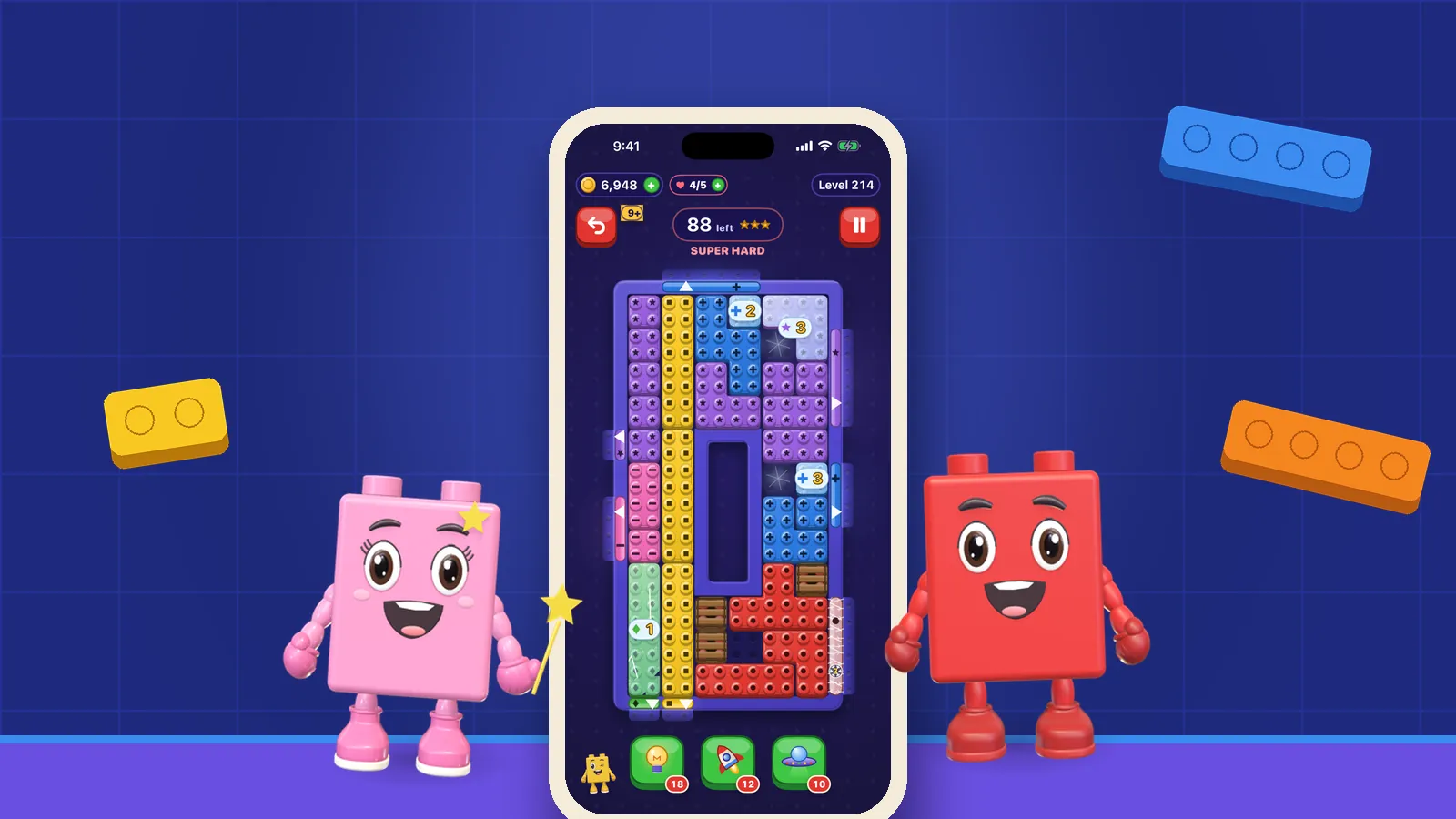
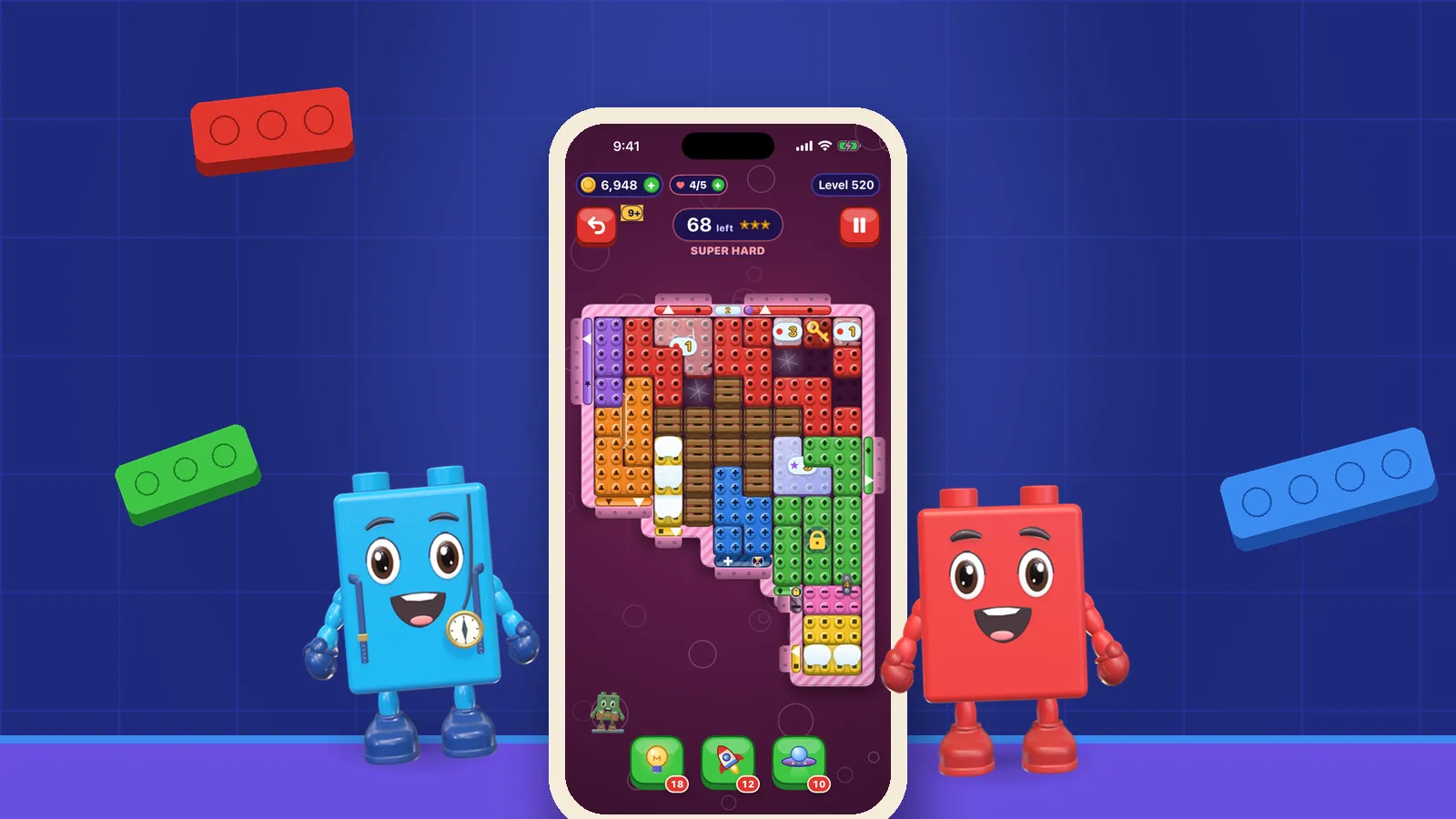
This is where the design of a game matters. OutBrick sets a move limit rather than a clock, shows every board’s goals from the first tap and gives you a free first undo on every board, so the challenge stays in the puzzle rather than in a race. The same design choices that support flow in puzzle games support recovery: clear goals, a sense of control, nothing interrupting. If you want to try it without committing to anything, there is a board you can play in your browser.
Timing matters too. A game straight after walking in the door can help draw a line under the working day, which is detachment in its most practical form. The same game at eleven at night, when relaxation should be winding down into sleep, is doing a different job.
Genre is not destiny, though. The survey link with recovery was strongest for action games, and some people unwind best with something loud and fast. The four ingredients are a better guide than any list of “relaxing” games; see our checklist for what makes a puzzle game calm if calm is what you are after.
Sources1Sonnentag, S., & Fritz, C. (2007). The Recovery Experience Questionnaire: Development and validation of a measure for assessing recuperation and unwinding from work. Journal of Occupational Health Psychology, 12(3), 204–221.4Collins, E., & Cox, A. L. (2014). Switch on to games: Can digital games aid post-work recovery? International Journal of Human-Computer Studies, 72(8–9), 654–662.
Reinecke found that people who tend to cope with stress by managing their feelings, rather than tackling the problem, were more likely to use games for recovery. That is not a bad thing in itself; everyone needs ways to feel better after a hard day. It becomes a problem when play is the only way, or when it stretches into the hours meant for sleep.
A few signs are worth watching: playing to avoid thinking about something that needs dealing with, evenings that run later than you meant, or feeling worse rather than better when you stop. Our pieces on when to play and when to pause and gaming before bed go into those edges.
- Give the evening one game session with a planned end, not an open tab.
- Mix in recovery activities with strong evidence, such as exercise and time with people.
- Notice whether you feel more energised or more drained afterwards, and adjust.
Sources3Reinecke, L. (2009). Games and recovery: The use of video and computer games to recuperate from stress and strain. Journal of Media Psychology, 21(3), 126–142.2Bennett, A. A., Bakker, A. B., & Field, J. G. (2018). Recovery from work-related effort: A meta-analysis. Journal of Organizational Behavior, 39(3), 262–275.
Filed under
Questions, answered
A few useful answers
Do video games help you relax after work?
They can. Surveys find people use games to recover from work stress, and a lab experiment found a casual puzzle game raised energy after a tiring task while a mindfulness app and a fidget toy did not. The evidence is promising but based on small studies.
What is the best way to recover after work?
Recovery research points to four experiences: mentally detaching from work, relaxing, mastering something absorbing and having control over your time. Any activity that provides them can help, and detachment has the strongest link with lower fatigue.
Are puzzle games or action games better for de-stressing?
It depends on the person. In one survey, action games had the strongest link with recovery, while calm puzzle games may suit people who want relaxation more than excitement. The four recovery experiences are a better guide than genre.
Can gaming become a way of avoiding problems?
Yes. Using games to feel better after a hard day is normal, but if play is your only way of coping, or it regularly eats into sleep, it is worth changing the balance.
APA 7
References
Where a source is a studio’s own history or a news account rather than a study, the article says so beside the claim.
- Sonnentag, S., & Fritz, C. (2007). The Recovery Experience Questionnaire: Development and validation of a measure for assessing recuperation and unwinding from work. Journal of Occupational Health Psychology, 12(3), 204–221. doi.org/10.1037/1076-8998.12.3.204 (opens in a new tab)
- Bennett, A. A., Bakker, A. B., & Field, J. G. (2018). Recovery from work-related effort: A meta-analysis. Journal of Organizational Behavior, 39(3), 262–275. doi.org/10.1002/job.2217 (opens in a new tab)
- Reinecke, L. (2009). Games and recovery: The use of video and computer games to recuperate from stress and strain. Journal of Media Psychology, 21(3), 126–142. doi.org/10.1027/1864-1105.21.3.126 (opens in a new tab)
- Collins, E., & Cox, A. L. (2014). Switch on to games: Can digital games aid post-work recovery? International Journal of Human-Computer Studies, 72(8–9), 654–662. doi.org/10.1016/j.ijhcs.2013.12.006 (opens in a new tab)
- Reinecke, L., Klatt, J., & Krämer, N. C. (2011). Entertaining media use and the satisfaction of recovery needs: Recovery outcomes associated with the use of interactive and noninteractive entertaining media. Media Psychology, 14(2), 192–215. doi.org/10.1080/15213269.2011.573466 (opens in a new tab)
- Collins, E., Cox, A., Wilcock, C., & Sethu-Jones, G. (2019). Digital games and mindfulness apps: Comparison of effects on post work recovery. JMIR Mental Health, 6(7), e12853. doi.org/10.2196/12853 (opens in a new tab)