Why we get attached to game characters, even silent ones
Players admire, worry about and miss game characters. Research on attachment, parasocial bonds and cuteness explains why, and what designers owe players.
People grieve for characters who never existed. They name pets after them, worry about them between sessions, and feel a small pang when a sidekick is left behind. None of this is new: audiences formed one-sided bonds with radio hosts long before games existed. But games add something films and books cannot, because the character reacts to you, and sometimes you are responsible for them. Research on player–character relationships has become rich enough to explain much of the pull, including why a character who never says a word can still matter. It also raises a question every studio with a mascot should ask: what do we owe players who come to care?
Julia Ayumi Bopp and colleagues asked 213 players to describe a game character they were particularly fond of, and why. Rather than one generic “attachment”, they found seven distinct forms, ranging from excitement about a character’s competence in play, through admiring a character as a role model, to deep concern for the character’s well-being. Some players liked a character because they were fun to control; others because they felt like a friend; others because they seemed to need protecting.
The study was qualitative, built on what players chose to write about, so it maps the kinds of attachment rather than measuring how common each is. Its value is in the range. Attachment is not one dial that turns up with more dialogue or better graphics. A small, simple character can earn admiration by being good at something, affection by being reliably pleasant company, or care by seeming a little vulnerable.
That range matters for design. A character built to be admired needs different qualities from one built to be cared for. Katharina Emmerich, Patrizia Ring and Maic Masuch surveyed 237 players about companion characters and found they value personality and integration into the game, and expect companions to behave in ways that fit the context, act on their own and take the initiative. A companion who stands still until prompted, or says the wrong thing at the wrong time, can spoil the whole experience.
Sources1Bopp, J. A., Müller, L. J., Aeschbach, L. F., Opwis, K., & Mekler, E. D. (2019). Exploring emotional attachment to game characters. Proceedings of the Annual Symposium on Computer-Human Interaction in Play, 313–324.2Emmerich, K., Ring, P., & Masuch, M. (2018). I’m glad you are on my side: How to design compelling game companions. Proceedings of the 2018 Annual Symposium on Computer-Human Interaction in Play, 141–152.
In 1956 the sociologists Donald Horton and Richard Wohl described a new kind of relationship created by radio and television. Audiences came to feel they knew the presenters and performers they saw and heard regularly, and responded to them almost as friends, even though the relationship ran only one way. They called this para-social interaction, and described it as intimacy at a distance.
Games stretch that idea, because the character on screen can respond. A friend who waves when you arrive, celebrates when you succeed and looks worried when you are stuck is still not a person, but the loop of action and reaction makes the bond feel more mutual. Melissa Lewis, René Weber and Nicholas David Bowman developed one of the first scales to measure character attachment in games. They found it related to game enjoyment and time spent playing, and also to measures of problematic play, a reminder that the same bond that makes a game warm can also make it hard to put down.
Sources3Horton, D., & Wohl, R. R. (1956). Mass communication and para-social interaction: Observations on intimacy at a distance. Psychiatry, 19(3), 215–229.4Lewis, M. L., Weber, R., & Bowman, N. D. (2008). “They may be pixels, but they’re MY pixels”: Developing a metric of character attachment in role-playing video games. CyberPsychology & Behavior, 11(4), 515–518.
Many mascots share a look: big heads, round faces, large eyes. The ethologist Konrad Lorenz called this set of features the baby schema. Melanie Glocker and colleagues tested it experimentally by digitally adjusting photographs of infant faces. With 122 students, faces with stronger baby-schema features were rated as cuter and prompted a stronger motivation to take care of them.
Cuteness may also shape how we pay attention. In three small experiments, Hiroshi Nittono and colleagues found that after viewing pictures of puppies and kittens, participants performed a fine-motor task and a visual search task more carefully than after viewing adult animals, and focused more narrowly. The samples were small and the tasks simple, so it would be a stretch to claim cute characters make anyone a better puzzler. The findings do help explain why a friendly face on a puzzle screen can feel steadying rather than distracting.
Sources5Glocker, M. L., Langleben, D. D., Ruparel, K., Loughead, J. W., Gur, R. C., & Sachser, N. (2009). Baby schema in infant faces induces cuteness perception and motivation for caretaking in adults. Ethology, 115(3), 257–263.6Nittono, H., Fukushima, M., Yano, A., & Moriya, H. (2012). The power of kawaii: Viewing cute images promotes a careful behavior and narrows attentional focus. PLOS ONE, 7(9), e46362.
Put the research together and it describes a real power. Characters can draw care, attention and loyalty. The ethical question is what a game does with that. Using a character to celebrate a player, keep them company or make a hard moment gentler is a gift. Using a character to guilt a player into returning, such as a sad face because you missed a day, or a friend who “needs” you to buy something, turns affection into leverage. It is one of the patterns covered in dark patterns in mobile games.
Here is a simple test. Would the character’s behaviour still feel kind if the player never spent anything or came back? If yes, the bond is probably being used well. If the character only warms up when the player pays, or turns sad when they leave, the affection has become a sales tool.
Sources4Lewis, M. L., Weber, R., & Bowman, N. D. (2008). “They may be pixels, but they’re MY pixels”: Developing a metric of character attachment in role-playing video games. CyberPsychology & Behavior, 11(4), 515–518.1Bopp, J. A., Müller, L. J., Aeschbach, L. F., Opwis, K., & Mekler, E. D. (2019). Exploring emotional attachment to game characters. Proceedings of the Annual Symposium on Computer-Human Interaction in Play, 313–324.
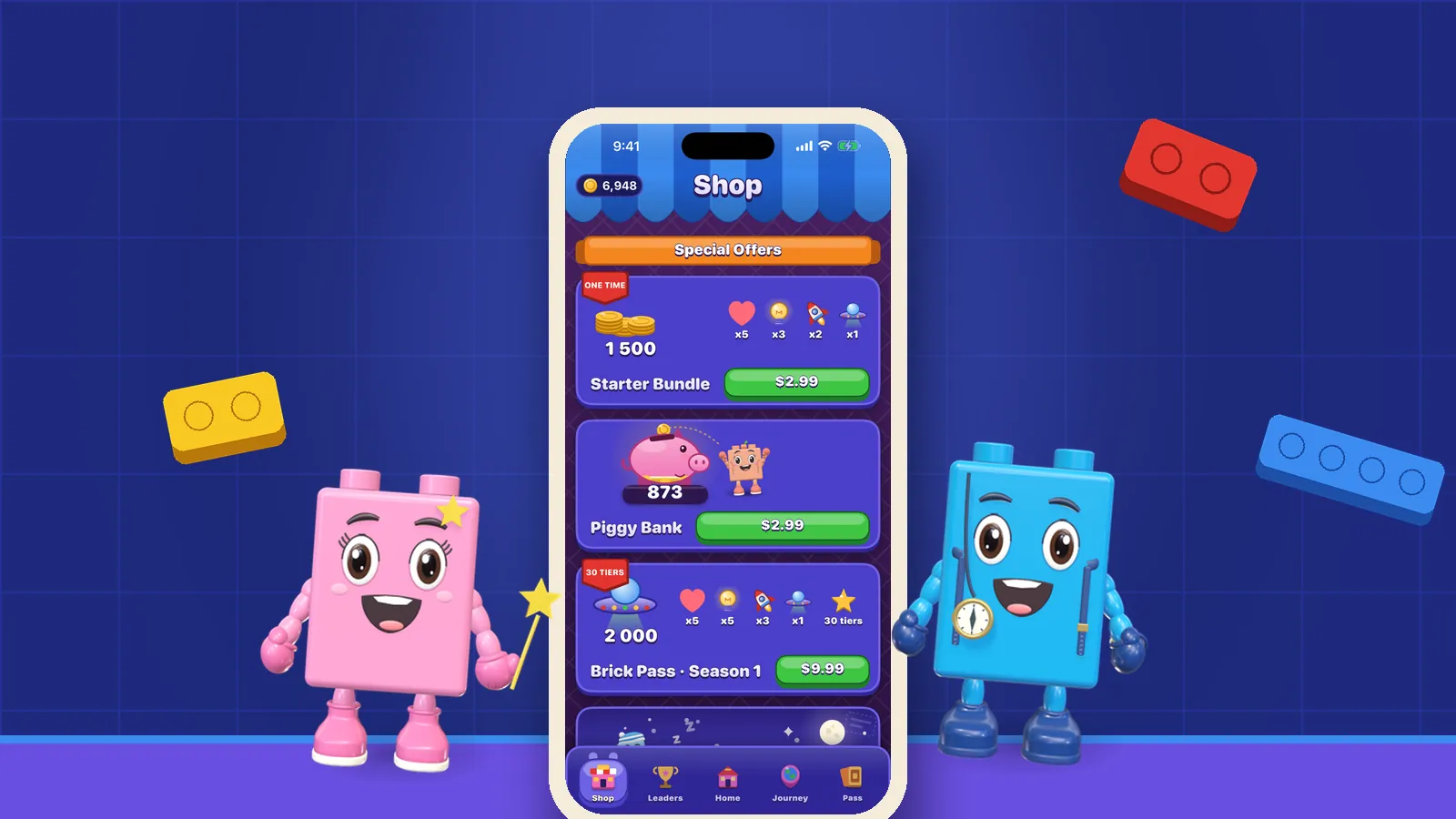
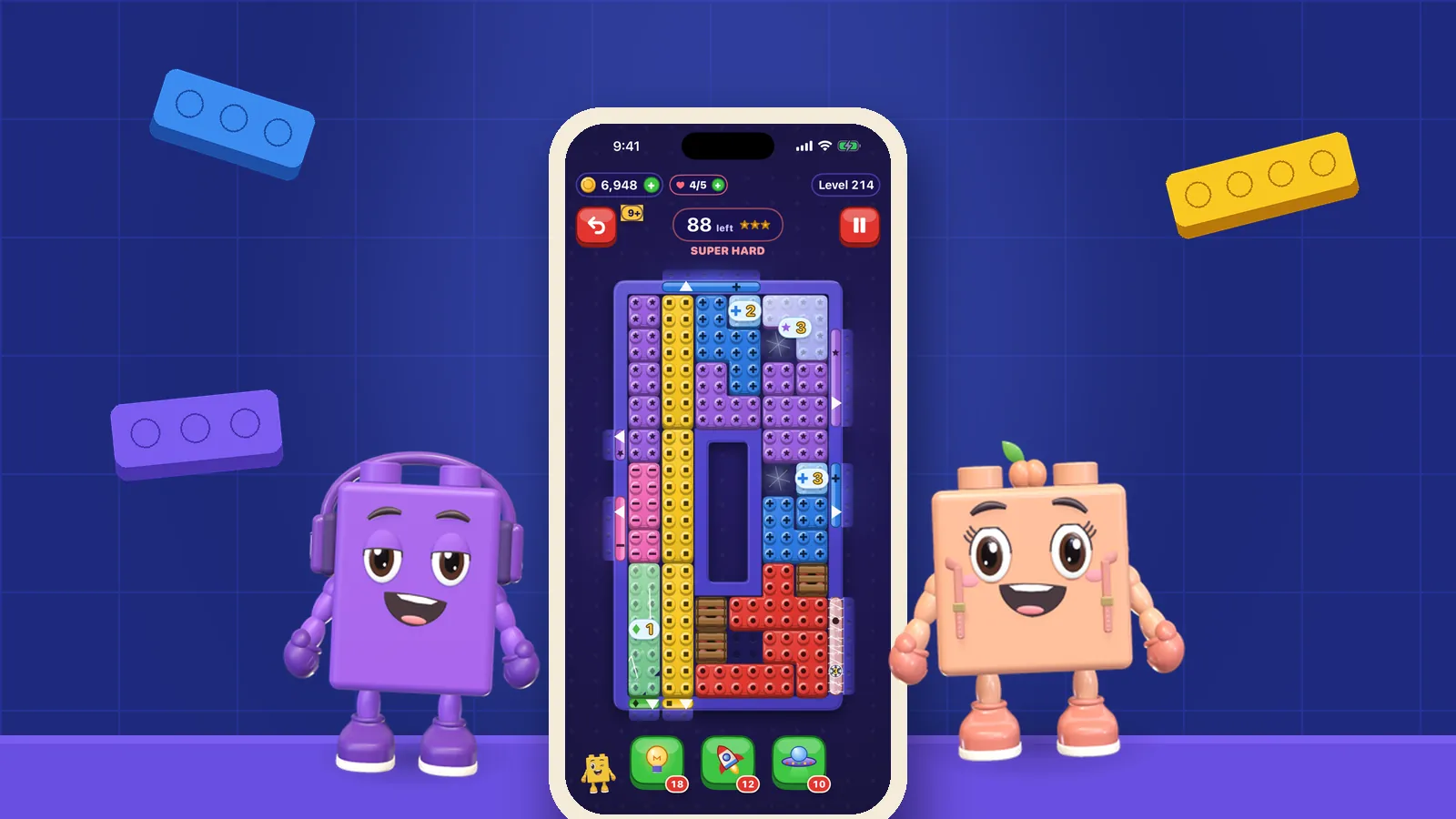
OutBrick has nine brick friends: Bloo, Bricko, Flurry, Moss, Peach, Poppy, Sprout, Vio and Zippy. They are brick-shaped, three appear on the Home screen at a time, and each has a victory move of their own. They have no voices; they animate and speak only in text bubbles. Each has a simple character the player can read at a glance: Bloo is the one with the watch, Peach is the careful planner, Sprout is the one with questions, Vio is the critic with headphones and Zippy is the one who drifts off. You can meet them all on the brick friends page.
The research suggests silence need not weaken a bond. Attachment in Bopp’s study came from competence, admiration and care as much as from dialogue, and a quiet character leaves more room for the player to fill in. It is the same principle of saying less that we admired in Monument Valley, and the companionship without demands we wrote about in Animal Crossing and shared time.
Sources1Bopp, J. A., Müller, L. J., Aeschbach, L. F., Opwis, K., & Mekler, E. D. (2019). Exploring emotional attachment to game characters. Proceedings of the Annual Symposium on Computer-Human Interaction in Play, 313–324.
Filed under
Questions, answered
A few useful answers
Why do people get attached to video game characters?
Players bond with characters for different reasons: admiring their skill, seeing them as role models, enjoying their company, or feeling responsible for their well-being. Because game characters respond to the player, these bonds can feel more mutual than bonds with film or book characters.
What is a parasocial relationship?
It is a one-sided bond with a media figure, such as a presenter or fictional character, who does not know you exist. Researchers described it in 1956, and it is a normal part of how people relate to media.
Why are game mascots usually cute?
Features such as a large head, round face and big eyes, known as the baby schema, are rated as cute and increase people’s motivation to care. Designers use them to make characters instantly likeable.
Do OutBrick’s characters talk?
No. OutBrick’s nine brick friends have no voices; they animate and speak only in text bubbles, and each has a victory move of their own.
APA 7
References
Where a source is a studio’s own history or a news account rather than a study, the article says so beside the claim.
- Bopp, J. A., Müller, L. J., Aeschbach, L. F., Opwis, K., & Mekler, E. D. (2019). Exploring emotional attachment to game characters. Proceedings of the Annual Symposium on Computer-Human Interaction in Play, 313–324. doi.org/10.1145/3311350.3347169 (opens in a new tab)
- Emmerich, K., Ring, P., & Masuch, M. (2018). I’m glad you are on my side: How to design compelling game companions. Proceedings of the 2018 Annual Symposium on Computer-Human Interaction in Play, 141–152. doi.org/10.1145/3242671.3242709 (opens in a new tab)
- Lewis, M. L., Weber, R., & Bowman, N. D. (2008). “They may be pixels, but they’re MY pixels”: Developing a metric of character attachment in role-playing video games. CyberPsychology & Behavior, 11(4), 515–518. doi.org/10.1089/cpb.2007.0137 (opens in a new tab)
- Glocker, M. L., Langleben, D. D., Ruparel, K., Loughead, J. W., Gur, R. C., & Sachser, N. (2009). Baby schema in infant faces induces cuteness perception and motivation for caretaking in adults. Ethology, 115(3), 257–263. doi.org/10.1111/j.1439-0310.2008.01603.x (opens in a new tab)
- Nittono, H., Fukushima, M., Yano, A., & Moriya, H. (2012). The power of kawaii: Viewing cute images promotes a careful behavior and narrows attentional focus. PLOS ONE, 7(9), e46362. doi.org/10.1371/journal.pone.0046362 (opens in a new tab)