

Monument Valley and the power of making less feel complete
A closer look at ustwo’s “less game, more experience” idea—and what OutBrick borrows from it.
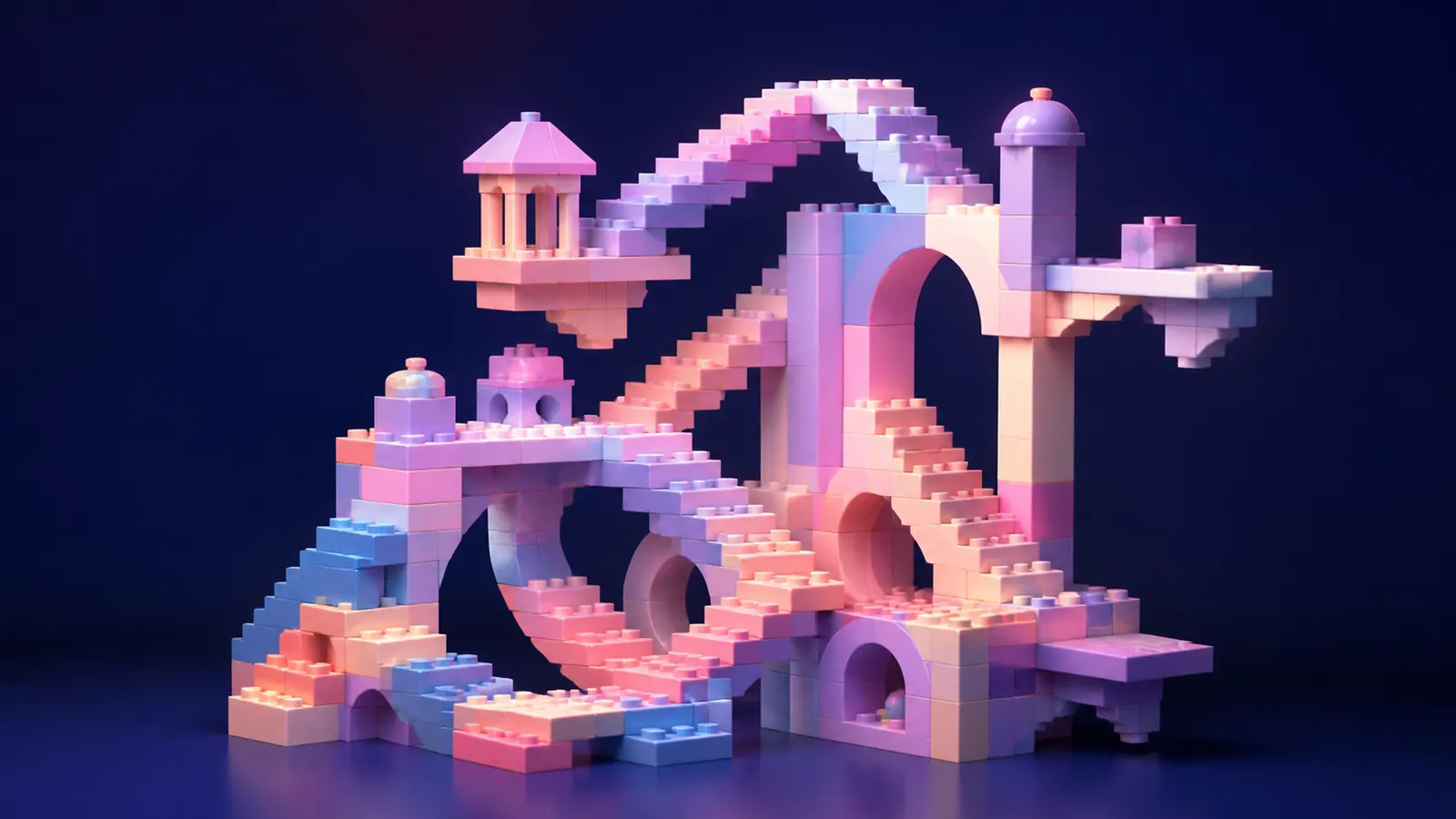
Some games earn attention by adding more. Monument Valley became a landmark by making each screen feel like a small, finished place. The design story is less about minimalism as a look and more about choosing what deserves the player’s attention.
ustwo’s project page describes Monument Valley as a short, complete experience: novel mechanics without grind, failure pressure, collectible stars, or leaderboards. The studio’s stated ambition was for players to finish the whole game on mobile, from beginning to end.
That first-party account explains intention rather than measuring causality. It does not prove that any single design choice caused the game’s success. But it gives us a clear design stance: a mobile game can be designed as a sequence of authored moments instead of an endless demand for more time.
Sources1ustwo. (n.d.). Monument Valley x ustwo. Retrieved September 4, 2026, from https://ustwo.com/work/monument-valley/
The GDC session description for lead designer Ken Wong connects M. C. Escher’s impossible architecture with ustwo’s background as a UX studio. Each screen was treated as a piece of art, and the team rethought the game as a user experience rather than a test of difficulty alone.
That shift is useful for puzzle makers. Difficulty is only one dimension of value. A board can also be memorable because it has a strong silhouette, a small surprise, or a moment where the player sees the rule from a new angle. OutBrick’s deep indigo chrome and brick-built villages are there to make those moments feel held, and there is no clock anywhere in the game to hurry them.
Sources2Wong, K. (2014). Designing Monument Valley: Less game, more experience [Conference session]. Game Developers Conference.
A complete experience can still ask for concentration. The important difference is whether the player can understand the purpose of the challenge and whether the game respects the player after the challenge is over.
OutBrick lets a board be knotty without making the whole app feel hostile. The first undo on every board is free and cannot run out. If no legal move remains outside sealed rooms, the Wedged sheet offers one free undo outside the tank. The board can be difficult. The relationship does not have to be.
Sources1ustwo. (n.d.). Monument Valley x ustwo. Retrieved September 4, 2026, from https://ustwo.com/work/monument-valley/3Ma, S. L. L. L., Bechard-Evans, M., et al. (2019). The use and effect of video game design theory in the creation of game-based systems for upper limb stroke rehabilitation. JMIR Serious Games, 7(2), e12131.
For OutBrick, “less game” means less friction between the player and the idea of the board. One screen can be enough. One move can be enough to teach a rule. One clear can be enough to end a session on a good note.
We are not trying to make a smaller copy of someone else’s success. We want a world where a small puzzle feels complete on its own terms, which is also why a two-minute board can feel like a proper reset.
Sources2Wong, K. (2014). Designing Monument Valley: Less game, more experience [Conference session]. Game Developers Conference.1ustwo. (n.d.). Monument Valley x ustwo. Retrieved September 4, 2026, from https://ustwo.com/work/monument-valley/
Filed under
APA 7
References
Where a source is a studio’s own history or a news account rather than a study, the article says so beside the claim.
- ustwo. (n.d.). Monument Valley x ustwo. Retrieved September 4, 2026, from https://ustwo.com/work/monument-valley/ ustwo.com/work/monument-valley (opens in a new tab)
- Wong, K. (2014). Designing Monument Valley: Less game, more experience [Conference session]. Game Developers Conference. www.gdcvault.com/play/1021380/Designing-Monument-Valley-Less-Game (opens in a new tab)
- Ma, S. L. L. L., Bechard-Evans, M., et al. (2019). The use and effect of video game design theory in the creation of game-based systems for upper limb stroke rehabilitation. JMIR Serious Games, 7(2), e12131. pmc.ncbi.nlm.nih.gov/articles/PMC6453078 (opens in a new tab)