Dark patterns in mobile games: how to spot them
Nagging pop-ups, confusing currencies, offers timed for your worst moment: what research says about manipulative design in games, and a checklist to spot it.
The term “dark pattern” was coined for websites: the pre-ticked box, the cancel button in grey on grey, the subscription that is one tap to start and twelve to stop. Games inherited all of those and invented some of their own. Because a game is designed to be absorbing, the line between engaging and manipulative can be hard to see from inside one. Researchers in human-computer interaction, consumer protection and addiction studies have started to map that line. Their work gives players a vocabulary for the feeling that a game is working against them, and gives designers a mirror. We make a free-to-play game, so we have held the mirror up to ourselves too.
Colin Gray and colleagues assembled a corpus of examples that UX practitioners themselves had flagged as dark patterns and analysed what ethical concerns they raised. They describe dark patterns as cases where user value is supplanted in favour of shareholder value, and sort the strategies into five families: nagging (repeatedly interrupting to push a choice), obstruction (making something harder than it needs to be), sneaking (hiding or delaying information), interface interference (manipulating the screen so one option stands out) and forced action (requiring something unrelated to get what you want).
These are not rare. Arunesh Mathur and colleagues built automated tools to scan about 53,000 product pages across some 11,000 shopping websites and found 1,818 instances of dark patterns, of 15 types, along with third-party companies selling them as ready-made features. If ordinary shops use them at that scale, it would be surprising if games, which have far more screens and far more moments of emotion, did not.
Sources1Gray, C. M., Kou, Y., Battles, B., Hoggatt, J., & Toombs, A. L. (2018). The dark (patterns) side of UX design. Proceedings of the 2018 CHI Conference on Human Factors in Computing Systems, 1–14.2Mathur, A., Acar, G., Friedman, M. J., Lucherini, E., Mayer, J., Chetty, M., & Narayanan, A. (2019). Dark patterns at scale: Findings from a crawl of 11K shopping websites. Proceedings of the ACM on Human-Computer Interaction, 3(CSCW), 1–32.
Elena Petrovskaya and David Zendle asked 1,104 players to describe a time they had met a game transaction that felt misleading, aggressive or unfair. From the answers they identified 35 separate techniques in eight domains: game dynamics designed to drive spending, products not meeting expectations, charging for basic quality of life, predatory advertising, in-game currencies, pay to win, the general presence of microtransactions, and other. Several of the practices players reported did not seem to align with UK consumer protection rules.
Notice how many of those domains have nothing to do with a shop screen. Charging for quality of life means making the free version deliberately tedious, so that paying feels like relief rather than a purchase. In-game currencies put a layer of conversion between you and the real price, and bundles of odd sizes make the arithmetic harder still. Some come from the game’s design as much as its shop. Daniel King and colleagues examined 13 patents for in-game purchasing systems and found designs that use behavioural tracking and price manipulation to personalise offers and encourage continued spending, often with limited protections such as refunds. The patents do not prove any particular game uses these systems, but they show what the industry has thought about building.
Sources3Petrovskaya, E., & Zendle, D. (2022). Predatory monetisation? A categorisation of unfair, misleading and aggressive monetisation techniques in digital games from the player perspective. Journal of Business Ethics, 181(4), 1065–1081.4King, D. L., Delfabbro, P. H., Gainsbury, S. M., Dreier, M., Greer, N., & Billieux, J. (2019). Unfair play? Video games as exploitative monetized services: An examination of game patents from a consumer protection perspective. Computers in Human Behavior, 101, 131–143.
Children and teenagers play many free-to-play games and may be more susceptible to manipulation. Dan Fitton and Janet Read combined practitioner insight, existing research and a study with 39 girls aged 12 and 13 to build a framework for what they call App Dark Design. The result is a set of problematic design aspects, many of them tied to advertising and in-app purchasing, that the authors say young people around the world meet in their apps every day.
For parents, that argues for talking about these patterns directly. A child who can name “that’s a fake close button” or “they want me to buy now because I just lost” is harder to steer. Settings help too: on Apple devices, Family Sharing’s Ask to Buy lets a parent approve a child’s purchases before they go through.
Sources5Fitton, D., & Read, J. C. (2019). Creating a framework to support the critical consideration of dark design aspects in free-to-play apps. Proceedings of the 18th ACM International Conference on Interaction Design and Children, 407–418.
Jacob Aagaard and colleagues ran interviews and workshops with mobile game players, designers, developers and business developers. Their account shows that dark patterns rarely come from a single villain; they emerge from commercial pressure, metrics and habit, and professionals themselves feel the tension. That is why a checklist helps. One rule of thumb covers most of it. If a game makes refusing hard, hides a cost or picks your worst moment to sell, it is working on you, not for you. Here are the specific patterns worth learning to spot, drawn from the studies above:
- Offers that appear right after you fail, when you are most frustrated.
- Currencies that make it hard to know what anything costs in real money.
- Timers and energy meters that stop play unless you pay or wait.
- Streaks and daily rewards that punish a missed day.
- Adverts that play without your asking, or close buttons that are tiny or delayed.
- Pop-ups that return every session until you give in.
- Features that used to be free being moved behind a purchase.
Sources6Aagaard, J., Knudsen, M. E. C., Bækgaard, P., & Doherty, K. (2022). A game of dark patterns: Designing healthy, highly-engaging mobile games. CHI Conference on Human Factors in Computing Systems Extended Abstracts, 1–8.3Petrovskaya, E., & Zendle, D. (2022). Predatory monetisation? A categorisation of unfair, misleading and aggressive monetisation techniques in digital games from the player perspective. Journal of Business Ethics, 181(4), 1065–1081.1Gray, C. M., Kou, Y., Battles, B., Hoggatt, J., & Toombs, A. L. (2018). The dark (patterns) side of UX design. Proceedings of the 2018 CHI Conference on Human Factors in Computing Systems, 1–14.
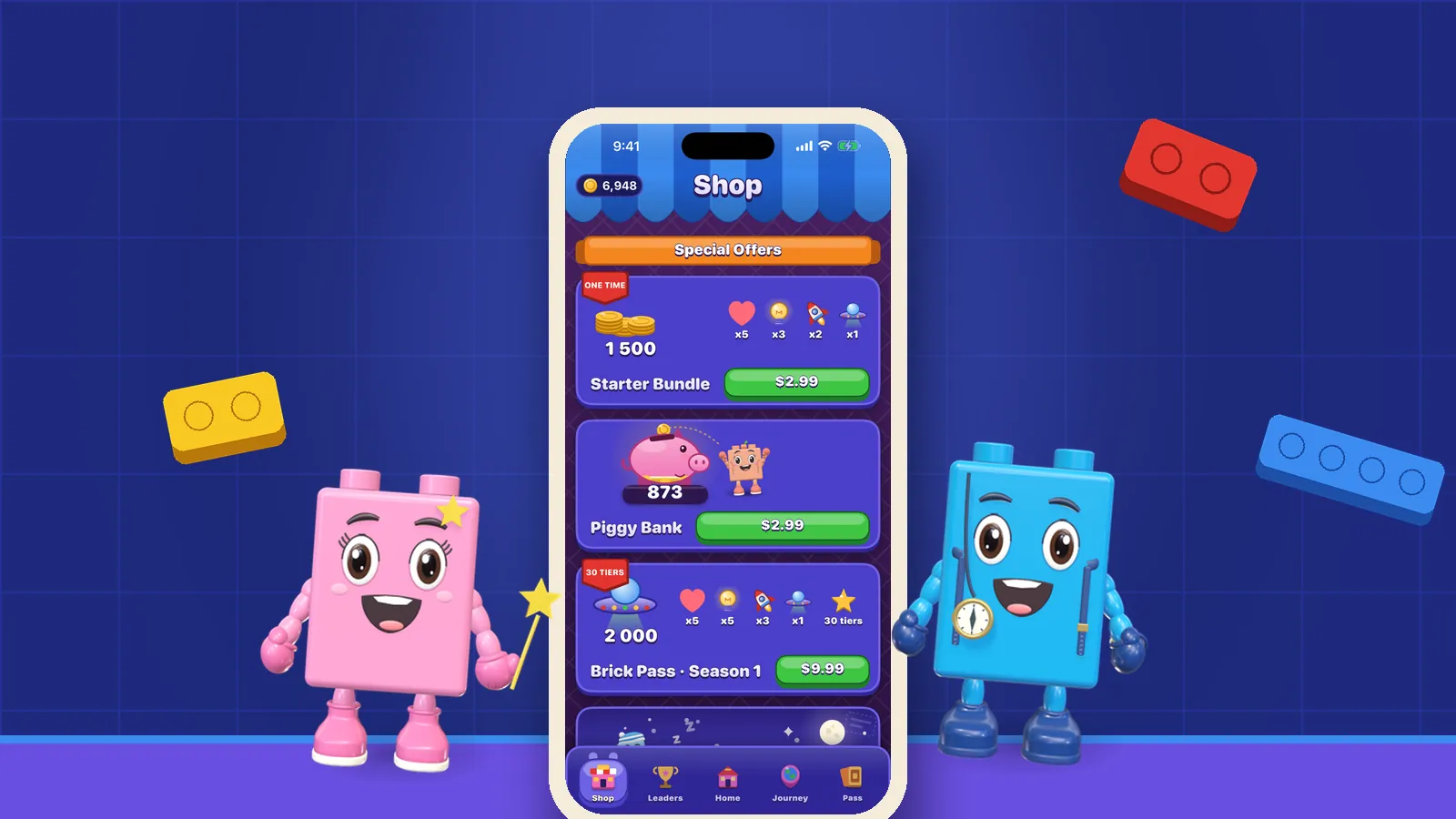
The cover of this article shows OutBrick’s own shop, with special offers and the Brick Pass, because we think the same questions should apply to us. Here is what we can say plainly. Advertising is rewarded video only: nothing plays unless you press a button asking for something, there are no banners or interstitials, and each of the eight placements has its own daily cap, with 39 views a day at most. Declining costs nothing, and nothing has to be bought or watched to play the core boards. Lives exist: you hold five, one returns every thirty minutes, and a life goes only when an attempt ends without a clear. All of this is set out on the home page under what lives, undos and adverts cost.
You will have to judge the rest yourself, and you should. The related question of randomised rewards is covered in loot boxes, variable rewards and ethical monetisation, and streak pressure in the case for daily rituals that do not demand you. If a game, ours included, leaves you feeling handled rather than entertained, our guide on when to play and when to put the phone down is a good place to start.
Filed under
Questions, answered
A few useful answers
What are dark patterns in games?
Dark patterns are design choices that steer players into doing something that benefits the game’s maker more than the player, such as spending money, watching adverts or playing longer than they meant to. Common forms include nagging pop-ups, hidden costs and offers timed for moments of frustration.
How can I spot manipulative design in a mobile game?
Watch for offers right after you fail, currencies that obscure real prices, adverts you did not ask for, streaks that punish missed days, and anything that makes saying no harder than saying yes.
Are dark patterns in games illegal?
Some can be. Consumer protection law in places such as the UK already prohibits misleading and aggressive commercial practices, and researchers have found game monetisation techniques that appear to sit uneasily with those rules. Many other dark patterns are legal but still worth avoiding.
Are children more affected by dark patterns in apps?
Researchers think younger players may be more susceptible. A study with 12- and 13-year-old girls found they regularly met hard-to-close adverts and pressure to spend in free-to-play apps.
Does OutBrick show adverts without asking?
No. OutBrick’s advertising is rewarded video only, played when you press a button asking for a specific reward, with a daily cap on each of its eight placements and no banners or interstitials.
APA 7
References
Where a source is a studio’s own history or a news account rather than a study, the article says so beside the claim.
- Gray, C. M., Kou, Y., Battles, B., Hoggatt, J., & Toombs, A. L. (2018). The dark (patterns) side of UX design. Proceedings of the 2018 CHI Conference on Human Factors in Computing Systems, 1–14. doi.org/10.1145/3173574.3174108 (opens in a new tab)
- Mathur, A., Acar, G., Friedman, M. J., Lucherini, E., Mayer, J., Chetty, M., & Narayanan, A. (2019). Dark patterns at scale: Findings from a crawl of 11K shopping websites. Proceedings of the ACM on Human-Computer Interaction, 3(CSCW), 1–32. doi.org/10.1145/3359183 (opens in a new tab)
- Petrovskaya, E., & Zendle, D. (2022). Predatory monetisation? A categorisation of unfair, misleading and aggressive monetisation techniques in digital games from the player perspective. Journal of Business Ethics, 181(4), 1065–1081. doi.org/10.1007/s10551-021-04970-6 (opens in a new tab)
- King, D. L., Delfabbro, P. H., Gainsbury, S. M., Dreier, M., Greer, N., & Billieux, J. (2019). Unfair play? Video games as exploitative monetized services: An examination of game patents from a consumer protection perspective. Computers in Human Behavior, 101, 131–143. doi.org/10.1016/j.chb.2019.07.017 (opens in a new tab)
- Fitton, D., & Read, J. C. (2019). Creating a framework to support the critical consideration of dark design aspects in free-to-play apps. Proceedings of the 18th ACM International Conference on Interaction Design and Children, 407–418. doi.org/10.1145/3311927.3323136 (opens in a new tab)
- Aagaard, J., Knudsen, M. E. C., Bækgaard, P., & Doherty, K. (2022). A game of dark patterns: Designing healthy, highly-engaging mobile games. CHI Conference on Human Factors in Computing Systems Extended Abstracts, 1–8. doi.org/10.1145/3491101.3519837 (opens in a new tab)