Loot boxes, variable rewards and ethical monetisation
Loot box spending is consistently linked to problem gambling. What the studies show, what makes monetisation predatory, and a fair test for any game.
A loot box is a simple thing: pay, open, and get something, but you do not know what until it is too late to change your mind. They have become one of the most studied features in games, and one of the most regulated. The research is now substantial enough to say some things clearly, and to be honest about what it cannot yet say. It also gives players and makers a practical test for any way a game asks for money, including ours. OutBrick makes money from optional purchases and opt-in rewarded video, so we have tried to apply the same test to ourselves at the end.
A loot box is an item you buy with real money, directly or through an in-game currency, whose contents are randomised. Its close relatives include card packs, gacha pulls and prize wheels. What makes them psychologically distinctive is the variable reward: you do not know what you will get, and occasionally you get something rare. Unpredictable rewards are among the most reliable ways known to keep people repeating a behaviour, which is exactly why they are used.
In 2018 Aaron Drummond and James Sauer compared the loot box systems of 22 recent games against five criteria that psychologists and regulators use to recognise gambling, including an exchange of money or something of value, an outcome decided at least partly by chance, and winners gaining at the expense of losers. Nearly half of the games met all five. Their argument was not that every loot box is illegal gambling, which is a legal question that varies by country, but that many are psychologically akin to it.
Sources1Drummond, A., & Sauer, J. D. (2018). Video game loot boxes are psychologically akin to gambling. Nature Human Behaviour, 2(8), 530–532.
The best-known study is a large survey by David Zendle and Paul Cairns of 7,422 gamers. The more people spent on loot boxes, the more severe their problem gambling symptoms tended to be. The link was about thirteen times stronger, in variance explained, than the link between problem gambling and spending on other in-game items, which suggests it is the gambling-like feature, not spending in general, that matters.
A follow-up with 1,155 players aged 16 to 18, by Zendle, Rachel Meyer and Harriet Over, found the same link, and stronger: of moderate to large size. Many of the reasons young players gave for buying loot boxes echoed common reasons for gambling. In 2021 Shaun Garea and colleagues pooled the literature in a meta-analysis. Across 15 studies, loot box spending correlated with problem gambling at about r = 0.26, and across seven studies with excessive gaming at about r = 0.25. They describe it as a small but replicable relationship that may be clinically relevant.
Sources2Zendle, D., & Cairns, P. (2018). Video game loot boxes are linked to problem gambling: Results of a large-scale survey. PLOS ONE, 13(11), e0206767.3Zendle, D., Meyer, R., & Over, H. (2019). Adolescents and loot boxes: Links with problem gambling and motivations for purchase. Royal Society Open Science, 6(6), 190049.4Garea, S. S., Drummond, A., Sauer, J. D., Hall, L. C., & Williams, M. N. (2021). Meta-analysis of the relationship between problem gambling, excessive gaming and loot box spending. International Gambling Studies, 21(3), 460–479.
These studies are mostly cross-sectional surveys, so they cannot tell us which way the arrow points. Loot boxes might draw people towards problem gambling. Or people who already have a gambling problem might spend heavily on loot boxes because they are there. Zendle and Cairns are explicit that their data cannot separate these. Their point is that both explanations are troubling: in one, the game causes harm; in the other, it profits disproportionately from people who are already vulnerable.
Daniel King and Paul Delfabbro gave the wider problem a name: predatory monetisation, meaning purchasing systems that disguise or withhold the long-term cost of an activity until players are already financially and psychologically committed. Loot boxes are one form. Others include offers timed for moments of frustration and currencies designed to make prices hard to compare. We look at these tricks in more detail in dark patterns in mobile games.
Sources2Zendle, D., & Cairns, P. (2018). Video game loot boxes are linked to problem gambling: Results of a large-scale survey. PLOS ONE, 13(11), e0206767.5King, D. L., & Delfabbro, P. H. (2018). Predatory monetization schemes in video games (e.g. ‘loot boxes’) and internet gaming disorder. Addiction, 113(11), 1967–1969.
Free games have to be paid for somehow, and asking for money is not wrong in itself. The research points to a handful of questions that separate a fair exchange from a predatory one. They are as useful to a parent checking a child’s game as to a studio designing a shop.
- Do you know exactly what you will get before you pay, in money or in time?
- Is the full cost clear, or hidden behind a currency, a bundle or a timer?
- Can you progress through the core game without paying?
- Does saying no cost you anything, or does the game make refusing unpleasant?
- Are offers timed for your worst moments, such as just after you fail?
- Is there a sensible limit, or can spending and repetition go on without end?
Sources5King, D. L., & Delfabbro, P. H. (2018). Predatory monetization schemes in video games (e.g. ‘loot boxes’) and internet gaming disorder. Addiction, 113(11), 1967–1969.1Drummond, A., & Sauer, J. D. (2018). Video game loot boxes are psychologically akin to gambling. Nature Human Behaviour, 2(8), 530–532.
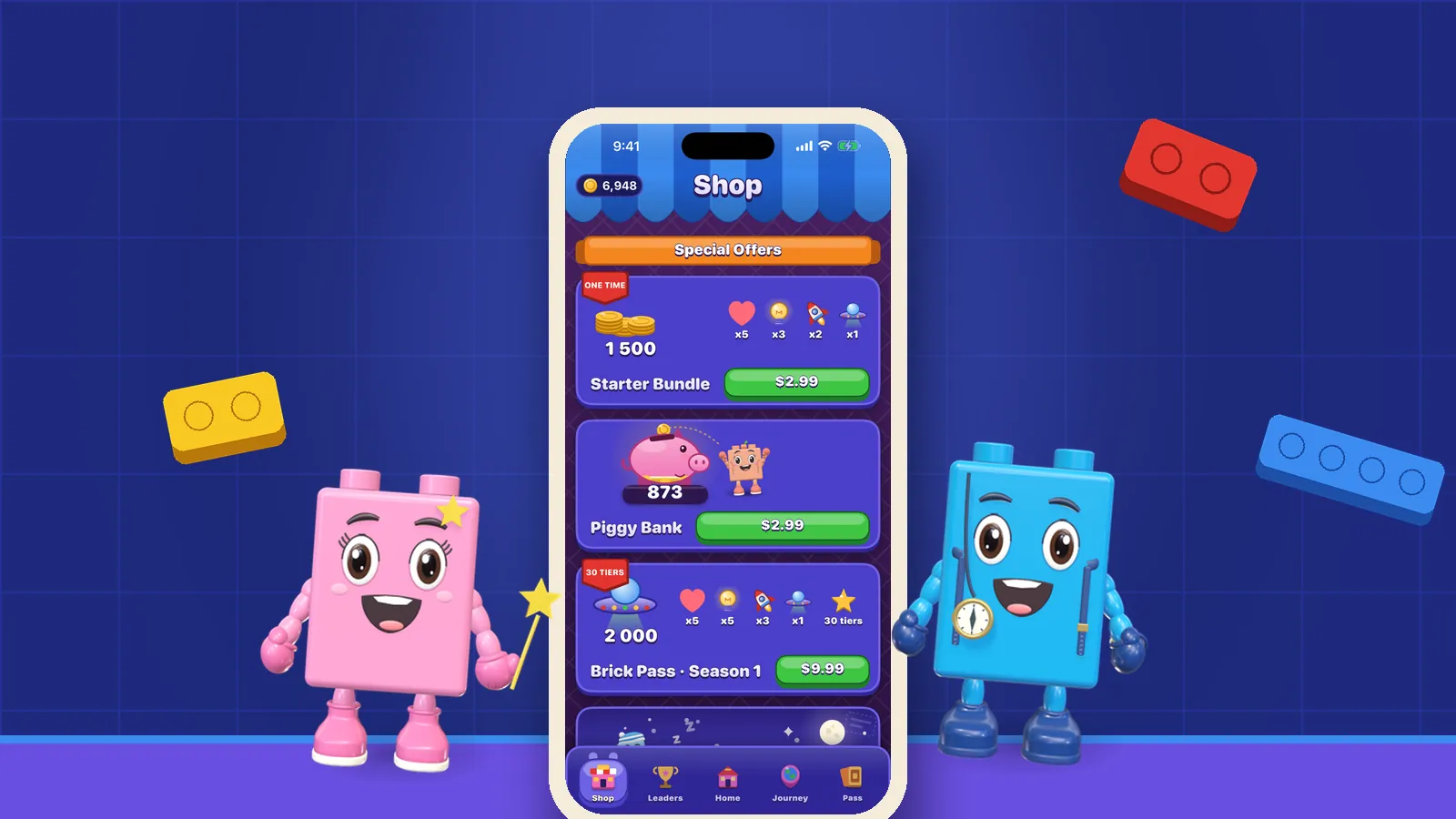
OutBrick earns money in two ways: optional in-app purchases, and rewarded video that plays only when you press a button to ask for something. There are eight placements: a life, two undos, extra moves, a free Hint, the clear’s coins doubled, a second spin of the Brick Wheel, a gift balloon and Brick Cinema. Each has its own daily cap, eight, eight, six, four, four, one, two and six, so 39 videos a day is the most the game will ever pay for. There are no banners and no interstitials. Declining costs nothing, and nothing a video pays for has to be bought or watched to play the core boards. Remove Ads switches advertising off for good, and the Brick Pass raises the lives cap from five to eight and turns advertising off for as long as it is held.
Most of the rewards are fixed and stated before you watch. The extra Brick Wheel spin is a small element of chance, which is why it is worth naming here, and it is limited to one a day. Whether that is the right balance is for you to judge, which is why the home page sets out exactly what lives, undos and adverts cost. We also think a game should be easy to put down; our notes on how games become habits explain why, and what makes a puzzle game calm looks at how lives and refills can be fair.
Filed under
Questions, answered
A few useful answers
Are loot boxes gambling?
Legally it depends on the country. Psychologically, researchers have found that many loot box systems meet the usual criteria for gambling, and spending on them is consistently linked to problem gambling symptoms.
Do loot boxes cause problem gambling?
The evidence shows a link but not its direction. Loot boxes may lead some players towards problem gambling, or people with gambling problems may spend more on them; researchers argue that either possibility is a reason for caution.
What is predatory monetisation in games?
It describes purchasing systems that hide or delay the true long-term cost of playing until players are already financially and psychologically committed, such as randomised paid rewards or offers timed for moments of frustration.
Does OutBrick have loot boxes?
OutBrick’s rewarded videos mostly pay fixed, stated rewards; the one daily second spin of the Brick Wheel involves chance. Every video is opt-in and capped, and declining costs nothing; the home page sets out exactly what lives, undos and adverts cost.
APA 7
References
Where a source is a studio’s own history or a news account rather than a study, the article says so beside the claim.
- Drummond, A., & Sauer, J. D. (2018). Video game loot boxes are psychologically akin to gambling. Nature Human Behaviour, 2(8), 530–532. doi.org/10.1038/s41562-018-0360-1 (opens in a new tab)
- Zendle, D., & Cairns, P. (2018). Video game loot boxes are linked to problem gambling: Results of a large-scale survey. PLOS ONE, 13(11), e0206767. doi.org/10.1371/journal.pone.0206767 (opens in a new tab)
- Zendle, D., Meyer, R., & Over, H. (2019). Adolescents and loot boxes: Links with problem gambling and motivations for purchase. Royal Society Open Science, 6(6), 190049. doi.org/10.1098/rsos.190049 (opens in a new tab)
- Garea, S. S., Drummond, A., Sauer, J. D., Hall, L. C., & Williams, M. N. (2021). Meta-analysis of the relationship between problem gambling, excessive gaming and loot box spending. International Gambling Studies, 21(3), 460–479. doi.org/10.1080/14459795.2021.1914705 (opens in a new tab)
- King, D. L., & Delfabbro, P. H. (2018). Predatory monetization schemes in video games (e.g. ‘loot boxes’) and internet gaming disorder. Addiction, 113(11), 1967–1969. doi.org/10.1111/add.14286 (opens in a new tab)