

Animal Crossing and the architecture of shared time
Why routines, roles, and custom play can make a digital place feel socially present even when players are apart.
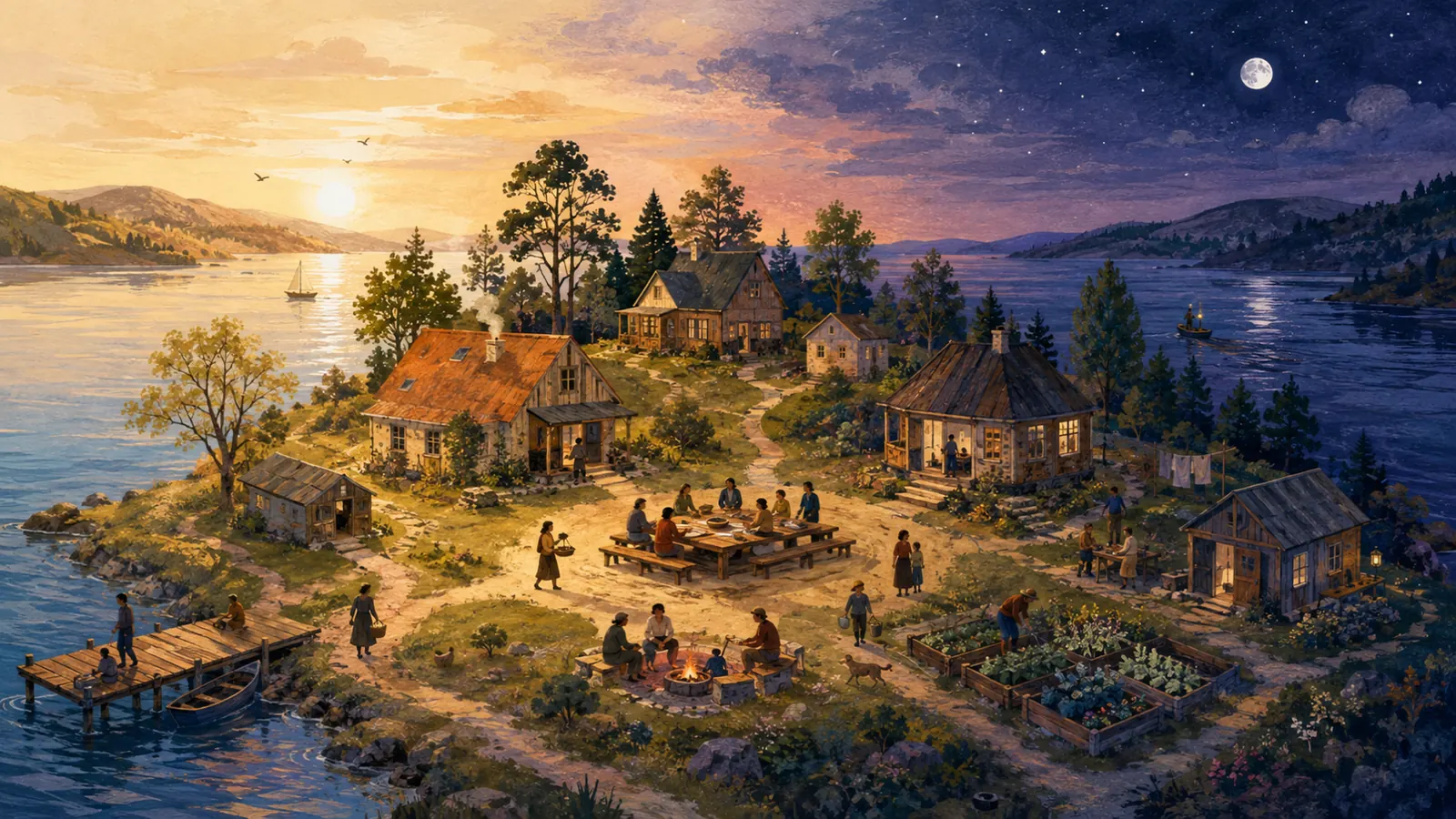
Shared time does not always look like simultaneous action. Sometimes it is a place people maintain, a routine they compare, or a persona they bring to a world that is waiting when they return.
Comerford’s Persona Studies article examines Animal Crossing: New Horizons through interviews and a survey of nearly 2,000 players. The paper describes how players used the game for routine substitution, social connectivity, agency, and personas during a period of social isolation. Its historical context is specific, but the design observation travels: a place can feel social because it holds traces of people’s choices between visits.
A waiting world creates a different rhythm from a match that exists only while everyone is online. The player can contribute a small act, leave, and return to a world that has continuity.
Sources1Comerford, C. (2021). Coconuts, custom-play & COVID-19: Social isolation, serious leisure and personas in Animal Crossing: New Horizons. Persona Studies, 6(2), 101–117.
Custom play gives players a role that the rules do not fully prescribe. One person becomes the gardener, another the host, another the collector, another the person who arranges a corner for visitors. These roles are not required to finish the game, which is why they can become meaningful rather than merely functional.
This is a form of autonomy. The system offers affordances, but the player decides what kind of person they want to be inside the space. Relatedness can then grow through the stories those choices make possible.
Sources1Comerford, C. (2021). Coconuts, custom-play & COVID-19: Social isolation, serious leisure and personas in Animal Crossing: New Horizons. Persona Studies, 6(2), 101–117.2Przybylski, A. K., Rigby, C. S., & Ryan, R. M. (2010). A motivational model of video game engagement. Review of General Psychology, 14(2), 154–166.
The kindest shared spaces do not demand identical schedules. They leave a trace that can be picked up later, and they make room for different levels of participation. A person can visit for five minutes, decorate one corner, or simply see what changed.
That is a useful standard for OutBrick’s wider ecosystem: every board should stand on its own, while the stories around the boards give players more ways to feel accompanied.
Sources1Comerford, C. (2021). Coconuts, custom-play & COVID-19: Social isolation, serious leisure and personas in Animal Crossing: New Horizons. Persona Studies, 6(2), 101–117.4Ballou, N., Vuorre, M., Hakman, T., Magnusson, K., & Przybylski, A. K. (2025). Perceived value of video games, but not hours played, predicts mental well-being in casual adult Nintendo players. Royal Society Open Science, 12(3).
Filed under
APA 7
References
Where a source is a studio’s own history or a news account rather than a study, the article says so beside the claim.
- Comerford, C. (2021). Coconuts, custom-play & COVID-19: Social isolation, serious leisure and personas in Animal Crossing: New Horizons. Persona Studies, 6(2), 101–117. doi.org/10.21153/psj2020vol6no2art970 (opens in a new tab)
- Przybylski, A. K., Rigby, C. S., & Ryan, R. M. (2010). A motivational model of video game engagement. Review of General Psychology, 14(2), 154–166. doi.org/10.1037/a0019440 (opens in a new tab)
- Ballou, N., Vuorre, M., Hakman, T., Magnusson, K., & Przybylski, A. K. (2025). Perceived value of video games, but not hours played, predicts mental well-being in casual adult Nintendo players. Royal Society Open Science, 12(3). doi.org/10.1098/rsos.241174 (opens in a new tab)