Why undo makes you a better puzzle solver, not a lazier one
Mistakes you can take back are some of the best teachers a puzzle has. What research on errors and planning says about using undo well, and when to hold back.
Some players treat undo as a confession. They would rather stare at a board for two minutes than take a move back, as if the button were for people who cannot really do puzzles. The research on learning points the other way, with one interesting catch. Errors you notice and correct are among the most useful things that can happen while you learn. But when mistakes cost nothing at all, people also plan less. Using undo well means getting the first effect without paying too much of the second.
In a 2017 review, Janet Metcalfe gathered the evidence on learning from errors. The picture surprises anyone raised on the idea that mistakes should be avoided at all costs. Making an error and then getting corrective feedback generally helps people learn; it does not stamp the error in. The benefit is strongest in the case that sounds worst: when the learner was confident that the wrong answer was right. A confident mistake that gets corrected is memorable.
Nate Kornell, Matthew Hays and Robert Bjork showed a related effect in the lab. People who tried to answer a question before seeing the answer learned it better than people who simply read the question and answer together, even when their attempt was bound to fail. The unsuccessful attempt seemed to prepare them for the correction.
A puzzle move is a kind of guess about the board. When the guess is wrong and you see why, you learn something about how the pieces interact that staring would not have shown you. That is what undo makes possible: the correction arrives at once, while the reasoning that led to the mistake is still fresh.
Sources1Metcalfe, J. (2017). Learning from errors. Annual Review of Psychology, 68, 465–489.2Kornell, N., Hays, M. J., & Bjork, R. A. (2009). Unsuccessful retrieval attempts enhance subsequent learning. Journal of Experimental Psychology: Learning, Memory, and Cognition, 35(4), 989–998.
Workplace training research has tested this at scale. Error management training deliberately encourages learners to explore, make mistakes and learn from them, instead of following a procedure that keeps them on the right path. In 2008 Nina Keith and Michael Frese pooled 24 studies with more than 2,000 participants. On average, error management training did better than the alternatives, with a moderate effect. The gap was largest not on the tasks people practised, but on later tasks that were structurally different, which is exactly where you would want a skill to hold up.
Two ingredients mattered: active exploration, and explicit encouragement to make errors. The second is easy to overlook. Being told that mistakes are part of the process changes how people react to them, and frustration has room to turn into curiosity. A game can send the same message through its design, by making the first correction cheap.
Transfer to new tasks is the right thing to care about in a puzzle game too. Nobody plays the same board for long. What you want to carry from one board to the next is not a memorised solution but a better sense of how pieces block each other, and exploration builds that sense.
Sources3Keith, N., & Frese, M. (2008). Effectiveness of error management training: A meta-analysis. Journal of Applied Psychology, 93(1), 59–69.
Kenton O’Hara and Stephen Payne ran a set of experiments in the late 1990s that every puzzle designer should know. People solved the 8-puzzle, a small sliding-tile puzzle, through interfaces that made each move either quick or laborious to carry out. When moves were costly, people planned more. When moves were cheap, they leaned on trial and error in the world instead.
The learning results were more mixed. In one experiment, people who had practised on the costly interface later did better on the same kind of puzzle than people who had practised on the cheap one. In another, where the later puzzle was a different one, the practice interface made no difference. A follow-up study manipulated other costs, including a lockout delay after each move and the cost of recovering from an error, and found the same basic pattern: when acting costs more, people plan more and act less.
Undo is the ultimate cost reducer. It makes a bad move nearly free. So the research predicts that plentiful undo can quietly stop people planning. The answer is not to avoid undo, but to spend it on purpose.
Sources4O’Hara, K. P., & Payne, S. J. (1998). The effects of operator implementation cost on planfulness of problem solving and learning. Cognitive Psychology, 35(1), 34–70.5O’Hara, K. P., & Payne, S. J. (1999). Planning and the user interface: The effects of lockout time and error recovery cost. International Journal of Human-Computer Studies, 50(1), 41–59.
The trick is to treat each undo as an experiment with a question attached. Before you make a move you might take back, say what you expect it to show: if the blue slides left, does the lane open? Then look, learn and undo. You keep the planning that cheap moves tend to erode, and you still get the quick correction that makes errors useful.
- Name the question before a probing move, not after it.
- After an undo, sum up in one sentence what the board just taught you.
- If you undo the same move twice, stop and reread the board; the problem is your plan, not the move.
- Save a fresh attempt for when your whole reading of the board was wrong.
Flicking back and forth between the same two positions is a sign that you are hoping rather than testing. That is the moment to reread the board from scratch, which how to read a puzzle before the first move walks through.
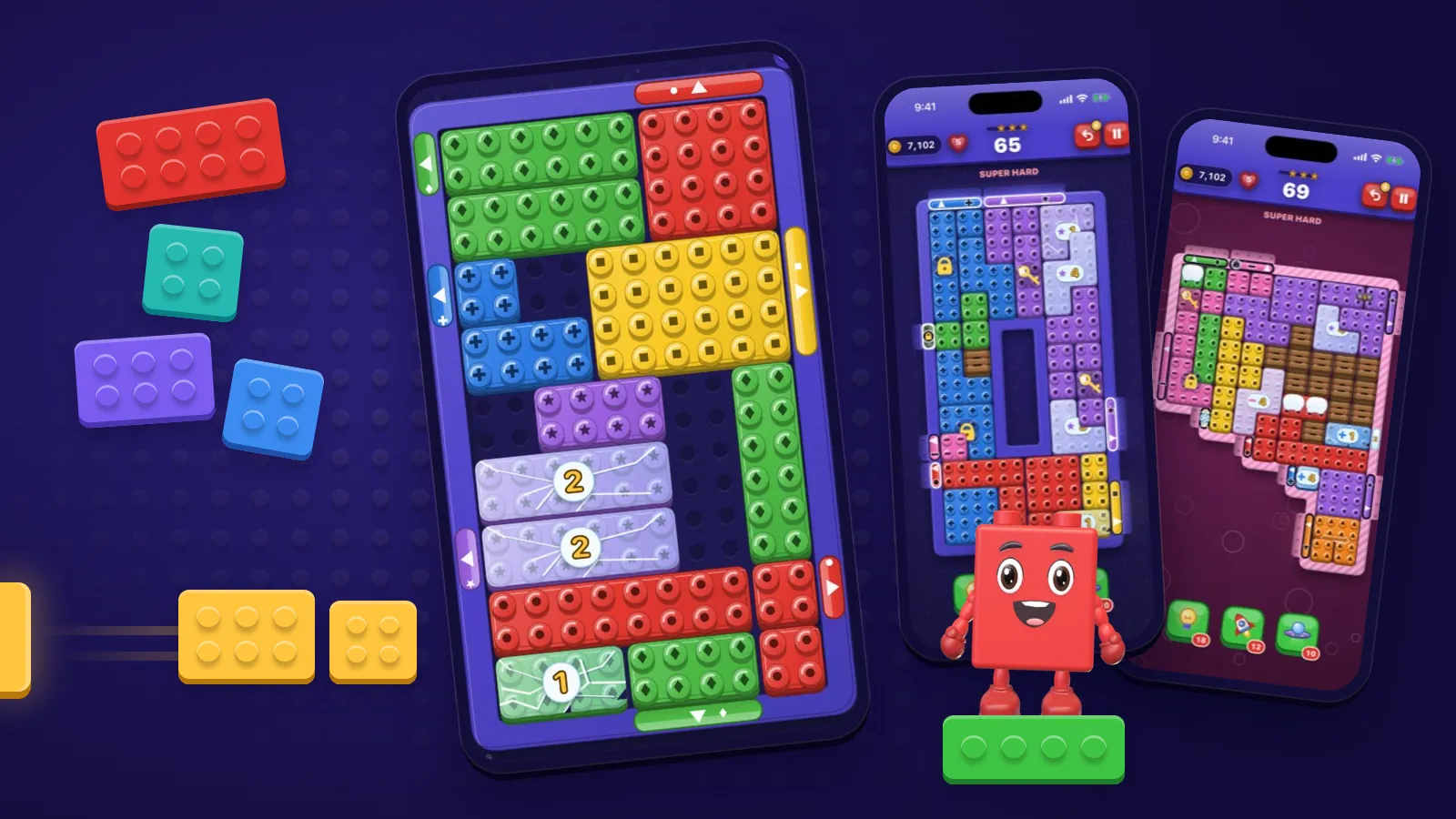
OutBrick is built around this balance. The first undo on every board is free and cannot run out, so the first correction is always cheap, which is the same message error management training tries to send. Beyond that, undos come from a small tank that refills over time, and a board left with no move reshuffles itself for free. The exact terms are in the fair-play ledger on the home page.
On the classic boards, which the browser demo still plays, the stars pull the other way, on purpose. One star is a clear. Two stars is a clear inside the move target. Three stars is a clear inside the target with no undo at all. (On iPhone and iPad, stars now follow each board’s score.) So the game rewards both kinds of learning: explore freely when you want the clear, and plan in your head when you want the third star. Our guide to earning three stars covers the planning side.
To feel the difference, try the browser board twice: once experimenting freely, once without touching undo. Notice how differently you look at the board the second time.
Filed under
Questions, answered
A few useful answers
Is using undo in puzzle games cheating?
No. Undo lets you correct a mistake while the reasoning behind it is still fresh, which research on learning from errors suggests is valuable. Its main risk is that very cheap undo can tempt you to plan less.
Does trial and error help you learn puzzles?
It can. A meta-analysis of error management training found that encouraging exploration and mistakes led to better transfer to new tasks than error-avoidant training. It works best when each trial tests a specific idea.
Why do I plan less when undo is unlimited?
Experiments with the 8-puzzle found that when moves were cheap to make, people relied on trial and error, and when moves were costly, they planned more. Undo makes mistakes cheap, so it shifts effort from planning to trying.
Does undo cost stars in OutBrick?
On iPhone and iPad the stars follow each board’s score, and the first undo on every board is free. On the classic boards of the browser demo, undo costs only the third star: one star is a clear, two stars is a clear inside the move target, and three stars is a clear inside the target with no undo.
APA 7
References
Where a source is a studio’s own history or a news account rather than a study, the article says so beside the claim.
- Metcalfe, J. (2017). Learning from errors. Annual Review of Psychology, 68, 465–489. doi.org/10.1146/annurev-psych-010416-044022 (opens in a new tab)
- Kornell, N., Hays, M. J., & Bjork, R. A. (2009). Unsuccessful retrieval attempts enhance subsequent learning. Journal of Experimental Psychology: Learning, Memory, and Cognition, 35(4), 989–998. doi.org/10.1037/a0015729 (opens in a new tab)
- Keith, N., & Frese, M. (2008). Effectiveness of error management training: A meta-analysis. Journal of Applied Psychology, 93(1), 59–69. doi.org/10.1037/0021-9010.93.1.59 (opens in a new tab)
- O’Hara, K. P., & Payne, S. J. (1998). The effects of operator implementation cost on planfulness of problem solving and learning. Cognitive Psychology, 35(1), 34–70. doi.org/10.1006/cogp.1997.0676 (opens in a new tab)
- O’Hara, K. P., & Payne, S. J. (1999). Planning and the user interface: The effects of lockout time and error recovery cost. International Journal of Human-Computer Studies, 50(1), 41–59. doi.org/10.1006/ijhc.1998.0234 (opens in a new tab)