How to get three stars in puzzle games: think in fewer moves
Three stars means solving well, not just solving. Satisficing, planning depth and the habits that cut wasted moves, with OutBrick’s star rules explained.
Clearing a board and clearing it well are different skills. The first asks whether you can find a solution. The second asks whether you can find a good one inside a budget of moves, and that draws on a different kind of thinking. I design boards for OutBrick, where the stars follow each board’s score and every move left at the end becomes a blaster for a bigger score, so I spend a lot of time watching the gap between a clear and a clean clear. Here is what the psychology of planning says about closing it.
In 1956 Herbert Simon argued that real minds rarely look for the best option. They look for one that is good enough and stop there, a strategy he called satisficing. Given limited time and attention, it is usually the rational thing to do. A shopper does not compare every loaf in the shop, and a puzzler does not usually compare every route to a clear.
A move target changes the question. It turns a satisficing problem, find any clear, into an optimising one, find a clear inside a budget. The instinct that serves you well on a first attempt is to take the first move that makes progress. That same instinct is what costs moves when you are chasing a target.
It is worth knowing which mode you are in and choosing it on purpose. Barry Schwartz and colleagues found that people who habitually try to get the best out of every choice reported lower happiness and more regret than people who settle for good enough. That research was about everyday decisions, not puzzles, but the lesson travels: optimise on the boards where you want to, and let the rest simply be a clear.
Sources1Simon, H. A. (1956). Rational choice and the structure of the environment. Psychological Review, 63(2), 129–138.2Schwartz, B., Ward, A., Monterosso, J., Lyubomirsky, S., White, K., & Lehman, D. R. (2002). Maximizing versus satisficing: Happiness is a matter of choice. Journal of Personality and Social Psychology, 83(5), 1178–1197.
Peter Delaney, Anders Ericsson and Mary Knowles studied water jug problems, a classic puzzle in which people normally dive in and start pouring without much planning. When people were told to plan a full solution first, they solved the problems differently and learned more. The striking result was what happened next: people who had practised planning went on producing better solutions even after they were no longer required to plan, while the comparison group improved little.
That is the case for playing some boards slowly. A board solved with a plan teaches you more than one solved by trial and error, and the habit of planning seems to stick. The first few seconds of reading a board, covered in how to read a puzzle before the first move, are where most saved moves come from.
In practice, planning for a target means counting. Before a run of moves, estimate what it will cost and compare that with what remains under the target. If the plan needs more moves than you have, it is the wrong plan, and it is far cheaper to find that out before the first slide than after the fifth.
Sources3Delaney, P. F., Ericsson, K. A., & Knowles, M. E. (2004). Immediate and sustained effects of planning in a problem-solving task. Journal of Experimental Psychology: Learning, Memory, and Cognition, 30(6), 1219–1234.
For decades researchers argued about whether experts plan further ahead or simply recognise better moves. In 2023 Bas van Opheusden, Wei Ji Ma and colleagues tackled the question with a variant of four-in-a-row, a game complex enough to reward deep planning, using both lab players and a large set of games played on mobile. Fitting a model of heuristic search to people’s moves, they found robust evidence that planning depth increases with expertise.
Depth is not free, though. Every extra move you look ahead multiplies the branches to consider, and people cope by pruning. Quentin Huys and colleagues found that people planning a sequence of choices tended to stop evaluating a branch as soon as it hit a large loss, even when that branch would have paid off later. The shortcut is usually sensible and occasionally expensive.
On a puzzle board, the equivalent is dismissing a move because its first step looks bad: sliding a brick away from its gate, say, or filling a lane you will need later. Some of the best moves on a tight board look exactly like that. When you cannot find a route inside the target, go back to the moves you rejected on sight and follow them two steps further.
Sources4van Opheusden, B., Kuperwajs, I., Galbiati, G., Bnaya, Z., Li, Y., & Ma, W. J. (2023). Expertise increases planning depth in human gameplay. Nature, 618(7967), 1000–1005.5Huys, Q. J. M., Eshel, N., O’Nions, E., Sheridan, L., Dayan, P., & Roiser, J. P. (2012). Bonsai trees in your head: How the Pavlovian system sculpts goal-directed choices by pruning decision trees. PLoS Computational Biology, 8(3), e1002410.
When I test boards, the same few leaks account for most of the gap between a clear and a clean clear.
- Two short slides where one long one would do. When a brick can slide as far as the open space allows, one slide can often do the work of two.
- Parking a brick in a lane you will need, then having to move it again.
- Clearing the easy colour first instead of the one whose exit frees the most.
- Repairing a mistake with three new moves when one reread would have prevented it.
Each leak is a satisficing move: it makes progress now and costs later. The fix is the same for all of them: ask what a move closes off as well as what it opens. Our colour sort puzzle tips go through these patterns one by one.
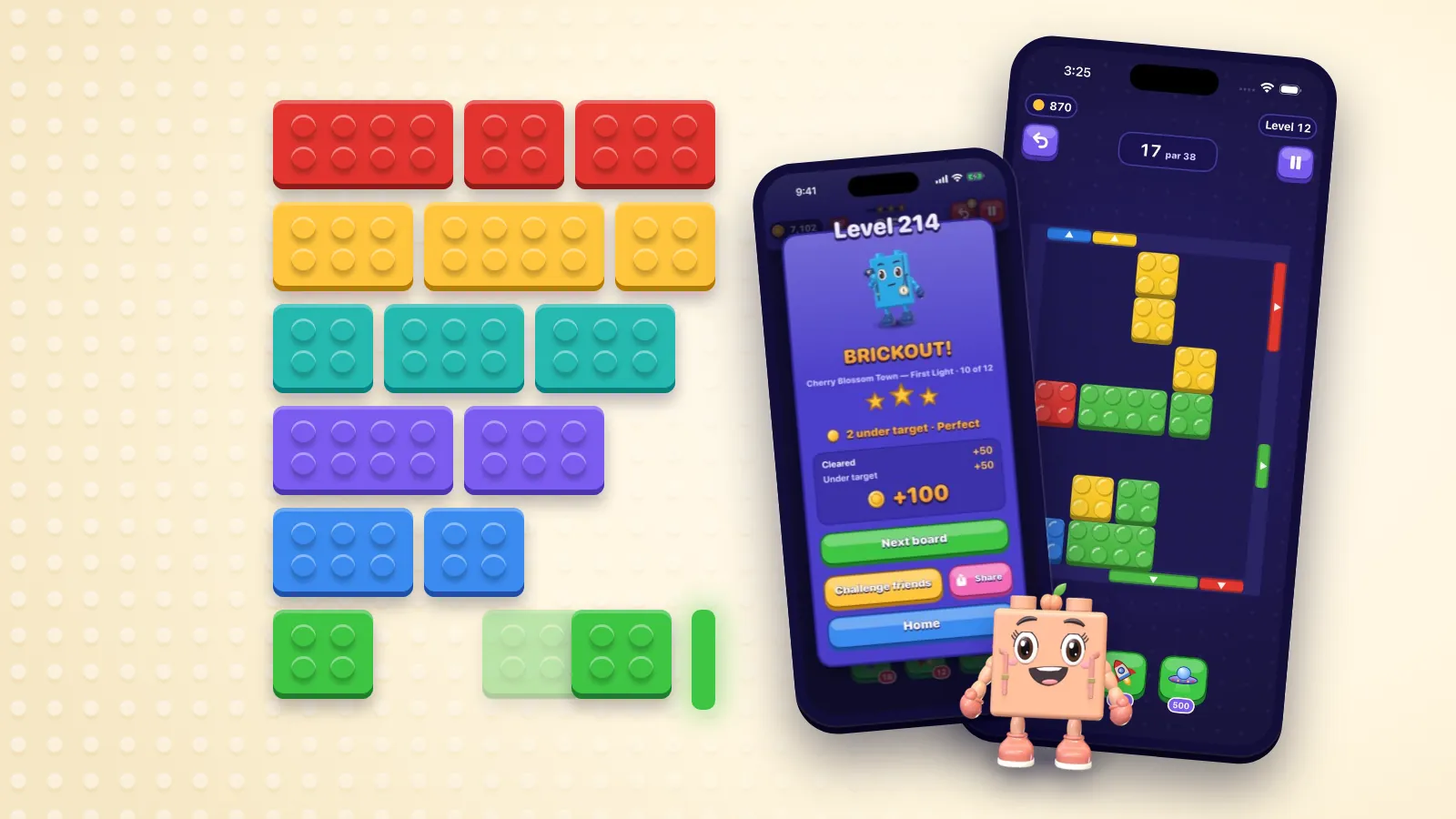
On iPhone and iPad, an OutBrick board’s stars follow its score, and every move left when the goals are met becomes a blaster for a bigger score, so a clear in fewer moves tends to earn more stars. The goals and the move limit are shown from the first tap, and there is never a clock, so the planning time is yours. The limit is the ceiling for the attempt, and when the moves run out you are offered five more before the attempt ends. On the classic boards the browser demo still plays, one star is a clear, two stars is a clear inside the move target, and three stars is a clear inside the target with no undo.
That design separates the two modes. The first undo on every board is free, so when you want the clear you can explore as much as you like; why undo makes you a better solver explains why that is worth doing. On the classic boards, three stars asks you to do the exploring in your head instead. On a new board that is genuinely hard, it is fine to settle for the clear. The planning habit will pay off on the next one.
To practise the planning side, try the browser board with a rule of your own: no move until you can say where the next three will leave every brick you touch.
Filed under
Questions, answered
A few useful answers
How do you get three stars in OutBrick?
On iPhone and iPad the stars follow the board’s score, and every move left when the goals are met becomes a blaster for a bigger score, so finish in as few moves as you can. On the classic boards of the browser demo, three stars is a clear inside the move target without undo, one star is any clear and two stars is a clear inside the target.
How can I solve puzzles in fewer moves?
Plan before you move, prefer one long slide to two short ones, and ask what each move closes off as well as what it opens. Most wasted moves come from taking the first move that makes progress.
What is satisficing?
Satisficing, a term coined by Herbert Simon, means choosing the first option that is good enough rather than searching for the best one. It is usually sensible, but a move target asks you to optimise instead.
Do better players plan more moves ahead?
Yes, according to a 2023 study of a complex board game, which found robust evidence that planning depth increases with expertise in both lab and large-scale mobile data.
APA 7
References
Where a source is a studio’s own history or a news account rather than a study, the article says so beside the claim.
- Simon, H. A. (1956). Rational choice and the structure of the environment. Psychological Review, 63(2), 129–138. doi.org/10.1037/h0042769 (opens in a new tab)
- Schwartz, B., Ward, A., Monterosso, J., Lyubomirsky, S., White, K., & Lehman, D. R. (2002). Maximizing versus satisficing: Happiness is a matter of choice. Journal of Personality and Social Psychology, 83(5), 1178–1197. doi.org/10.1037/0022-3514.83.5.1178 (opens in a new tab)
- Delaney, P. F., Ericsson, K. A., & Knowles, M. E. (2004). Immediate and sustained effects of planning in a problem-solving task. Journal of Experimental Psychology: Learning, Memory, and Cognition, 30(6), 1219–1234. doi.org/10.1037/0278-7393.30.6.1219 (opens in a new tab)
- van Opheusden, B., Kuperwajs, I., Galbiati, G., Bnaya, Z., Li, Y., & Ma, W. J. (2023). Expertise increases planning depth in human gameplay. Nature, 618(7967), 1000–1005. doi.org/10.1038/s41586-023-06124-2 (opens in a new tab)
- Huys, Q. J. M., Eshel, N., O’Nions, E., Sheridan, L., Dayan, P., & Roiser, J. P. (2012). Bonsai trees in your head: How the Pavlovian system sculpts goal-directed choices by pruning decision trees. PLoS Computational Biology, 8(3), e1002410. doi.org/10.1371/journal.pcbi.1002410 (opens in a new tab)