Why crosswords, jigsaws and sliding puzzles endure
Puzzles have outlasted every craze around them. What research on crossword solvers, jigsaw puzzlers and the aha moment says about why they stay with us.
Most entertainment crazes burn out. Puzzles have a strange habit of not doing so. The jigsaw began in the eighteenth century as a way of teaching geography and is still sold by the million. The crossword appeared in a New York newspaper just before the First World War, was mocked as a passing fad in the 1920s and now runs in papers and apps around the world. Sliding-block puzzles swept the United States in 1880 and are still being redesigned. Each of these forms has changed its materials many times while keeping the same basic pleasure. Research on the people who solve them helps explain what that pleasure is.
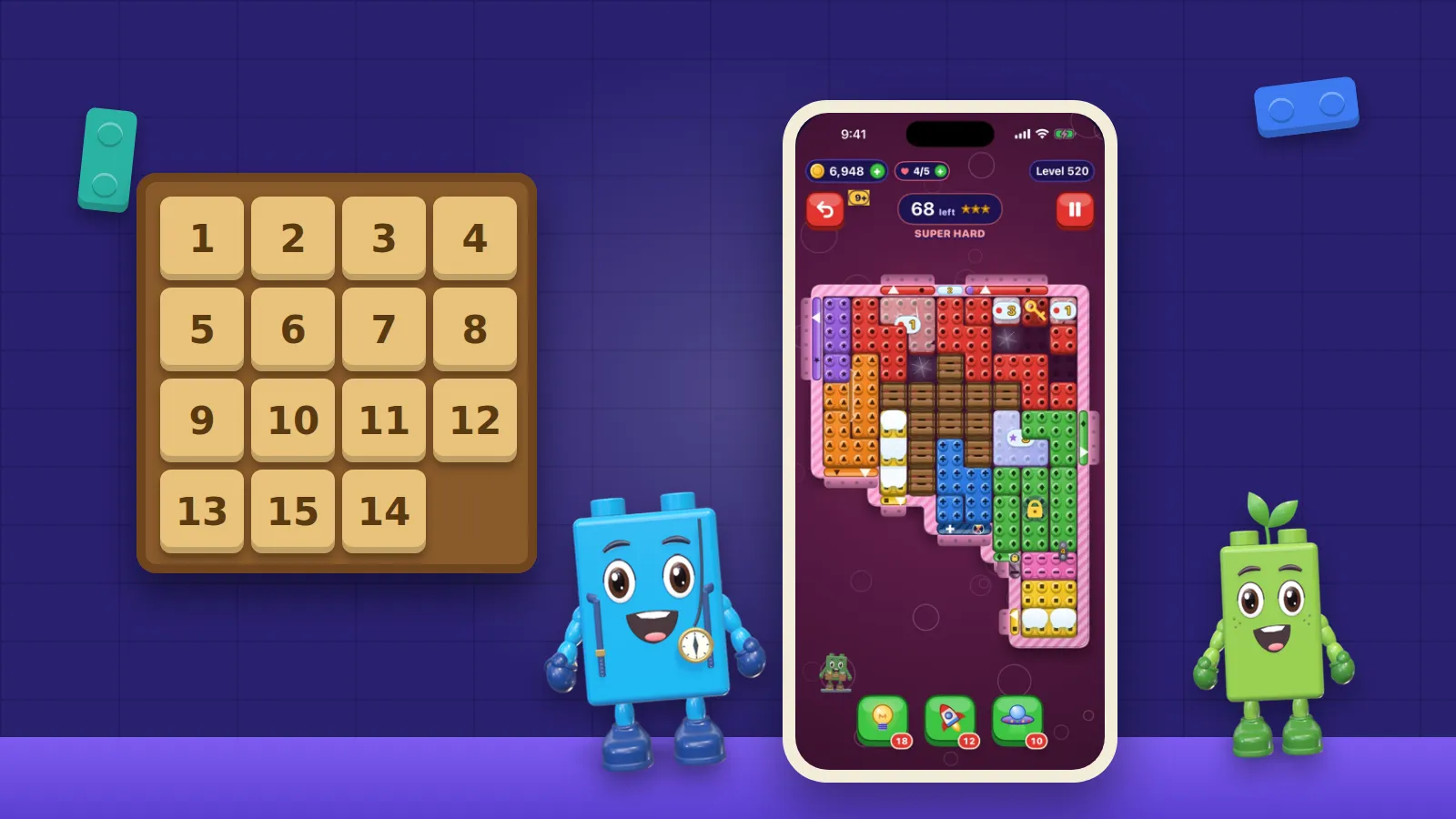
Jigsaws are usually traced to London in the 1760s, when mapmakers mounted maps on wood and cut them along borders so children could learn geography by reassembling them. The crossword is generally credited to Arthur Wynne, whose “word-cross” ran in the New York World in December 1913; within a decade crossword books were bestsellers. Sliding-block puzzles had their own craze in 1880 with the 15 Puzzle, a story we tell in full in the history of sliding block puzzles.
Each also survived a moment when it looked like a fad. The crossword boom of the mid-1920s drew newspaper editorials complaining about time wasted and dictionaries worn out, and the 15 Puzzle craze of 1880 faded within months. Yet in each case, what remained after the craze was a steady, lasting habit. The fad passed; the puzzle stayed.
What is striking is how differently the three work. A crossword tests what you know and how quickly you can find it. A jigsaw tests what you can see. A sliding-block puzzle tests how far ahead you can plan in a cramped space. That variety is part of why puzzles as a whole endure: there is a form for almost every kind of mind, and people often discover which one is theirs.
David Hambrick, Timothy Salthouse and Elizabeth Meinz ran four studies, each with about 200 adults aged 18 to 80, to find out what makes someone good at American-style crosswords. The strongest predictor by far was general knowledge. Abstract reasoning, surprisingly, had no direct link to puzzle skill. They also found no sign that years of crossword experience slowed age-related decline in fluid thinking.
British cryptic crosswords are a different animal. Kathryn Friedlander and Philip Fine describe them as code-cracking: every clue has a misleading surface reading and a hidden set of grammatical instructions that lead to one answer. Their survey of cryptic solvers pointed to skills well beyond vocabulary, including pattern-matching, quasi-algebraic thinking and the ability to break out of a frame. It is one reason cryptic solvers talk about their hobby with such devotion: it is a craft that can be learnt over a lifetime.
Sources1Hambrick, D. Z., Salthouse, T. A., & Meinz, E. J. (1999). Predictors of crossword puzzle proficiency and moderators of age–cognition relations. Journal of Experimental Psychology: General, 128(2), 131–164.2Friedlander, K. J., & Fine, P. A. (2016). The grounded expertise components approach in the novel area of cryptic crossword solving. Frontiers in Psychology, 7, 567.
For a pastime so common, the jigsaw was barely studied until Patrick Fissler and colleagues tested 100 adults over 50. Skill at an untrained 40-piece jigsaw was strongly associated with a whole range of visual and spatial abilities, from perception and mental rotation to working memory and reasoning. People who had done more jigsaws over their lives had better visuospatial thinking.
The same study then randomly assigned half the group to puzzle for at least an hour a day for 30 days. They got better at jigsaws, but their broader visuospatial thinking did not improve compared with the control group. Lifetime experience went with better cognition; a month of intensive puzzling did not change it. That is the honest shape of most puzzle research, and we look at it in detail in are puzzle games good for your brain?
Sources3Fissler, P., Küster, O. C., Laptinskaya, D., Loy, L. S., von Arnim, C. A. F., & Kolassa, I.-T. (2018). Jigsaw puzzling taps multiple cognitive abilities and is a potential protective factor for cognitive aging. Frontiers in Aging Neuroscience, 10, 299.
If puzzles are not medicine, why do people keep doing them? George Loewenstein’s influential account of curiosity offers one answer. He described curiosity as the feeling of an information gap: when we become aware of something we do not know but could, we want to close the gap. A puzzle is a perfectly shaped gap. It tells you there is exactly one answer, that it is within reach, and that you do not have it yet.
Closing the gap can come with a jolt. Sascha Topolinski and Rolf Reber describe the aha experience as sudden, easy, pleasant and accompanied by a strong feeling of being right. Their explanation is fluency: when the answer suddenly clicks, processing it becomes easy all at once, and our minds read that sudden ease as both pleasure and truth. The last jigsaw piece, the crossword clue that suddenly parses, the brick that turns out to unlock the whole board: all deliver the same small jolt.
Sources4Loewenstein, G. (1994). The psychology of curiosity: A review and reinterpretation. Psychological Bulletin, 116(1), 75–98.5Topolinski, S., & Reber, R. (2010). Gaining insight into the “aha” experience. Current Directions in Psychological Science, 19(6), 402–405.
The final reason puzzles endure is social. Crosswords come with a vocabulary, setters with personalities and solvers who talk about them over breakfast. Jigsaws sit half-finished on family tables through the holidays, with everyone adding a piece in passing. Puzzles give people something to do side by side and something to talk about afterwards, which may be the most durable quality of all. We explore that daily, shared side in why a daily puzzle becomes a shared ritual.
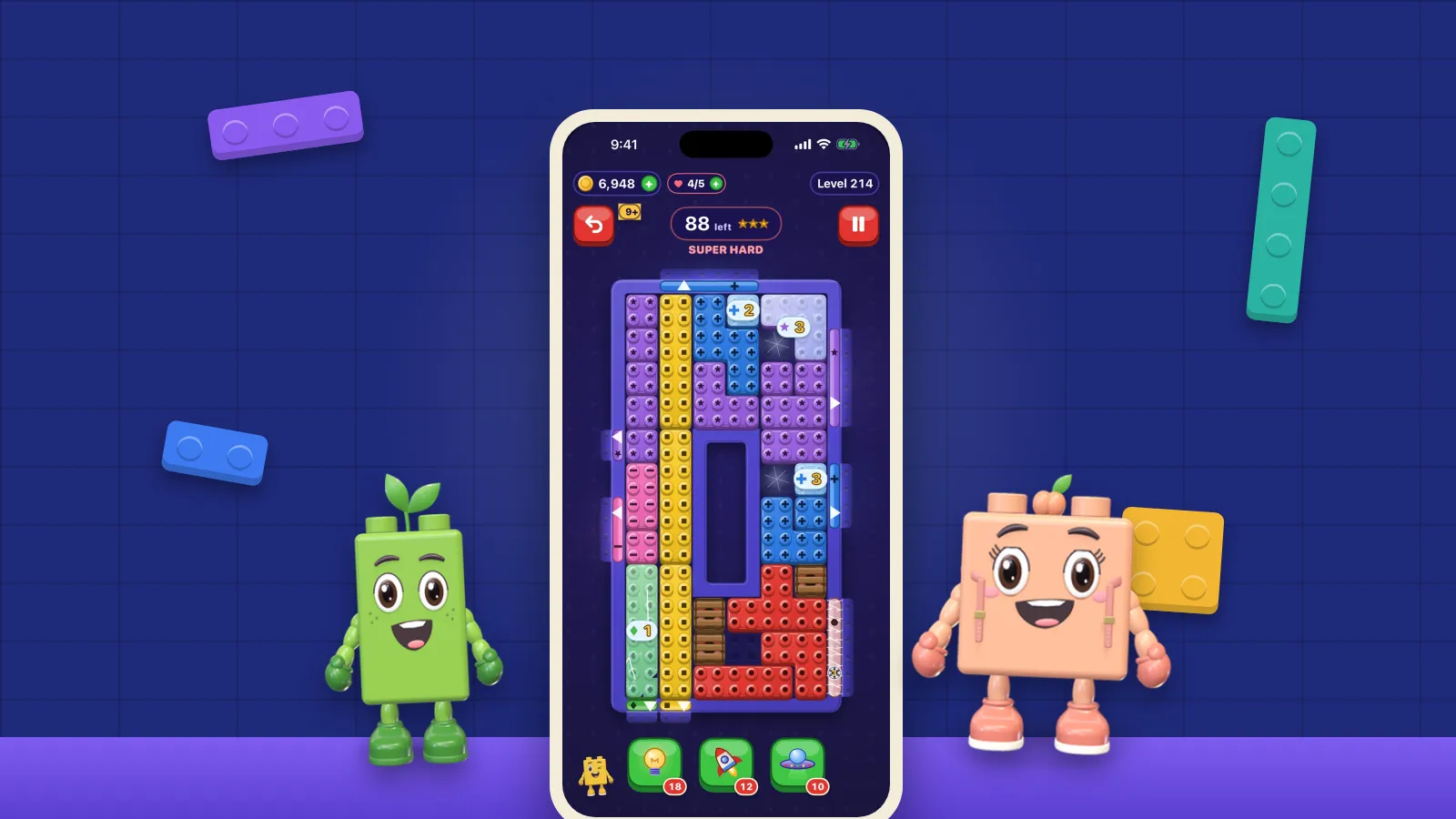
OutBrick is our small addition to one of these old families. Its classic rule, still playable in the browser, is one a Victorian puzzler would recognise: slide a brick until it stops, and send every brick out through the gate of its colour. On iPhone and iPad, bricks now also swap and match in threes. You can try a board in your browser and see which of the old pleasures it brings back for you.
Sources4Loewenstein, G. (1994). The psychology of curiosity: A review and reinterpretation. Psychological Bulletin, 116(1), 75–98.
Filed under
Questions, answered
A few useful answers
Why do people enjoy puzzles?
Psychologists point to curiosity, the urge to close a gap between what we know and what we could know, and to the aha experience, a sudden, pleasant sense of being right when the answer clicks. Puzzles also give people something to share and talk about.
What makes someone good at crosswords?
For American-style crosswords, studies found general knowledge was the strongest predictor of skill, and abstract reasoning had no direct link. Cryptic crosswords draw on further skills such as pattern-matching and seeing past a misleading surface reading.
Are jigsaw puzzles good for the brain?
Jigsaw skill is strongly linked to visual and spatial abilities, and lifelong puzzlers tend to score better on them. In a 30-day trial, however, daily puzzling improved jigsaw skill but not broader thinking, so there is no proof that jigsaws protect cognition.
When were crosswords and jigsaws invented?
Jigsaws are usually traced to dissected wooden maps made in London in the 1760s. The crossword is generally credited to Arthur Wynne, whose word-cross appeared in the New York World in December 1913.
APA 7
References
Where a source is a studio’s own history or a news account rather than a study, the article says so beside the claim.
- Hambrick, D. Z., Salthouse, T. A., & Meinz, E. J. (1999). Predictors of crossword puzzle proficiency and moderators of age–cognition relations. Journal of Experimental Psychology: General, 128(2), 131–164. doi.org/10.1037/0096-3445.128.2.131 (opens in a new tab)
- Friedlander, K. J., & Fine, P. A. (2016). The grounded expertise components approach in the novel area of cryptic crossword solving. Frontiers in Psychology, 7, 567. doi.org/10.3389/fpsyg.2016.00567 (opens in a new tab)
- Fissler, P., Küster, O. C., Laptinskaya, D., Loy, L. S., von Arnim, C. A. F., & Kolassa, I.-T. (2018). Jigsaw puzzling taps multiple cognitive abilities and is a potential protective factor for cognitive aging. Frontiers in Aging Neuroscience, 10, 299. doi.org/10.3389/fnagi.2018.00299 (opens in a new tab)
- Loewenstein, G. (1994). The psychology of curiosity: A review and reinterpretation. Psychological Bulletin, 116(1), 75–98. doi.org/10.1037/0033-2909.116.1.75 (opens in a new tab)
- Topolinski, S., & Reber, R. (2010). Gaining insight into the “aha” experience. Current Directions in Psychological Science, 19(6), 402–405. doi.org/10.1177/0963721410388803 (opens in a new tab)