Games like Tetris: what makes a block puzzle last
Simple rules, a board you can read, fair difficulty and a short loop: what makes block puzzles endure, and how to judge any game like Tetris.
Search for games like Tetris and you will find hundreds of block puzzles: pieces that fall, pieces that slide, pieces you drop onto a grid, pieces you sort by colour. Most are forgotten within a week of being installed. A few get played for years. We make one of them, OutBrick, a slide-and-match brick puzzle, so we are not neutral, and we will not rank anybody else’s game. What we can do is set out the design qualities that help a block puzzle last, with Tetris as the reference point, so you can judge any game in the genre for yourself.
The Tetris Company’s history dates the first version to 1984, when Alexey Pajitnov built it on an Electronika 60 computer in Moscow. From there it went through a long tangle of rights negotiations and on to Nintendo’s Game Boy, which shipped with Tetris included. The history is told by the rights-holder, so any sales figures in it are the company’s own, but the outline is well established. We have looked at how Tetris’s small ruleset keeps opening up in an earlier piece.
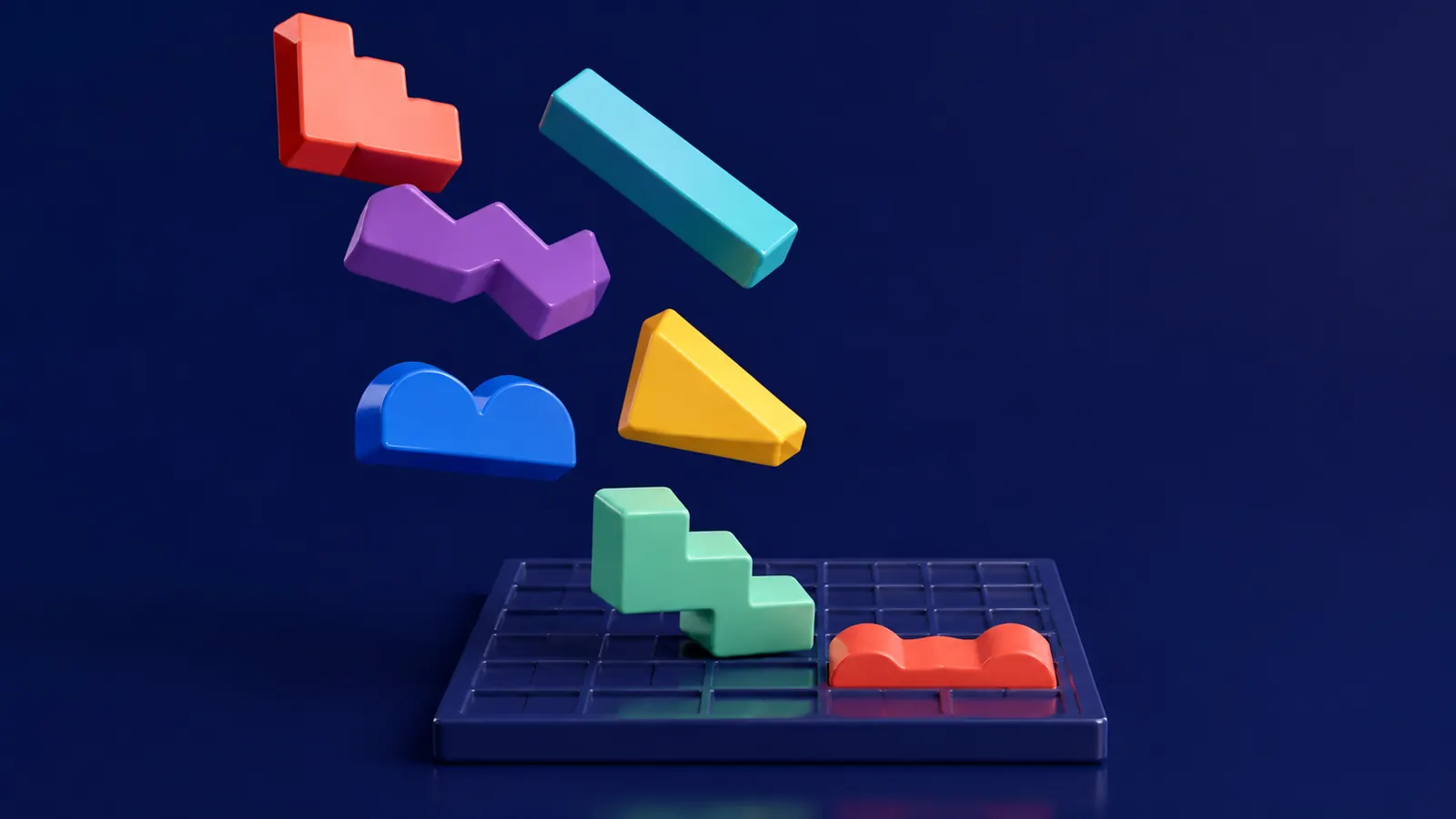
What Tetris set up is a family more than a formula: pieces made of square cells, a grid that fills, and a rule that clears space when you complete a pattern. Games like Tetris vary almost every part of that. Some drop pieces under gravity, some let you place them anywhere on a grid, and some give you fixed pieces to slide around a crowded board and out through an exit. The ones that last share a handful of qualities that have little to do with which variant they picked.
Sources1The Tetris Company. (n.d.). The history of Tetris. Retrieved September 4, 2026, from https://tetris.com/news/the-history-of-tetris
Tetris can be explained in one sentence: fit the falling pieces together so that rows fill and clear. Nearly every lasting block puzzle has a rule of that size, and its depth comes from the situations the rule creates. When a game needs a tutorial chapter before the first real level, it is usually because the rules are carrying weight that the board ought to carry.
Small rules also resist brute force, which is part of why they stay interesting. Breukelaar and colleagues proved that even the offline version of Tetris, where you know every piece in advance, is NP-complete for goals such as clearing the most rows. Sliding-block puzzles are harder still in the formal sense: Hearn and Demaine showed the general case is PSPACE-complete. For players, that means no known shortcut solves every board, so each board is a fresh problem.
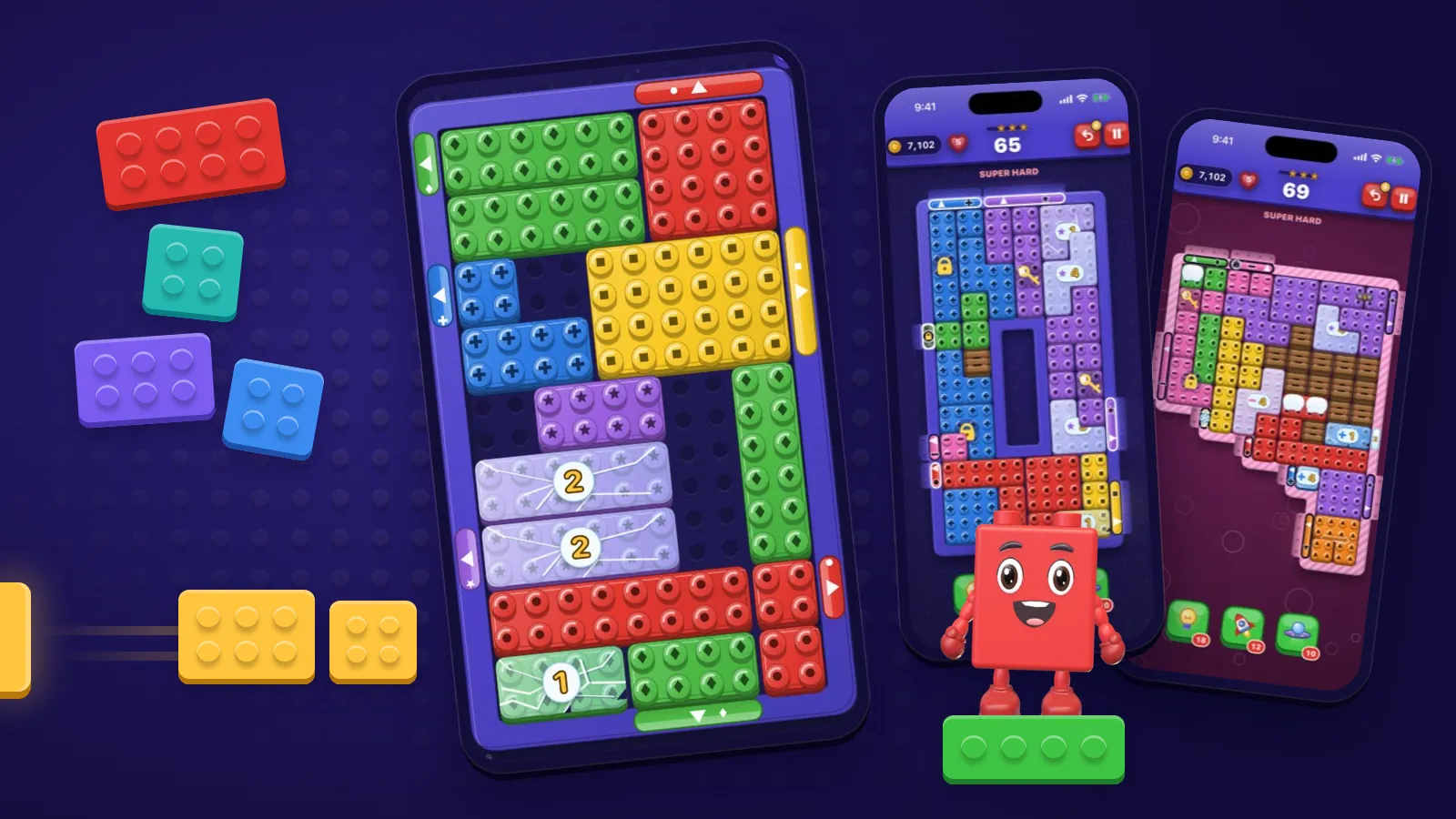
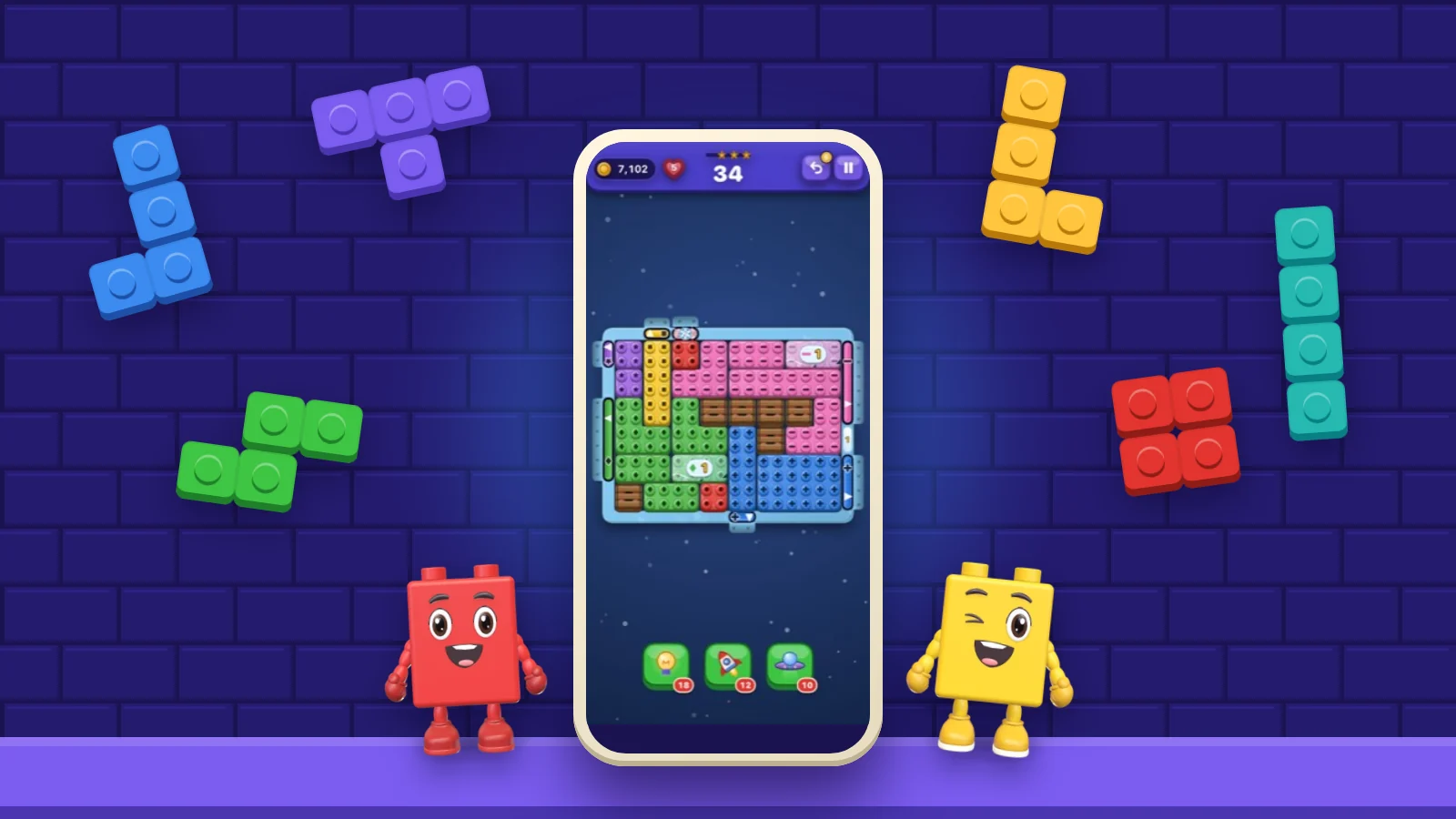
OutBrick’s rule is the same size. Slide a brick home through the gate of its colour, or swap it with a neighbour so three of a colour line up and clear. New pieces arrive over a long game, including crates, ice, locks, moss, statues and counted gates, but each one is a new angle on the same rule rather than a new rule to learn.
Sources2Breukelaar, R., Demaine, E. D., Hohenberger, S., Hoogeboom, H. J., Kosters, W. A., & Liben-Nowell, D. (2004). Tetris is hard, even to approximate. International Journal of Computational Geometry & Applications, 14(1–2), 41–68.3Hearn, R. A., & Demaine, E. D. (2005). PSPACE-completeness of sliding-block puzzles and other problems through the nondeterministic constraint logic model of computation. Theoretical Computer Science, 343(1–2), 72–96.
Look at a game of Tetris at any moment and the whole state is in front of you: the stack, the gaps, the current piece and the next one. Nothing important is hidden. That readability is what lets a player plan, and planning is what makes a puzzle feel like thinking rather than luck.
Research on Tetris players shows how much of the skill lives in looking. Kirsh and Maglio watched people play and found they often rotated and shifted pieces to see their options faster, rather than to move them closer to where they would land. They called these epistemic actions: moves made to make thinking easier rather than to change the position. Lindstedt and Gray measured 39 features of play for 240 players, each playing Tetris for an hour, and found that experts stood apart through an integrated mix of perception, decision-making and action, which they called the Mind’s Hand and the Mind’s Eye.
For a block puzzle designer the lesson is to make the state easy to take in and to make trying things cheap. Clear colours backed by shape, pieces that look like what they do, and an undo that invites experiment all help. In OutBrick, colour-blind mode is on by default and stamps a glyph on every brick and gate, and the first undo on every board is free.
Sources4Kirsh, D., & Maglio, P. (1994). On distinguishing epistemic from pragmatic action. Cognitive Science, 18(4), 513–549.5Lindstedt, J. K., & Gray, W. D. (2019). Distinguishing experts from novices by the Mind’s Hand and Mind’s Eye. Cognitive Psychology, 109, 1–25.
Tetris gets harder by getting faster. That works because the rules never change: the player loses to their own placements under pressure, and can see exactly where the stack went wrong. Fair difficulty means that when you lose, you can see why. Unfair difficulty is a board that could never have been cleared, a twist the player had no way to see coming, or a rule revealed only after it has cost them.
Speed is one kind of pressure, and there are others. A sliding or placing puzzle can ask for efficiency instead of reflexes, with a move limit in place of a clock. That trades the rush of Tetris at high levels for time to think, which suits a different mood and often a different player. Both are fair when the limit is visible before you start.
Fairness also depends on every board being possible. A puzzle, whether made by hand or generated, should be checked before a player sees it. OutBrick’s 2,000 boards were each cleared by a solver before they shipped, and every board shows its goals and its move limit from the first tap. Difficulty should then rise in steps the player can feel, with new ideas introduced one at a time; our piece on a kinder difficulty curve goes into how.
The smallest unit of Tetris is one piece, a few seconds of decision. The next unit up is one game, which can be short or long depending on skill. That nesting is a large part of why it has lasted. You can play a single game while the kettle boils, and the same game can hold your attention for an hour.
Lasting block puzzles tend to keep a short unit at their core. A single board or round should be finishable in a few minutes, have a clear end, and cost nothing to stop after. Streaks, daily goals and events can sit around that core, but once they start dictating how long you play, the game has swapped its loop for a schedule. An OutBrick board takes about two minutes and clearing one costs nothing, which is the scale we think the genre works best at. There is more on that in why two-minute puzzles feel good.
Whichever kind of block puzzle you prefer, these are the questions worth asking in the first ten minutes with a new one. If sliding puzzles are new to you, how to solve sliding block puzzles is a good place to start.
- Could you explain the rule to a friend in one sentence?
- Can you see everything that matters on the board at once?
- When you lose, can you point to the move that did it?
- Is every level known to be solvable, and are the limits shown up front?
- Can you finish one round in a few minutes and stop without losing anything?
- Do new mechanics arrive one at a time, as variations on the same rule?
Filed under
Questions, answered
A few useful answers
What kinds of games are like Tetris?
Tetris belongs to a large family of block puzzles: falling-block games, grid games where you place pieces onto a board, and sliding-block puzzles where fixed pieces move around a crowded board. OutBrick is a slide-and-match brick puzzle. Rather than trusting a ranking, try the checklist in this article on any game you are considering.
What is the difference between falling and sliding block puzzles?
In a falling-block game, new pieces keep arriving and the pressure usually comes from speed. In a sliding-block puzzle, the pieces are usually all on the board from the start and the challenge is finding the order of moves that clears it, often within a move limit.
Why has Tetris lasted so long?
A rule you can learn in seconds, a board whose whole state is visible, difficulty that comes from speed rather than hidden rules, and a round short enough for a spare few minutes. The Tetris Company dates the first version to 1984.
Is OutBrick like Tetris?
It shares the family traits: bricks made of square cells, a small rule and short rounds. The difference is that you slide and swap OutBrick’s bricks rather than steer falling ones, there is no clock, and each board has a move limit instead.
APA 7
References
Where a source is a studio’s own history or a news account rather than a study, the article says so beside the claim.
- The Tetris Company. (n.d.). The history of Tetris. Retrieved September 4, 2026, from https://tetris.com/news/the-history-of-tetris tetris.com/news/the-history-of-tetris (opens in a new tab)
- Breukelaar, R., Demaine, E. D., Hohenberger, S., Hoogeboom, H. J., Kosters, W. A., & Liben-Nowell, D. (2004). Tetris is hard, even to approximate. International Journal of Computational Geometry & Applications, 14(1–2), 41–68. doi.org/10.1142/S0218195904001354 (opens in a new tab)
- Hearn, R. A., & Demaine, E. D. (2005). PSPACE-completeness of sliding-block puzzles and other problems through the nondeterministic constraint logic model of computation. Theoretical Computer Science, 343(1–2), 72–96. doi.org/10.1016/j.tcs.2005.05.008 (opens in a new tab)
- Kirsh, D., & Maglio, P. (1994). On distinguishing epistemic from pragmatic action. Cognitive Science, 18(4), 513–549. doi.org/10.1207/s15516709cog1804_1 (opens in a new tab)
- Lindstedt, J. K., & Gray, W. D. (2019). Distinguishing experts from novices by the Mind’s Hand and Mind’s Eye. Cognitive Psychology, 109, 1–25. doi.org/10.1016/j.cogpsych.2018.11.003 (opens in a new tab)