Playing games with your grandchildren: why it is worth it
Research on intergenerational play finds real benefits for both generations when the game is chosen well. What the studies show, and how to make it work.
Grandparents are often told that their grandchildren’s games are a wall between them: noisy, fast, incomprehensible and best left alone. The research on playing together suggests the opposite. When the game is chosen well, shared play is one of the easier ways for two generations to spend time as equals, with the child as often the teacher as the pupil. Here is what the studies have found, what tends to go wrong, and how to pick and play games that work across a sixty-year gap.
De la Hera and colleagues systematically reviewed empirical studies of intergenerational digital games, sixteen in all, with older players aged 55 to 81 and younger players aged 4 to 22. The benefits they found fell into four groups: stronger family bonds, learning that ran in both directions, a better understanding of the other generation, and reduced social anxiety. An earlier review by Costa and Veloso, covering 36 papers published between 2006 and 2014, reached similar conclusions and set out design recommendations for games meant to bring generations together.
One of the better-controlled studies came from Singapore. Chua and colleagues paired young people and older adults for regular sessions over two months, some playing video games together and some doing other activities. The pairs who played games reported larger improvements in their attitudes towards the other generation and less anxiety about mixing with them. The samples in this field are small and most studies are short, so the size of the effect should not be overstated. The direction is consistent, though.
Sources1De la Hera, T., Loos, E., Simons, M., & Blom, J. (2017). Benefits and factors influencing the design of intergenerational digital games: A systematic literature review. Societies, 7(3), 18.2Costa, L., & Veloso, A. (2016). Being (grand) players: Review of digital games and their potential to enhance intergenerational interactions. Journal of Intergenerational Relationships, 14(1), 43–59.3Chua, P.-H., Jung, Y., Lwin, M. O., & Theng, Y.-L. (2013). Let’s play together: Effects of video-game play on intergenerational perceptions among youth and elderly participants. Computers in Human Behavior, 29(6), 2303–2311.
Osmanovic and Pecchioni interviewed older adults and the younger relatives they played with. Both sides said the games were a way of spending time together and of staying connected, and both described the positive emotions of play itself. For many older players the game was less the point than the company. Voida and Greenberg, observing families and groups playing console games together, described games as a meeting place where people of very different ages and abilities could take on different roles: player, coach, spectator, commentator.
That flexibility of role is important. Siyahhan, Barab and Downton, studying parents and children playing an online quest game together, found that the nature of the shared play varied a great deal from pair to pair, with some parents leading, some following and some working side by side, and that it had positive outcomes across those styles. There is no right way to play together. There is only finding a way that suits the two of you.
The learning in these studies also runs both ways, which De la Hera and colleagues single out as one of the main benefits. Children teach the controls, the shortcuts and the conventions of the game. Grandparents often bring patience, a feel for strategy and the habit of thinking a move through before making it. In a puzzle, those are exactly the qualities that win, which quietly evens the contest. Plenty of grandparents find that a shared game gives them something to talk about with a grandchild who otherwise answers questions in single words.
Sources4Osmanovic, S., & Pecchioni, L. (2016). Beyond entertainment: Motivations and outcomes of video game playing by older adults and their younger family members. Games and Culture, 11(1–2), 130–149.5Voida, A., & Greenberg, S. (2009). Wii all play: The console game as a computational meeting place. In Proceedings of the SIGCHI Conference on Human Factors in Computing Systems (pp. 1559–1568). ACM.6Siyahhan, S., Barab, S. A., & Downton, M. P. (2010). Using activity theory to understand intergenerational play: The case of Family Quest. International Journal of Computer-Supported Collaborative Learning, 5(4), 415–432.1De la Hera, T., Loos, E., Simons, M., & Blom, J. (2017). Benefits and factors influencing the design of intergenerational digital games: A systematic literature review. Societies, 7(3), 18.
The reviews agree on the main difficulty: a difference in abilities. Children are often faster and more practised with touchscreens and game conventions; grandparents may have more patience and better strategic sense but slower reactions and different eyesight. Games that reward speed put the older player permanently behind, which is no fun for either. Games with dense text or tiny controls exclude the youngest and sometimes the oldest.
The other difficulty is motivation. De la Hera and colleagues note that the two generations often want different things from a game, and the games that work best give each something to enjoy. A child might love collecting and exploring; a grandparent might prefer a clear goal and a quiet puzzle. The best shared games have room for both.
Sources1De la Hera, T., Loos, E., Simons, M., & Blom, J. (2017). Benefits and factors influencing the design of intergenerational digital games: A systematic literature review. Societies, 7(3), 18.
Look for games where turns take as long as they need to. A move limit is fine; a clock is not. Look for games you can pass back and forth on one device, so you are sitting side by side rather than playing on separate screens. And look for games with a gentle start, so the less experienced player can find their feet without being embarrassed. Our checklist for puzzle games for older adults covers readability and settings in more detail.
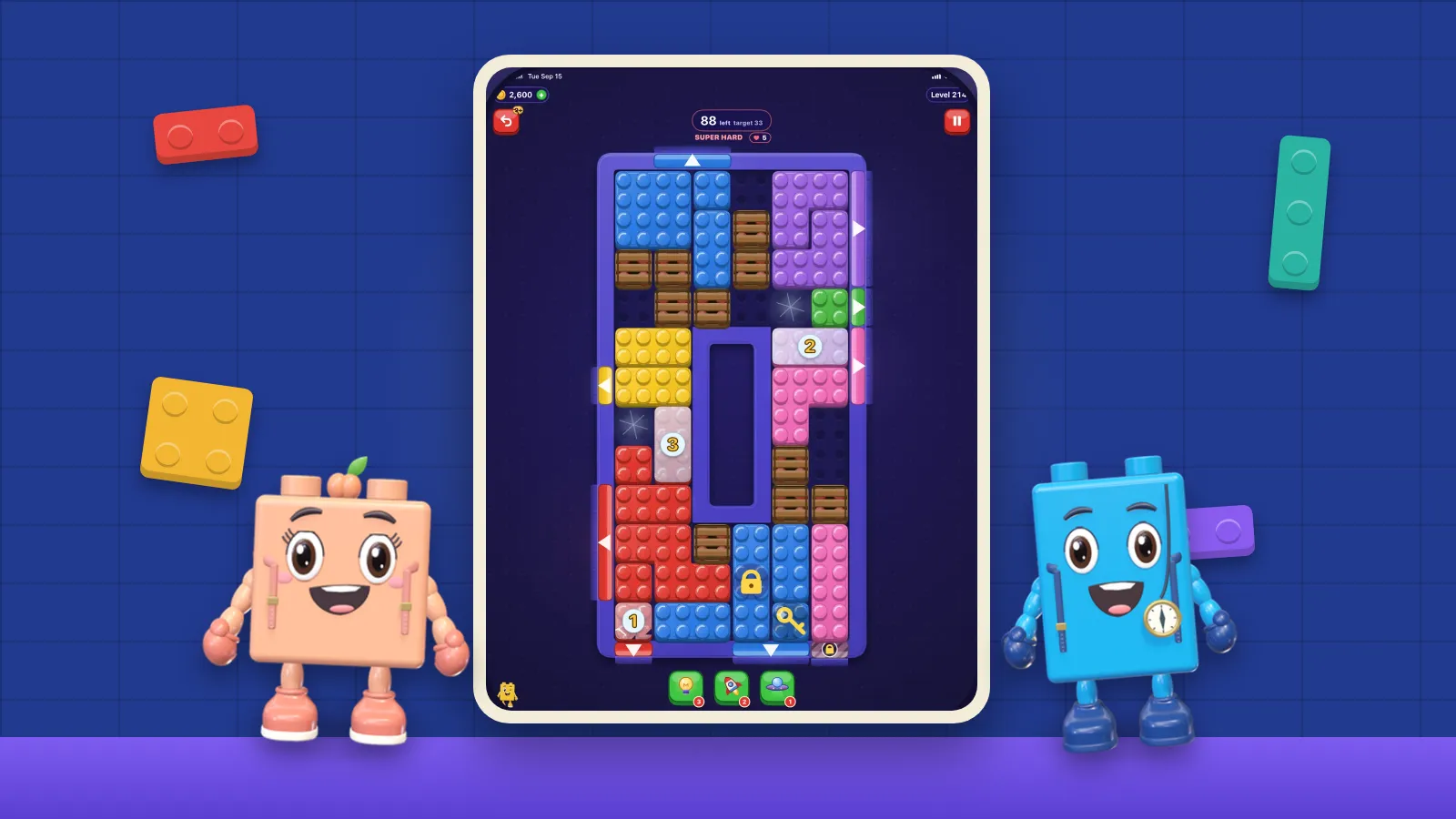
A daily puzzle makes a good shared ritual, especially at a distance. OutBrick puts a daily board on its website that anyone can play in a browser, so a grandparent and grandchild can both try the same board and compare how they did on the phone that evening. In the game itself, each board has a move limit but never a clock, the first undo is free, and colour-blind glyphs are on by default, which helps if one of you finds some colours hard to tell apart.
Think about the setting as well as the game. A tablet on a table between you is easier for older eyes than a phone held in a child’s hand, and it makes turn-taking natural. Check that the text is large enough for the grandparent and that the sound is low enough for conversation. If either of you has particular needs, such as colour vision, hearing or a tremor, a few minutes in the settings first will save frustration later. Our piece on colour blindness in games explains one of the most common.
The research suggests that the value of shared play lies in the relationship around it more than in the game itself. A few habits help, and they apply whether you are playing on the sofa or over a video call. For the social side of games more broadly, Animal Crossing and shared time is a good companion piece.
- Let the child teach you the game, and be a willing pupil. Children rarely get to be the expert.
- Take turns on one device and talk through each move, rather than racing on two.
- Share what you notice: strategies, patterns, a good idea you had three moves ago.
- Keep sessions short and stop on a good note, so next time is something to look forward to.
- Agree together on how long to play before you start, so stopping is not a battle.
Sources6Siyahhan, S., Barab, S. A., & Downton, M. P. (2010). Using activity theory to understand intergenerational play: The case of Family Quest. International Journal of Computer-Supported Collaborative Learning, 5(4), 415–432.4Osmanovic, S., & Pecchioni, L. (2016). Beyond entertainment: Motivations and outcomes of video game playing by older adults and their younger family members. Games and Culture, 11(1–2), 130–149.
Filed under
Questions, answered
A few useful answers
Is playing video games with grandchildren good for grandparents?
Studies of intergenerational play report stronger family bonds, learning in both directions and more positive attitudes between generations. The studies are mostly small and short, but their findings point the same way.
What kind of games are best for grandparents and grandchildren?
Turn-based games with no clock, simple controls and a gentle start work best, because they even out differences in speed and experience. Games you can pass back and forth on one device encourage talking and teaching.
How can grandparents play games with grandchildren who live far away?
Share a daily puzzle that you both play and compare results, or play together over a video call, taking turns and talking through moves. OutBrick’s daily board can be played in any browser.
APA 7
References
Where a source is a studio’s own history or a news account rather than a study, the article says so beside the claim.
- De la Hera, T., Loos, E., Simons, M., & Blom, J. (2017). Benefits and factors influencing the design of intergenerational digital games: A systematic literature review. Societies, 7(3), 18. doi.org/10.3390/soc7030018 (opens in a new tab)
- Costa, L., & Veloso, A. (2016). Being (grand) players: Review of digital games and their potential to enhance intergenerational interactions. Journal of Intergenerational Relationships, 14(1), 43–59. doi.org/10.1080/15350770.2016.1138273 (opens in a new tab)
- Chua, P.-H., Jung, Y., Lwin, M. O., & Theng, Y.-L. (2013). Let’s play together: Effects of video-game play on intergenerational perceptions among youth and elderly participants. Computers in Human Behavior, 29(6), 2303–2311. doi.org/10.1016/j.chb.2013.04.037 (opens in a new tab)
- Osmanovic, S., & Pecchioni, L. (2016). Beyond entertainment: Motivations and outcomes of video game playing by older adults and their younger family members. Games and Culture, 11(1–2), 130–149. doi.org/10.1177/1555412015602819 (opens in a new tab)
- Voida, A., & Greenberg, S. (2009). Wii all play: The console game as a computational meeting place. In Proceedings of the SIGCHI Conference on Human Factors in Computing Systems (pp. 1559–1568). ACM. doi.org/10.1145/1518701.1518940 (opens in a new tab)
- Siyahhan, S., Barab, S. A., & Downton, M. P. (2010). Using activity theory to understand intergenerational play: The case of Family Quest. International Journal of Computer-Supported Collaborative Learning, 5(4), 415–432. doi.org/10.1007/s11412-010-9097-1 (opens in a new tab)