Colour blindness in games: how common it is and what helps
About one man in twelve of European descent has red–green colour deficiency. What that means at the controls, and the settings and design choices that help.
In any room of twenty-five men of European descent, two are likely to see red and green differently from everyone else. Most games are still designed as if they were not there. This is a guide to what colour vision deficiency actually is, how often it turns up, what it does to a player at the controls, and what helps, both the settings you can switch on today and the design choices that make them unnecessary.
Jennifer Birch’s 2012 review of large random population surveys is the figure most researchers reach for. In European Caucasian populations, about 8% of men and about 0.4% of women have an inherited red–green colour deficiency. Among men of Chinese and Japanese ethnicity the rate is lower, between 4% and 6.5%, and Birch notes that recent surveys suggest the figure is rising in men of African ethnicity and in regions settled by migrants. She puts the differences down to founder effects and genetic drift rather than natural selection.
The gap between men and women has a simple cause. As Simunovic explains in his review in Eye, the common forms are inherited on the X chromosome in a recessive pattern, so a man needs one affected copy and a woman needs two. That is also why a mother with normal colour vision can pass it to her son. For a game played by millions of people, those percentages add up to a very large number of players who meet a colour-coded interface on different terms.
Sources1Birch, J. (2012). Worldwide prevalence of red-green color deficiency. Journal of the Optical Society of America A, 29(3), 313–320.2Simunovic, M. P. (2010). Colour vision deficiency. Eye, 24(5), 747–755.
The popular picture of colour blindness, a world in black and white, describes a very rare condition. Most people with colour vision deficiency are anomalous trichromats: they have all three kinds of cone, but one responds differently, so some colours that look distinct to others look alike to them. Dichromats, who lack one cone type, have a narrower range again. Reds, greens, browns and oranges are the classic confusions in the common red–green forms; blue–yellow deficiency exists but is far rarer.
Barry Cole’s long review of the practical handicap is the most useful account of what this means day to day. Nearly everyone with abnormal colour vision, apart from some mildly affected people, reports problems with colour in everyday life. They struggle when colour is used as a code, they can be unreliable when a colour name is used as an identifier, and they are slower and less successful at visual search when colour is what marks the target. Read that last finding with a game in mind: “find the red one” is exactly the kind of task many puzzles set.
It also explains why the people around a colour-blind player so often underestimate the problem. Flatla and Gutwin built simulations based on each person’s own measured colour perception rather than a generic model, then asked pairs of friends or relatives to talk through everyday images seen through that simulation. The personalised versions were more accurate than the standard models, and the conversations turned up details of the person’s experience their companions had never understood.
Sources2Simunovic, M. P. (2010). Colour vision deficiency. Eye, 24(5), 747–755.3Cole, B. L. (2004). The handicap of abnormal colour vision. Clinical and Experimental Optometry, 87(4–5), 258–275.4Flatla, D. R., & Gutwin, C. (2012). “So that’s what you see”: Building understanding with personalized simulations of colour vision deficiency. In Proceedings of the 14th International ACM SIGACCESS Conference on Computers and Accessibility (pp. 167–174). ACM.
Some patterns turn up again and again. Health bars that shift from green to red. Team colours that are red and green. Map markers, rarity tiers and loot drops sorted only by hue. Match and sort puzzles whose pieces differ in nothing but colour. And, less obviously, “correct” and “wrong” feedback that flashes green or red with no icon, sound or movement to back it up.
The fix most games reach for is a filter: a menu that shifts the whole palette for protanopia, deuteranopia or tritanopia. Filters help some players, but they have limits. They assume everyone with one label sees the same way, which Flatla and Gutwin’s work shows is not the case, and they can make the rest of the game look strange. A better approach is to make colour one signal among several, so no filter is needed. We made the general case for that in why colour should never be the only clue in a puzzle; the research on patterns shows how to do it well.
Sources4Flatla, D. R., & Gutwin, C. (2012). “So that’s what you see”: Building understanding with personalized simulations of colour vision deficiency. In Proceedings of the 14th International ACM SIGACCESS Conference on Computers and Accessibility (pp. 167–174). ACM.
Geddes, Flatla, Tigwell and Peiris tested colour patterns, overlays that encode a colour as a shape or texture, in an online study with people with colour vision deficiency. Earlier pattern schemes had worked in the lab but were hard to learn. The team compared a published scheme with two new designs across three tasks: picking a colour, following a colour gradient, and sorting. No single pattern won everything. One that turned each colour into a simple icon helped with selection and sorting but struggled on gradients; a blended design gave some help on every task.
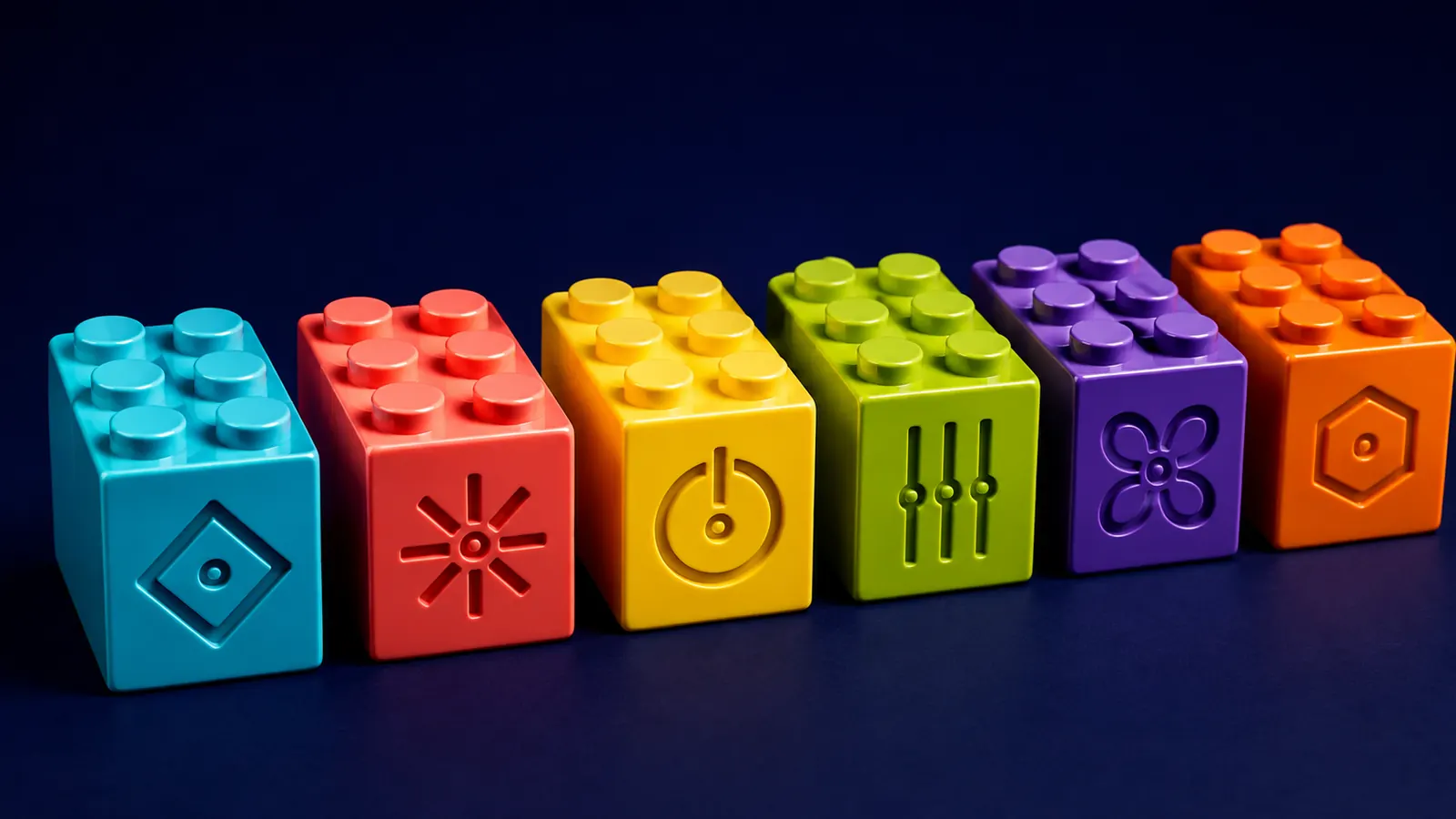
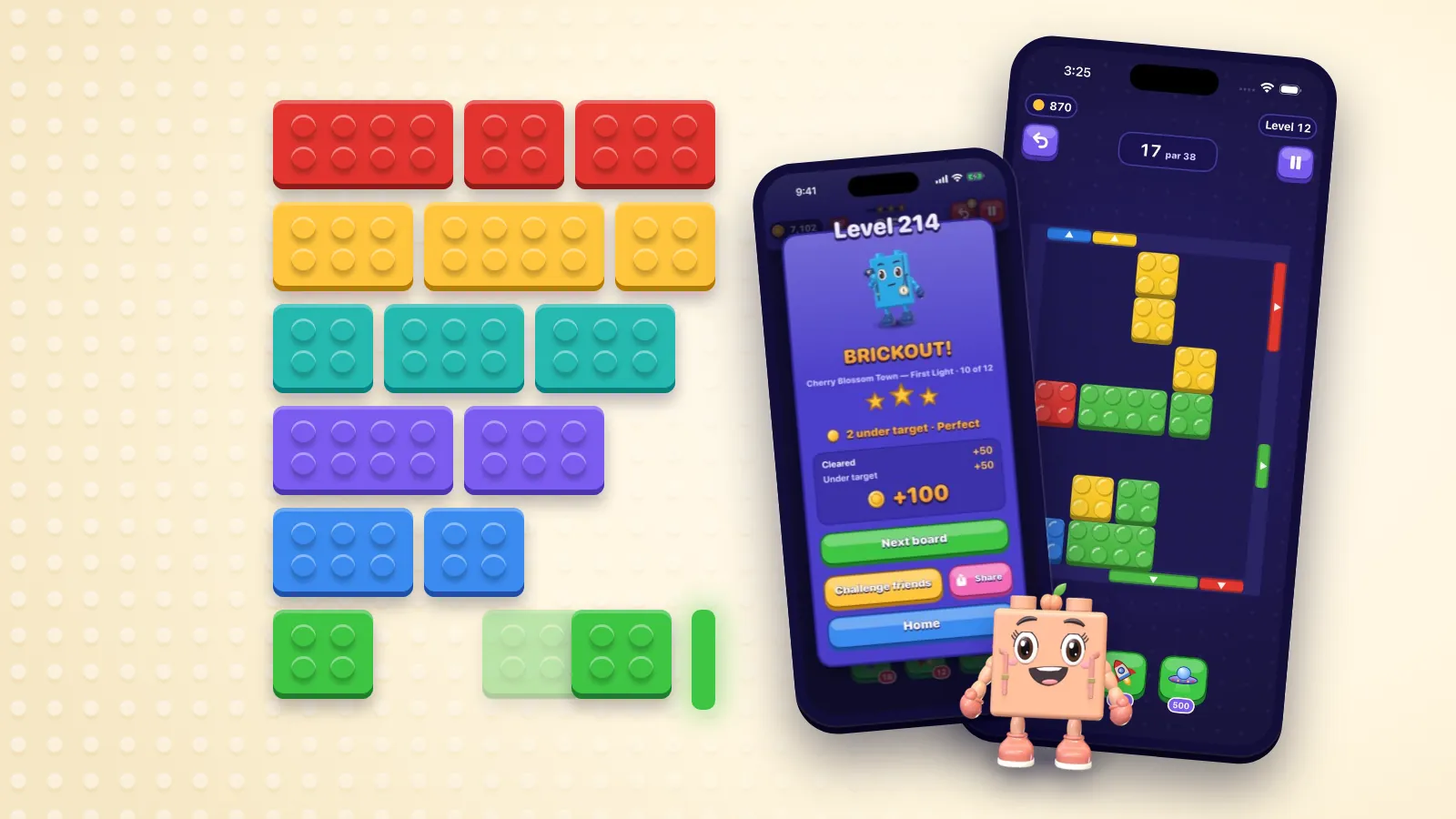
The lesson for a puzzle designer is clear: when the job is to sort distinct pieces into distinct places, a simple, memorable symbol per colour is the right tool, and it should be learnable at a glance rather than decoded. That is the approach we took in OutBrick. Colour-blind mode is on by default and stamps a distinct glyph on every brick and on the gate it belongs to, so a player never has to ask for help to tell two pieces apart. We still want to hear where it falls short; the accessibility page explains how to tell us.
Sources5Geddes, C., Flatla, D. R., Tigwell, G. W., & Peiris, R. L. (2022). Improving colour patterns to assist people with colour vision deficiency. In Proceedings of the 2022 CHI Conference on Human Factors in Computing Systems (pp. 1–17). ACM.3Cole, B. L. (2004). The handicap of abnormal colour vision. Clinical and Experimental Optometry, 87(4–5), 258–275.
If you know or suspect you have a colour vision deficiency, a few habits make games easier. None of them needs a diagnosis, though an optician can test you quickly, and the NHS has a clear overview of colour vision deficiency if you want the background. Simunovic’s review also notes that tinted lenses sold as colour-blindness aids may help with particular tasks but do not give normal colour discrimination, so treat them with some scepticism.
- Open a new game’s accessibility or display menu before you play, and look for a colour-blind mode that adds symbols rather than only changing the palette.
- On iPhone and iPad, turn on Differentiate Without Colour under Settings, Accessibility, Display & Text Size. Well-made games respect it.
- Try Colour Filters in the same menu if a particular game has no options, but expect them to change everything on screen, not only the game.
- In sorting puzzles, learn each piece by its symbol or shape early on, before the boards get crowded. Most colour sort strategies work just as well by symbol.
- Tell developers what went wrong and where. A screenshot of the confusing screen is worth a paragraph of description.
Colour vision deficiency can also be acquired later in life through eye disease or some medicines. A change in how you see colour is worth mentioning to an optician or doctor.
Sources2Simunovic, M. P. (2010). Colour vision deficiency. Eye, 24(5), 747–755.
Filed under
Questions, answered
A few useful answers
How common is colour blindness?
Inherited red–green colour deficiency affects about 8% of men and 0.4% of women of European descent, and between 4% and 6.5% of Chinese and Japanese men. Blue–yellow deficiency and total colour blindness are much rarer.
Do colour-blind people see in black and white?
Almost never. Most see a wide range of colour but confuse particular pairs, most often reds, greens, browns and oranges, and find colour-coded targets more slowly.
What is the best colour-blind setting in a game?
A mode that adds a symbol, shape or pattern to each colour usually helps more than a filter that only shifts the palette, because it works for every type and degree of colour vision deficiency.
Is OutBrick playable if I am colour-blind?
Yes. Colour-blind mode is on by default and puts a distinct glyph on every brick and its matching gate, so you can sort by symbol instead of hue. You can try a board in your browser first.
APA 7
References
Where a source is a studio’s own history or a news account rather than a study, the article says so beside the claim.
- Birch, J. (2012). Worldwide prevalence of red-green color deficiency. Journal of the Optical Society of America A, 29(3), 313–320. doi.org/10.1364/josaa.29.000313 (opens in a new tab)
- Simunovic, M. P. (2010). Colour vision deficiency. Eye, 24(5), 747–755. doi.org/10.1038/eye.2009.251 (opens in a new tab)
- Cole, B. L. (2004). The handicap of abnormal colour vision. Clinical and Experimental Optometry, 87(4–5), 258–275. doi.org/10.1111/j.1444-0938.2004.tb05056.x (opens in a new tab)
- Flatla, D. R., & Gutwin, C. (2012). “So that’s what you see”: Building understanding with personalized simulations of colour vision deficiency. In Proceedings of the 14th International ACM SIGACCESS Conference on Computers and Accessibility (pp. 167–174). ACM. doi.org/10.1145/2384916.2384946 (opens in a new tab)
- Geddes, C., Flatla, D. R., Tigwell, G. W., & Peiris, R. L. (2022). Improving colour patterns to assist people with colour vision deficiency. In Proceedings of the 2022 CHI Conference on Human Factors in Computing Systems (pp. 1–17). ACM. doi.org/10.1145/3491102.3502024 (opens in a new tab)