Deliberate practice for casual players: what actually helps
Practice matters, but less than the 10,000-hour story claims. What studies of deliberate practice and online game players suggest for getting better at puzzles.
You do not need to become a grandmaster to want to get better at something. Most people who play puzzles for a few minutes a day would still like to clear harder boards, waste fewer moves and feel stuck less often. The science of expertise has a lot to say about improvement, much of it built around the idea of deliberate practice. It also has a lively argument about how far that idea goes. Here is what holds up, and how it translates for a casual player with a phone and ten spare minutes.
In 1993 Anders Ericsson, Ralf Krampe and Clemens Tesch-Römer published a study of violinists at a music academy in Berlin. The students judged most accomplished had, by their own estimates, accumulated far more hours of solitary practice than those judged less accomplished. The authors proposed that expert performance is mainly the result of deliberate practice: effortful activity designed specifically to improve, usually guided by a teacher, focused on weaknesses and sustained over many years.
The distinction that matters for everyone is between practice and play. Deliberate practice is not simply doing the activity a lot. It is working on the parts you are bad at, on purpose, and checking whether you got better. A pianist playing favourite pieces is enjoying the piano. A pianist playing the same four bars slowly until the fingering is right is practising.
Sources1Ericsson, K. A., Krampe, R. T., & Tesch-Römer, C. (1993). The role of deliberate practice in the acquisition of expert performance. Psychological Review, 100(3), 363–406.
The idea became popular as the “10,000-hour rule”, which its authors never proposed as a rule. Researchers then set out to measure how much of the difference between people practice actually accounts for. In 2014 Brooke Macnamara, David Hambrick and Frederick Oswald pooled studies across domains. Deliberate practice explained about 26 per cent of the variance in performance in games, 21 per cent in music, 18 per cent in sports, 4 per cent in education and less than 1 per cent in professions. Their conclusion: practice is important, but not as important as had been argued.
In 2019 Macnamara and Megha Maitra repeated the original violin study with a double-blind design. They did not replicate its core finding that accumulated practice separated each skill level. The link between practice and skill was still substantial, just considerably smaller than in 1993.
Chess, a close cousin of puzzles, is where practice looks strongest. In two large samples of tournament players, Neil Charness and colleagues found that serious study alone was the best predictor of rating among the activities they measured, and that chess activities together accounted for about 40 per cent of the variance in skill. Grandmasters reported around 5,000 hours of serious solo study in their first ten years of play, nearly five times the figure for intermediate players. Practice matters a great deal in games; it is just not the whole story.
Most of these figures rest on people’s own estimates of past practice, which are hard to make accurately. Part of the disagreement between researchers is about definitions: what counts as deliberate practice changes how much it appears to explain.
Sources2Macnamara, B. N., Hambrick, D. Z., & Oswald, F. L. (2014). Deliberate practice and performance in music, games, sports, education, and professions: A meta-analysis. Psychological Science, 25(8), 1608–1618.3Macnamara, B. N., & Maitra, M. (2019). The role of deliberate practice in expert performance: Revisiting Ericsson, Krampe & Tesch-Römer (1993). Royal Society Open Science, 6(8), 190327.4Charness, N., Tuffiash, M., Krampe, R., Reingold, E., & Vasyukova, E. (2005). The role of deliberate practice in chess expertise. Applied Cognitive Psychology, 19(2), 151–165.
Most practice research relies on people remembering how much they practised. Tom Stafford and Michael Dewar found a way around that, using records from 854,064 players of Axon, a simple online game that demands rapid perception and decisions. With every play logged, they could link practice history directly to performance.
Two findings are useful to anyone. First, spacing mattered: players who spread their practice over a longer period reached higher scores than those who packed the same amount together, confirming outside the lab what experiments had long shown. Second, players whose early scores varied more went on to perform better later. The authors linked this to the trade-off between exploring and exploiting: trying different approaches early seems to pay off, even if it costs some points at the time.
Axon is a fast reaction game, not a puzzle, so the details may not carry over. But both findings fit what is known about learning, and both are easy to act on.
Sources5Stafford, T., & Dewar, M. (2014). Tracing the trajectory of skill learning with a very large sample of online game players. Psychological Science, 25(2), 511–518.
Nobody needs a coach to get better at puzzles, but the ingredients of deliberate practice scale down well.
- Pick one weakness per session: wasted moves at the start, say, or losing track of a plan halfway through.
- Use honest feedback. A move target is feedback, and so is noticing where you reached for undo.
- Spend thirty seconds after a hard clear asking what you would do differently next time.
- Space it out. Several short sessions across a week beat one long one.
- Explore early. On a new kind of board, try different openings before settling on one.
- Stay within reach. Boards slightly beyond your comfort teach more than boards far beyond it.
The fourth point is where casual players already have an advantage: a few minutes a day is exactly the spaced practice the research favours. The daily board gives everyone the same puzzle each day, a natural fixed point for it. And when you get stuck, stepping away is part of the plan, not a failure of it.
There is a risk in all this. Deliberate practice, as Ericsson and colleagues defined it, is not inherently enjoyable; it is work. A puzzle game turned into a training regime can stop being the thing you loved. Most casual players are better served by a light version: enjoy most boards, and practise on a few.
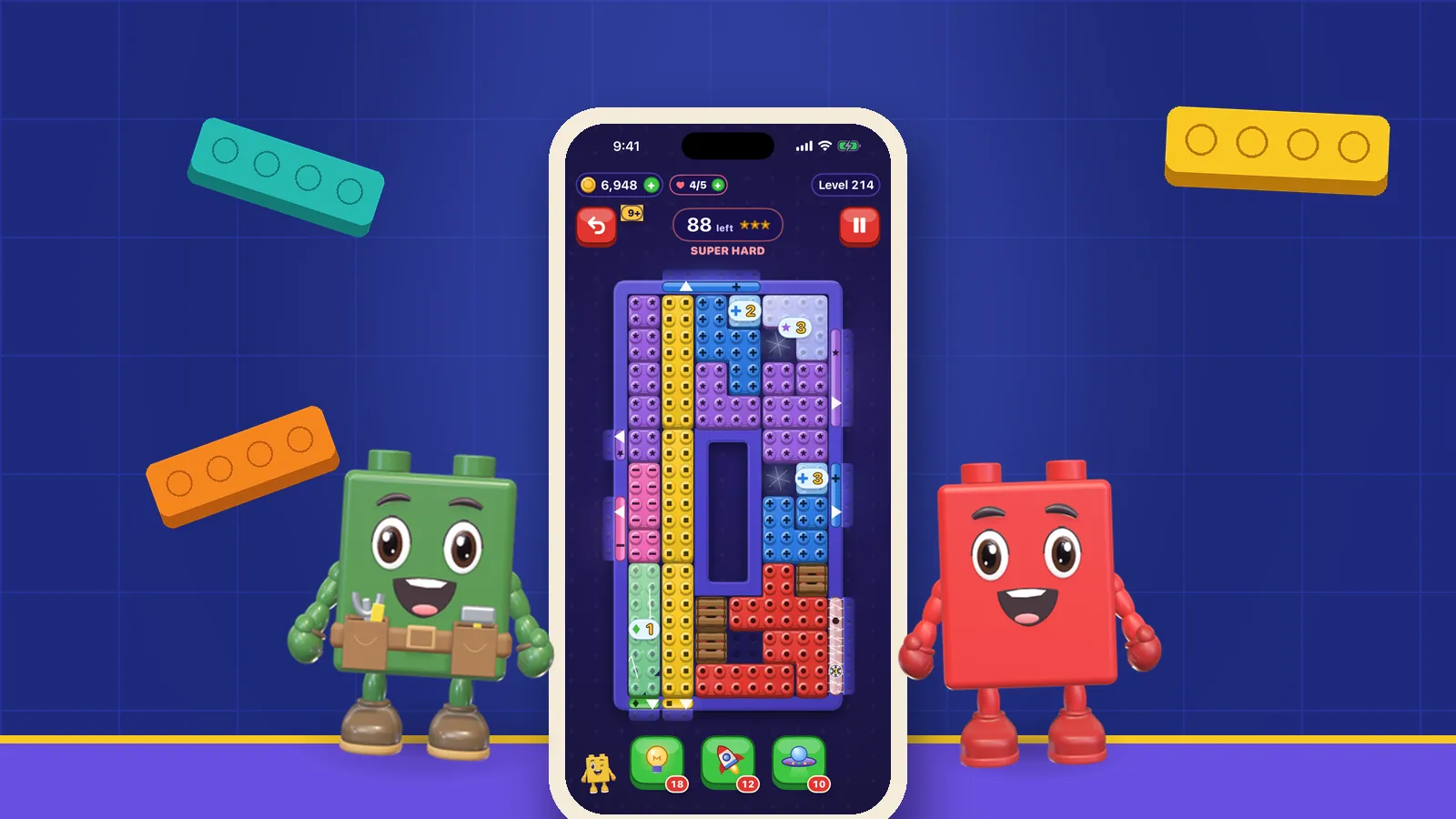
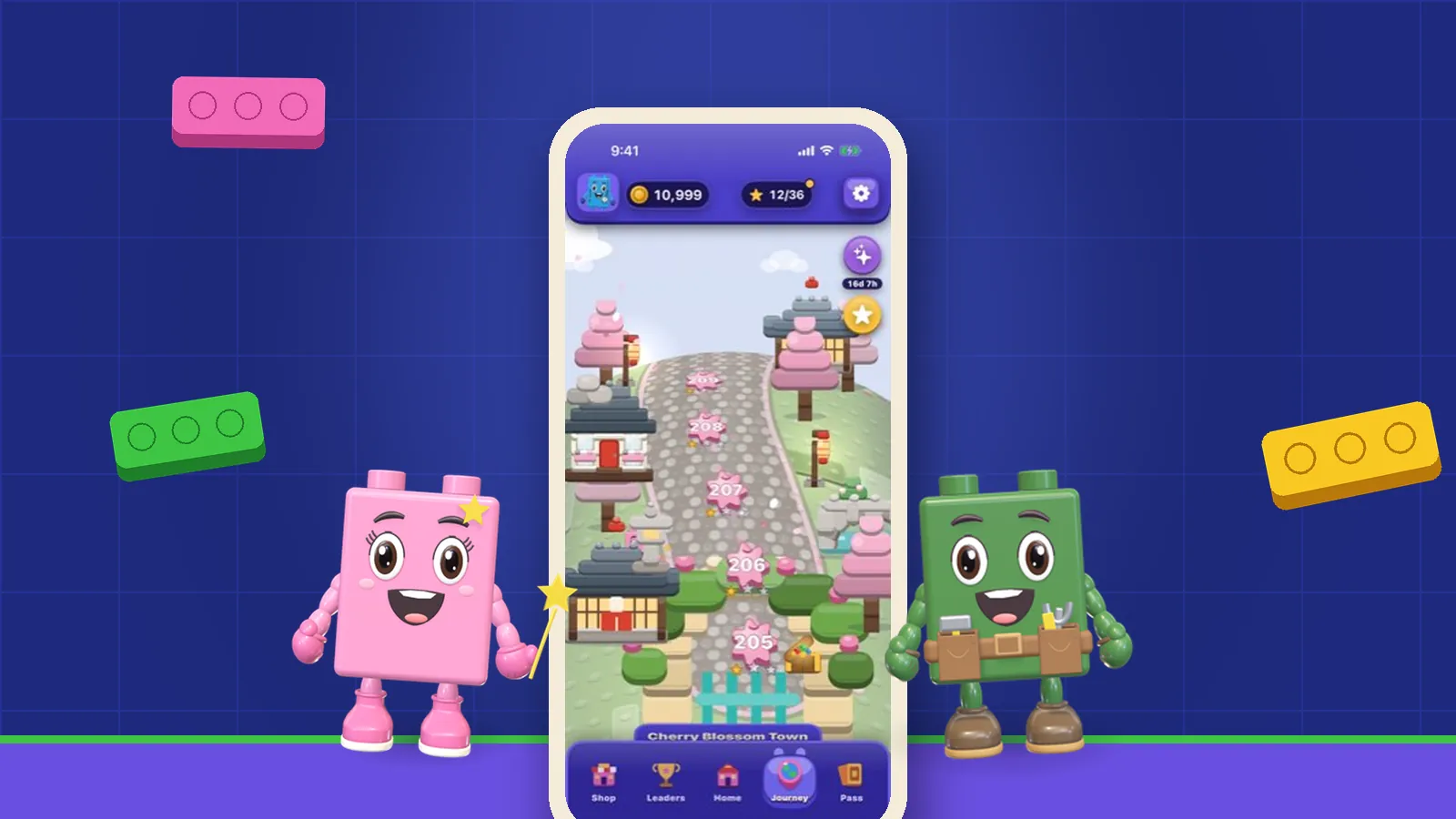
That is roughly how OutBrick is meant to be played. Its 2,000 boards are spread across 100 chapters, a shape of challenge we discussed in how to build a kinder difficulty curve. The goals, the score and the stars give feedback if you want it and stay out of the way if you do not. And the patterns you build along the way, described in our piece on chunking, are the real result of practice: not a number, but a way of seeing the board.
Filed under
Questions, answered
A few useful answers
What is deliberate practice?
Deliberate practice is focused, effortful practice aimed at specific weaknesses, with feedback, rather than simply repeating an activity you already do well. The idea comes from Anders Ericsson and colleagues’ research on expert performance.
Is the 10,000-hour rule true?
Not as a rule. A 2014 meta-analysis found that deliberate practice explained about 26 per cent of the differences in performance in games and less in most other domains. Practice matters, but it is not the only factor.
How often should I practise puzzles to improve?
Short, spaced sessions are a good bet. A study of more than 850,000 online game players found that spreading practice out was linked to higher later scores than packing it together.
How can I get better at puzzle games?
Work on one weakness at a time, use feedback such as move targets, reflect briefly after hard boards and spread your play across the week. On new kinds of boards, try different approaches before settling on one.
APA 7
References
Where a source is a studio’s own history or a news account rather than a study, the article says so beside the claim.
- Ericsson, K. A., Krampe, R. T., & Tesch-Römer, C. (1993). The role of deliberate practice in the acquisition of expert performance. Psychological Review, 100(3), 363–406. doi.org/10.1037/0033-295X.100.3.363 (opens in a new tab)
- Macnamara, B. N., Hambrick, D. Z., & Oswald, F. L. (2014). Deliberate practice and performance in music, games, sports, education, and professions: A meta-analysis. Psychological Science, 25(8), 1608–1618. doi.org/10.1177/0956797614535810 (opens in a new tab)
- Macnamara, B. N., & Maitra, M. (2019). The role of deliberate practice in expert performance: Revisiting Ericsson, Krampe & Tesch-Römer (1993). Royal Society Open Science, 6(8), 190327. doi.org/10.1098/rsos.190327 (opens in a new tab)
- Charness, N., Tuffiash, M., Krampe, R., Reingold, E., & Vasyukova, E. (2005). The role of deliberate practice in chess expertise. Applied Cognitive Psychology, 19(2), 151–165. doi.org/10.1002/acp.1106 (opens in a new tab)
- Stafford, T., & Dewar, M. (2014). Tracing the trajectory of skill learning with a very large sample of online game players. Psychological Science, 25(2), 511–518. doi.org/10.1177/0956797613511466 (opens in a new tab)