The aha moment: what insight looks like in the brain
The sudden click of a solved puzzle has a signature in the brain. What research says about insight, why aha answers are usually right, and when they are not.
There are two ways to solve a puzzle. Sometimes you grind towards the answer one step at a time, with a steady sense of getting closer. Other times nothing seems to move, and then all at once the answer is simply there, obvious and complete, with a jolt of pleasure. That second experience, the aha moment, has fascinated psychologists for a century. In the past twenty years neuroscience has begun to show that it is not just a feeling laid over ordinary thinking, but a different route to a solution.
In a classic 1987 study, Janet Metcalfe and David Wiebe asked people to rate, at regular intervals while they worked, how close they felt to a solution: a “feeling of warmth”. On ordinary algebra problems, warmth rose steadily as people approached the answer. On insight problems it did not. People felt cold, then cold, then cold, and then they had it. From the inside, insight gave almost no warning.
That pattern is the behavioural signature of insight. It suggests that the decisive work happens somewhere the solver cannot monitor, and that the solution reaches awareness all at once rather than piece by piece.
Sources1Metcalfe, J., & Wiebe, D. (1987). Intuition in insight and noninsight problem solving. Memory & Cognition, 15(3), 238–246.
Mark Jung-Beeman, John Kounios and colleagues used compound word puzzles to catch the moment as it happened. Each puzzle gives three words, such as pine, crab and sauce, and asks for a fourth that makes a compound or phrase with all three (apple). After each solution, people said whether it had come by insight or by methodical search.
In brain imaging, insight solutions went with increased activity in a region of the right temporal lobe, the anterior superior temporal gyrus, which is involved in linking distantly related meanings. In EEG recordings, the same area showed a sudden burst of high-frequency gamma activity beginning about a third of a second before people reported an insight solution. Both kinds of solution drew on a largely shared network, but the flash of insight had its own signature.
John Kounios and Mark Beeman’s later review fills in more of the picture. Around insight solutions, attention tends to turn inward, as if the brain briefly quietens outside input so that a weak idea can surface. People also differ in how often they solve by insight, and those differences show up even in brain activity at rest. The field is young, and most findings come from word puzzles rather than visual ones, but the outline is consistent.
Sources2Jung-Beeman, M., Bowden, E. M., Haberman, J., Frymiare, J. L., Arambel-Liu, S., Greenblatt, R., Reber, P. J., & Kounios, J. (2004). Neural activity when people solve verbal problems with insight. PLoS Biology, 2(4), e97.3Kounios, J., & Beeman, M. (2014). The cognitive neuroscience of insight. Annual Review of Psychology, 65, 71–93.
Cognitive psychologists explain insight as a change in how a problem is represented. Günther Knoblich, Stellan Ohlsson and colleagues tested this with matchstick arithmetic: false equations made of matchsticks that become true when a single stick is moved. Problems became much harder when the solution required relaxing a rule people had assumed without noticing, or breaking apart a familiar chunk, such as seeing an X as two separate sticks rather than one symbol.
This ties insight to chunking. The chunks that make experts fast are the same chunks that sometimes have to be broken before a new solution can appear. An impasse on a puzzle board often means you are treating something as fixed that is not: a brick you have decided must leave last, or a lane you have decided must stay clear.
It also suggests why breaks help. Stepping away can loosen an assumption enough for the representation to shift, which is why so many aha moments arrive after a pause. We look at that in stuck on a puzzle? The science of stepping away.
Sources4Knoblich, G., Ohlsson, S., Haider, H., & Rhenius, D. (1999). Constraint relaxation and chunk decomposition in insight problem solving. Journal of Experimental Psychology: Learning, Memory, and Cognition, 25(6), 1534–1555.
Carola Salvi, Mark Beeman and colleagues compared insight and analytic solutions across four experiments with verbal, visual and mixed problems. In every experiment, the solutions people labelled as insights were on average more accurate than their analytic ones. The analytic answers included relatively more wrong answers, suggesting that people sometimes submit a half-finished analysis as a guess, while insight tends to arrive complete or not at all.
But the feeling is not a guarantee. Amory Danek and Jennifer Wiley asked 70 people to work out how magic tricks were done and to rate each of their solutions. Some wrong solutions came with an aha experience too, which the researchers called false insights. Correct solutions tended to bring stronger feelings of pleasure, suddenness and certainty, but the overlap was real.
Ruben Laukkonen and colleagues showed how far the feeling can stray. In a preregistered experiment with 300 participants, statements were rated as more likely to be true when they appeared alongside an anagram the person had just solved, even when the statements were false, and the effect was stronger when people reported an aha. The glow of insight can spill over onto whatever happens to be nearby.
Sources5Salvi, C., Bricolo, E., Kounios, J., Bowden, E., & Beeman, M. (2016). Insight solutions are correct more often than analytic solutions. Thinking & Reasoning, 22(4), 443–460.6Danek, A. H., & Wiley, J. (2017). What about false insights? Deconstructing the Aha! experience along its multiple dimensions for correct and incorrect solutions separately. Frontiers in Psychology, 7, 2077.7Laukkonen, R. E., Kaveladze, B. T., Tangen, J. M., & Schooler, J. W. (2020). The dark side of Eureka: Artificially induced Aha moments make facts feel true. Cognition, 196, 104122.
On a sliding puzzle, the lesson is to enjoy the aha and then check it. A move that suddenly looks brilliant usually is, but it costs nothing to trace it two steps forward before you commit, especially when a move target is at stake.
You can also invite the click. At an impasse, list the assumptions you are making about the board, out loud if it helps: this brick must leave last, that lane must stay open, the key has to come first. Then drop them one at a time and look again. It is the constraint relaxation that Knoblich and Ohlsson described, done on purpose.
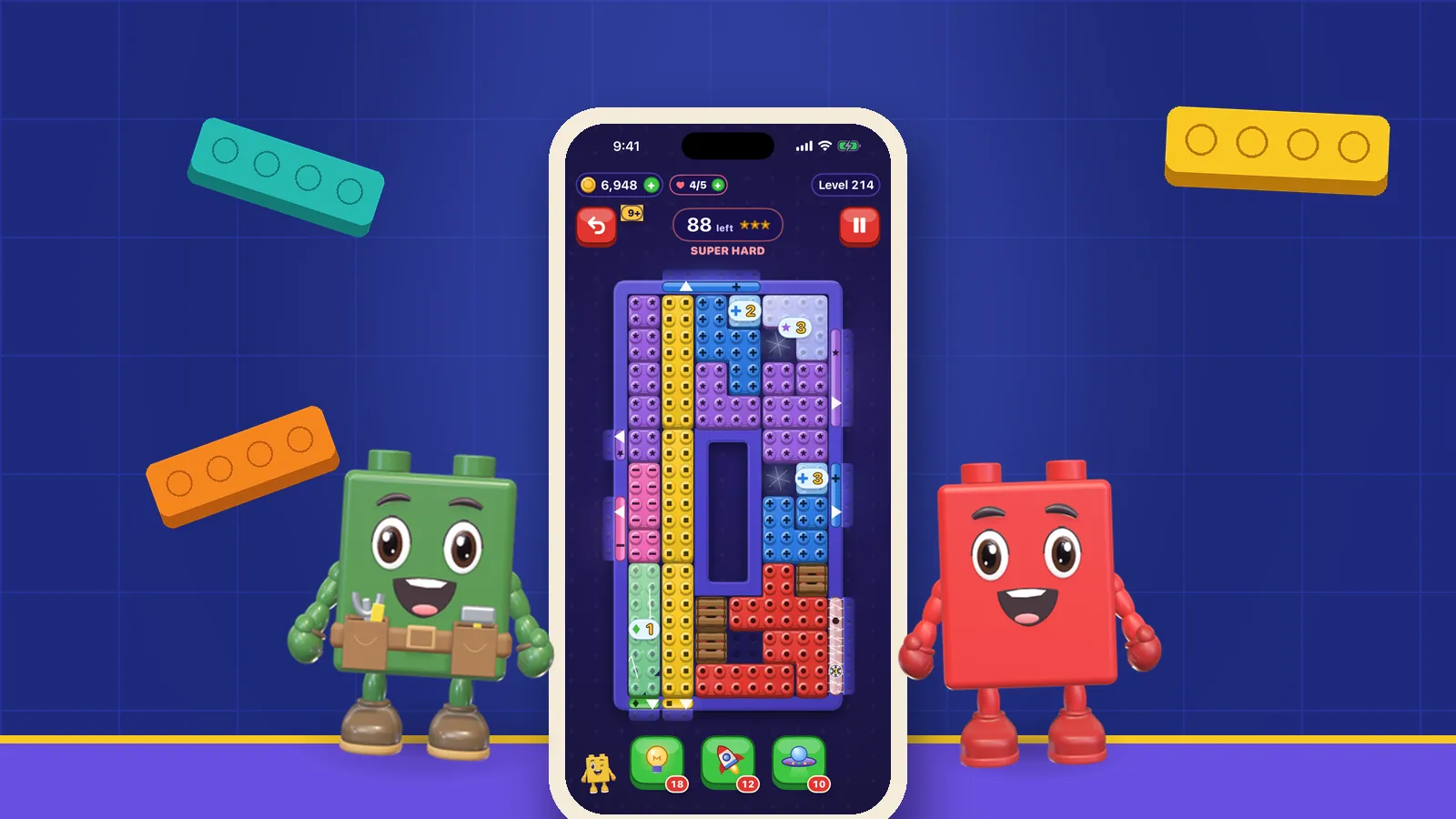
Puzzle designers build boards around that click. In OutBrick, the most satisfying boards are often the ones where a slide you had ruled out turns out to unlock everything, because it changes what you thought the board was about. The rules are simple on purpose, bricks slide or swap, three or more of a colour in a line clear, and each brick goes home through the gate of its own colour, so the surprise lives in the arrangement rather than in hidden rules. Games that leave room for that kind of discovery teach through curiosity rather than instruction, a theme we explored in when a game teaches curiosity without a lecture.
If you want to hunt for the click yourself, the browser board is a quick way to meet a board you have never seen.
Filed under
Questions, answered
A few useful answers
What happens in the brain during an aha moment?
Studies using word puzzles found increased activity in a region of the right temporal lobe for insight solutions, and a burst of high-frequency gamma activity there about a third of a second before people reported the answer.
Are insight solutions more accurate than analytic ones?
Usually. Across four experiments, answers people reported as insights were on average more accurate than their analytic answers, although the aha feeling can also accompany wrong answers.
Why do solutions pop into my head suddenly?
Insight seems to involve a change in how you represent the problem, such as dropping an assumption or breaking a familiar pattern apart. Because that change happens outside awareness, the answer appears to arrive all at once.
Can an aha moment be wrong?
Yes. In a study of people working out how magic tricks were done, some wrong solutions came with an aha experience, although correct ones tended to feel stronger and more certain.
APA 7
References
Where a source is a studio’s own history or a news account rather than a study, the article says so beside the claim.
- Metcalfe, J., & Wiebe, D. (1987). Intuition in insight and noninsight problem solving. Memory & Cognition, 15(3), 238–246. doi.org/10.3758/BF03197722 (opens in a new tab)
- Jung-Beeman, M., Bowden, E. M., Haberman, J., Frymiare, J. L., Arambel-Liu, S., Greenblatt, R., Reber, P. J., & Kounios, J. (2004). Neural activity when people solve verbal problems with insight. PLoS Biology, 2(4), e97. doi.org/10.1371/journal.pbio.0020097 (opens in a new tab)
- Kounios, J., & Beeman, M. (2014). The cognitive neuroscience of insight. Annual Review of Psychology, 65, 71–93. doi.org/10.1146/annurev-psych-010213-115154 (opens in a new tab)
- Knoblich, G., Ohlsson, S., Haider, H., & Rhenius, D. (1999). Constraint relaxation and chunk decomposition in insight problem solving. Journal of Experimental Psychology: Learning, Memory, and Cognition, 25(6), 1534–1555. doi.org/10.1037/0278-7393.25.6.1534 (opens in a new tab)
- Salvi, C., Bricolo, E., Kounios, J., Bowden, E., & Beeman, M. (2016). Insight solutions are correct more often than analytic solutions. Thinking & Reasoning, 22(4), 443–460. doi.org/10.1080/13546783.2016.1141798 (opens in a new tab)
- Danek, A. H., & Wiley, J. (2017). What about false insights? Deconstructing the Aha! experience along its multiple dimensions for correct and incorrect solutions separately. Frontiers in Psychology, 7, 2077. doi.org/10.3389/fpsyg.2016.02077 (opens in a new tab)
- Laukkonen, R. E., Kaveladze, B. T., Tangen, J. M., & Schooler, J. W. (2020). The dark side of Eureka: Artificially induced Aha moments make facts feel true. Cognition, 196, 104122. doi.org/10.1016/j.cognition.2019.104122 (opens in a new tab)