Working memory: why some puzzle boards feel impossible
A hard board is often a memory problem in disguise. How working memory and cognitive load shape puzzle difficulty, and practical ways to lighten the load.
Some puzzle boards are hard because the solution is long or well hidden. Others are hard for a less obvious reason: they ask you to hold more in mind at once than a mind comfortably can. From the inside the two feel alike, a creeping sense that the board makes no sense, but they call for different responses. Understanding the second kind starts with working memory, the small mental workspace where we juggle whatever we are thinking about right now.
For decades the textbook figure for short-term memory was seven items, plus or minus two. In a 2001 review, Nelson Cowan argued that once you stop people rehearsing or grouping items, the real capacity is nearer three to five chunks, with four as a reasonable central estimate. Everything you are actively juggling while solving a puzzle has to fit in that space: the current position, the goal, the move you are considering and what it would block.
Four is not much. It is why a plan of ten single moves falls apart halfway through, and why you can spot a clever three-move sequence, glance away for a moment and lose it entirely. Most people have met this limit on a puzzle board without having a name for it.
The workspace is not a fixed size from moment to moment, either. Tiredness, distraction and worry all compete for it, which is one reason a board that felt impossible at the end of a long day can look straightforward the next morning. If a board suddenly feels much harder than the one before, it is worth asking whether the board changed or you did.
Sources1Cowan, N. (2001). The magical number 4 in short-term memory: A reconsideration of mental storage capacity. Behavioral and Brain Sciences, 24(1), 87–114.
John Sweller’s cognitive load theory grew out of problem-solving research. In a 1988 paper he argued that means–ends analysis, the strategy of constantly comparing where you are with where you want to be and picking moves that shrink the difference, takes up a great deal of working memory. That leaves little capacity for noticing the patterns that would make the next problem easier. People could solve problems this way and still learn surprisingly little from them.
Three decades of later work, summarised by Sweller, Jeroen van Merriënboer and Fred Paas in 2019, built a theory of instruction around the same limit. Its central claim is simple: new information has to pass through a working memory that is limited in both capacity and duration, while knowledge already stored in long-term memory escapes those limits. Experience makes hard problems easier largely by moving what you know out of the small workspace and into the large store.
For a puzzler, this explains a familiar frustration. On a board at the very edge of your ability, all your capacity goes into finding moves, and you may clear it without being sure how. On a board just inside your limit, you have spare capacity to notice why the solution worked, and that is when you learn.
Sources2Sweller, J. (1988). Cognitive load during problem solving: Effects on learning. Cognitive Science, 12(2), 257–285.3Sweller, J., van Merriënboer, J. J. G., & Paas, F. (2019). Cognitive architecture and instructional design: 20 years later. Educational Psychology Review, 31(2), 261–292.
Louise Phillips, Ken Gilhooly and colleagues tested mental planning directly with the Tower of London, a disc-moving puzzle widely used to study planning. Most people could accurately plan up to two subgoals ahead, but not three. In another experiment, people told to make a complete mental plan before moving spent much longer planning than people given no instruction, yet carried out their solutions no more efficiently.
That is a useful, humbling number. Two subgoals, each a short run of moves, is about as far as most people can reliably see on a puzzle of that kind, and trying to plan further often wastes effort. Plan to the next point where the board changes character, play it, and look again.
Sources4Phillips, L. H., Wynn, V. E., McPherson, S., & Gilhooly, K. J. (2001). Mental planning and the Tower of London task. The Quarterly Journal of Experimental Psychology Section A, 54(2), 579–597.
You cannot enlarge working memory by wishing, but you can spend it better. The most powerful tool is chunking: treating several moves as one intention, such as “clear the right lane”, so a longer plan fits in the same space. Our piece on how expert puzzlers see patterns explains how chunks form.
The second tool is to let the world hold information for you. Evan Risko and Sam Gilbert reviewed research on cognitive offloading: using physical actions or outside aids, such as notes, reminders or tilting your head to read rotated text, to reduce the demands on internal thinking. People offload more when a task is demanding and when they doubt their own memory. On a puzzle board, the board itself is the external memory. Tracing a path with your finger, or making a probing move and taking it back, frees a slot in your head.
- Plan in named chunks of two to four moves, not in single moves.
- Plan no more than two chunks ahead, then reread the board.
- Use the board as memory: point, trace or probe instead of simulating everything in your head.
- Shrink the goal: aim to free one colour at a time rather than solve the whole board at once.
Sources5Risko, E. F., & Gilbert, S. J. (2016). Cognitive offloading. Trends in Cognitive Sciences, 20(9), 676–688.
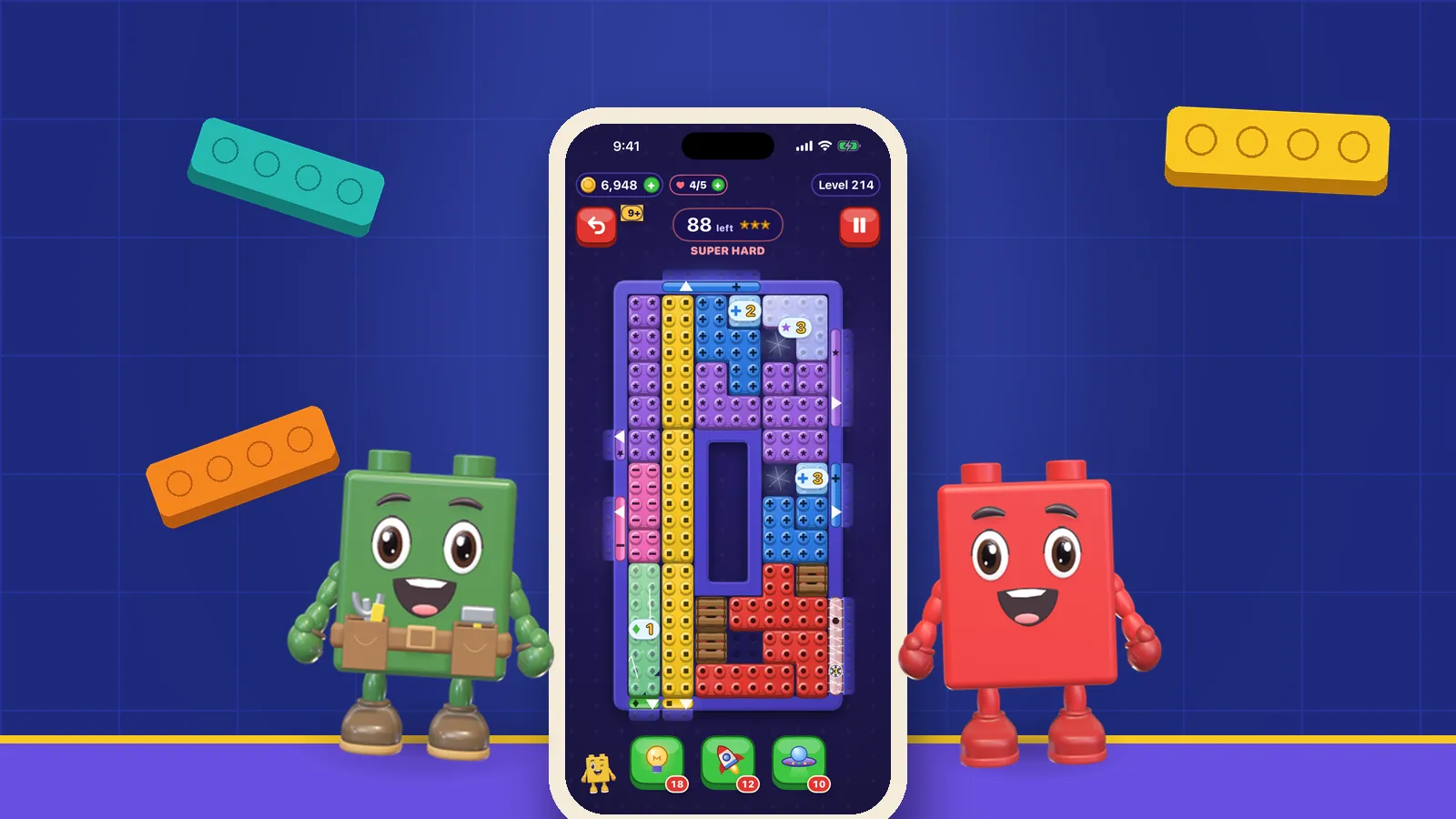
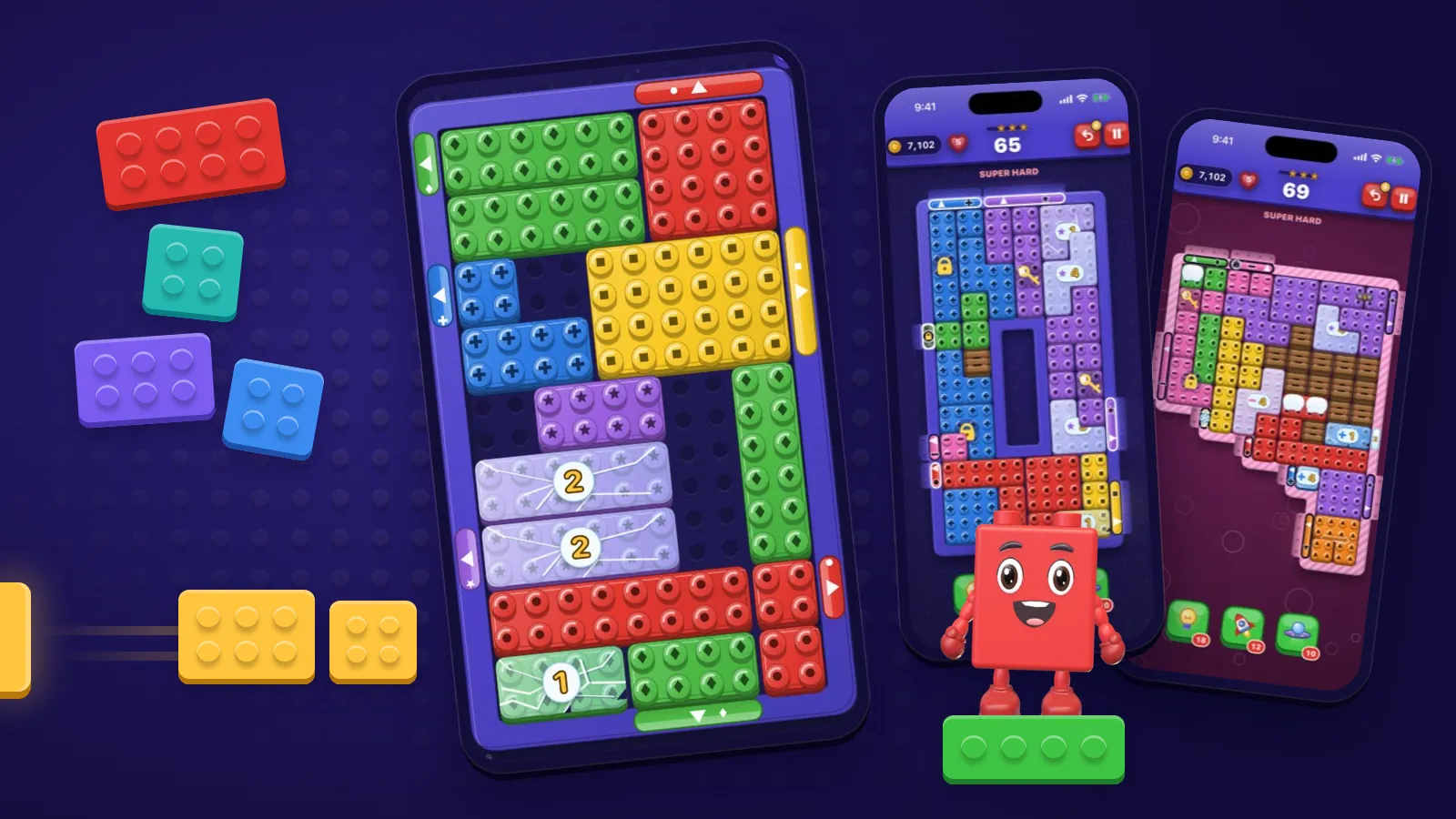
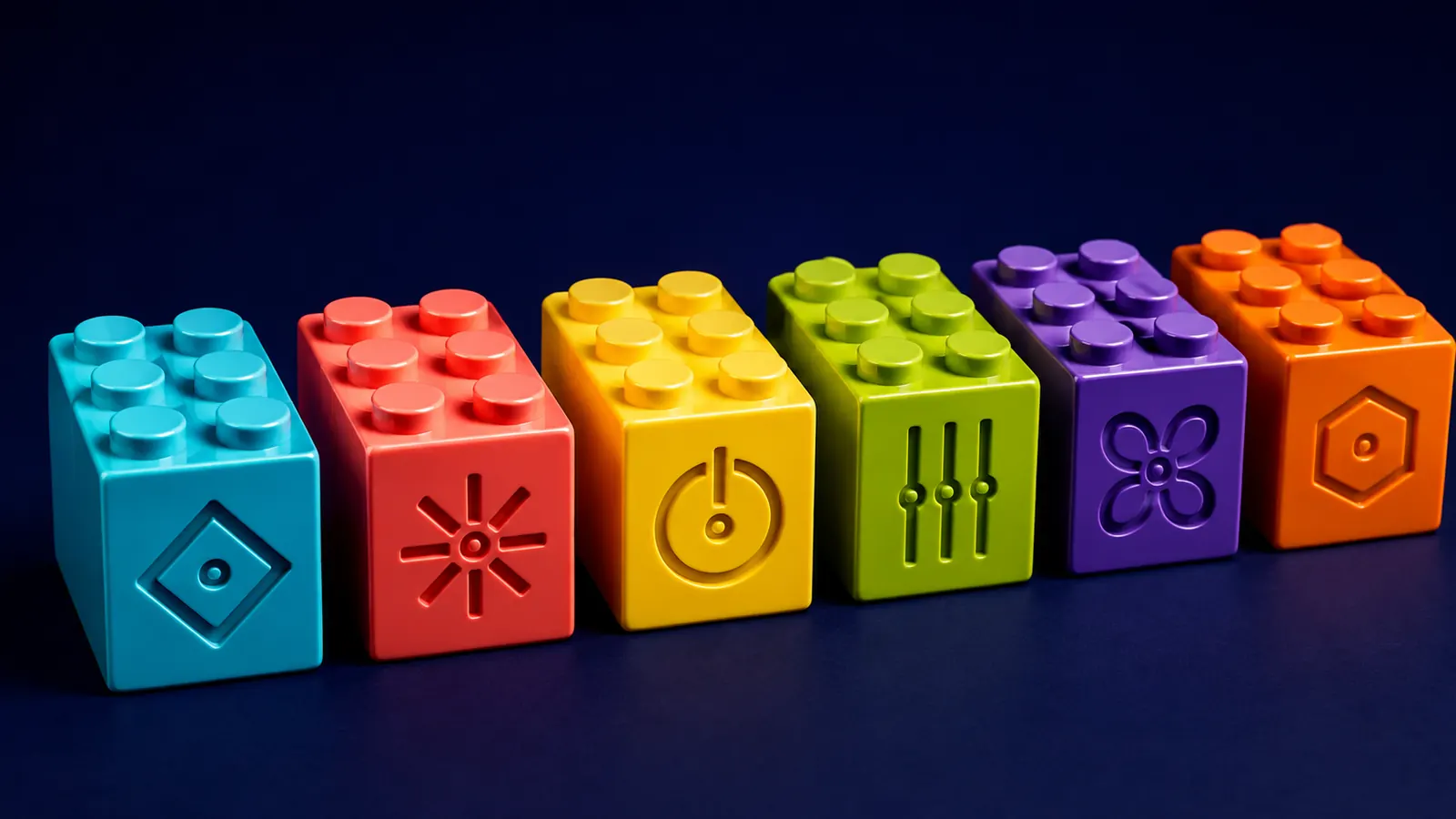
A good puzzle should spend your working memory on the puzzle, not on bookkeeping. OutBrick tries to keep that incidental load low. Every brick shows its colour and, with colour-blind mode on by default, a matching glyph, so you are not spending a memory slot on which similar shade is which; the case for that is in why colour should never be the only clue in a puzzle. The gates enforce the colour rule themselves, the goals and move limit stay on screen, and nothing is timed, so you are never holding a plan while watching a clock.
What remains is the hard part you came for: the positions, the blockers, the order. When a board feels impossible, ask which kind of difficulty you are facing. If it is a search problem, keep reading the board. If it is a memory problem, and you notice yourself losing plans halfway, shrink the plan. The accessibility page lists other ways the game can fit how you play, and the browser board is a quick place to practise planning in chunks.
Filed under
Questions, answered
A few useful answers
How many things can working memory hold?
Estimates vary, but a widely cited review puts it at around four chunks for adults when rehearsal and grouping are prevented. Grouping items into larger, meaningful chunks lets you hold more.
Why do some puzzles feel impossible even though they are solvable?
Often because they demand holding more in mind at once than working memory allows. Planning in chunks, using the board as an external memory and working towards one small goal at a time can make them manageable.
How many moves ahead can people plan?
In one study with the Tower of London puzzle, most people could plan accurately up to two subgoals ahead but not three. Planning in short stretches and then rereading the board is usually more effective.
What is cognitive load theory?
Cognitive load theory, developed by John Sweller, holds that new information must pass through a limited working memory, so tasks and teaching should avoid wasting that capacity. It began with research showing that some problem-solving strategies use so much capacity that little is left for learning.
APA 7
References
Where a source is a studio’s own history or a news account rather than a study, the article says so beside the claim.
- Cowan, N. (2001). The magical number 4 in short-term memory: A reconsideration of mental storage capacity. Behavioral and Brain Sciences, 24(1), 87–114. doi.org/10.1017/S0140525X01003922 (opens in a new tab)
- Sweller, J. (1988). Cognitive load during problem solving: Effects on learning. Cognitive Science, 12(2), 257–285. doi.org/10.1207/s15516709cog1202_4 (opens in a new tab)
- Sweller, J., van Merriënboer, J. J. G., & Paas, F. (2019). Cognitive architecture and instructional design: 20 years later. Educational Psychology Review, 31(2), 261–292. doi.org/10.1007/s10648-019-09465-5 (opens in a new tab)
- Phillips, L. H., Wynn, V. E., McPherson, S., & Gilhooly, K. J. (2001). Mental planning and the Tower of London task. The Quarterly Journal of Experimental Psychology Section A, 54(2), 579–597. doi.org/10.1080/713755977 (opens in a new tab)
- Risko, E. F., & Gilbert, S. J. (2016). Cognitive offloading. Trends in Cognitive Sciences, 20(9), 676–688. doi.org/10.1016/j.tics.2016.07.002 (opens in a new tab)