Achievements and collections: why completing a set feels good
Why the last badge, sticker or level pulls so hard, what the Zeigarnik effect really shows, and how to enjoy collecting in games without being driven by it.
Nine out of ten stickers in the album. Forty-nine of fifty achievements. One village left on the map. Few things in games pull quite like the last item in a set, and many players have found themselves grinding through something they do not especially enjoy simply because it is the thing that would make the collection complete. The pull is real, and psychology has several explanations for it. Some are solid, some have been repeated far beyond their evidence, and one of the most famous turns out, on closer inspection, to be mostly a myth.
The oldest explanation comes from behaviourism: animals run faster as they near a reward. Ran Kivetz, Oleg Urminsky and Yuhuang Zheng showed the same goal gradient in people. Customers in a real café reward programme bought coffee more often the closer they were to a free one. People rating songs online for reward certificates visited more often and rated more songs per visit as they approached the reward.
They also found something that games have long known intuitively. Customers given a 12-stamp card with two stamps already filled in finished the ten required purchases faster than customers given a plain 10-stamp card. The distance was identical; the sense of progress was not.
Joseph Nunes and Xavier Drèze named this the endowed progress effect. In their car-wash study, customers given a loyalty card needing eight stamps completed it far less often than customers given a ten-stamp card with two stamps already on it, even though both needed eight more washes. A set that already looks started is a set people want to finish.
Games use both effects constantly, sometimes without meaning to. A progress bar that starts a little filled, a map where the first few stops are already lit, a collection screen that shows the empty slots as clearly as the full ones: each turns a distant goal into a nearby one. That can be a kindness, making a long game feel approachable. It can also be a lever, pulling players forward faster than they would otherwise choose. The difference usually lies in whether the thing at the end of the bar is worth having.
Sources1Kivetz, R., Urminsky, O., & Zheng, Y. (2006). The goal-gradient hypothesis resurrected: Purchase acceleration, illusionary goal progress, and customer retention. Journal of Marketing Research, 43(1), 39–58.2Nunes, J. C., & Drèze, X. (2006). The endowed progress effect: How artificial advancement increases effort. Journal of Consumer Research, 32(4), 504–512.
Almost every article about unfinished tasks mentions the Zeigarnik effect: the idea, from Bluma Zeigarnik’s work in the 1920s, that people remember interrupted tasks better than completed ones, and that this lingering memory is what nags at us to finish. It is a lovely story. It is also, on current evidence, mostly wrong.
In 2025 Romain Ghibellini and Beat Meier published a meta-analysis of the research that followed. They found no memory advantage for unfinished tasks. What they did find was a general tendency to go back to interrupted tasks and complete them, known as the Ovsiankina effect, after Maria Ovsiankina, another student in the same Berlin group. We do not necessarily remember the unfinished set better. We just tend to return to it.
That distinction matters for how we think about games. The pull of an incomplete collection is not a memory trick lodged in your head; it is a tendency to resume. Which means it is also something you can notice and choose about.
Sources3Ghibellini, R., & Meier, B. (2025). Interruption, recall and resumption: A meta-analysis of the Zeigarnik and Ovsiankina effects. Humanities and Social Sciences Communications, 12, 962.
Juho Hamari and Veikko Eranti set out a framework for game achievements with three parts: a signifier (the name, description and icon), completion logic (what has to happen, and under what conditions) and a reward. Their point was that achievements are a design layer on top of the game, and that they can be designed well or badly: they can steer players towards interesting parts of a game or merely count repetitive actions.
Do they change behaviour? In a field experiment on a peer-to-peer trading service, Hamari found that users who could earn badges posted more trade proposals, made more transactions and commented more than users who could not. Carlos Cruz, Michael Hanus and Jesse Fox surveyed console players about achievement and trophy systems and found many players described them as motivating and part of how they chose to play, while others ignored them entirely.
That split is worth taking seriously. For some players, achievements are a second game layered over the first, with its own satisfactions: planning a route through every optional challenge, or finding the odd secret the designers hid. For others they are noise. A well-designed game lets both kinds of player have the experience they want, and does not lock the ordinary pleasures of play behind the completionist’s list.
Like leaderboards, achievements mainly move effort, and they work best when they add to a game that is worth playing anyway. Our look at what the gamification research says covers the wider picture.
Sources4Hamari, J., & Eranti, V. (2011). Framework for designing and evaluating game achievements. In Proceedings of DiGRA 2011 Conference: Think Design Play. Digital Games Research Association.5Hamari, J. (2017). Do badges increase user activity? A field experiment on the effects of gamification. Computers in Human Behavior, 71, 469–478.6Cruz, C., Hanus, M. D., & Fox, J. (2017). The need to achieve: Players’ perceptions and uses of extrinsic meta-game reward systems for video game consoles. Computers in Human Behavior, 71, 516–524.
A collection is good when completing it means you have seen more of what the game has to offer, and bad when completing it means doing the same dull thing a hundred times. A useful test: would you be glad to have done this even if the badge did not exist?
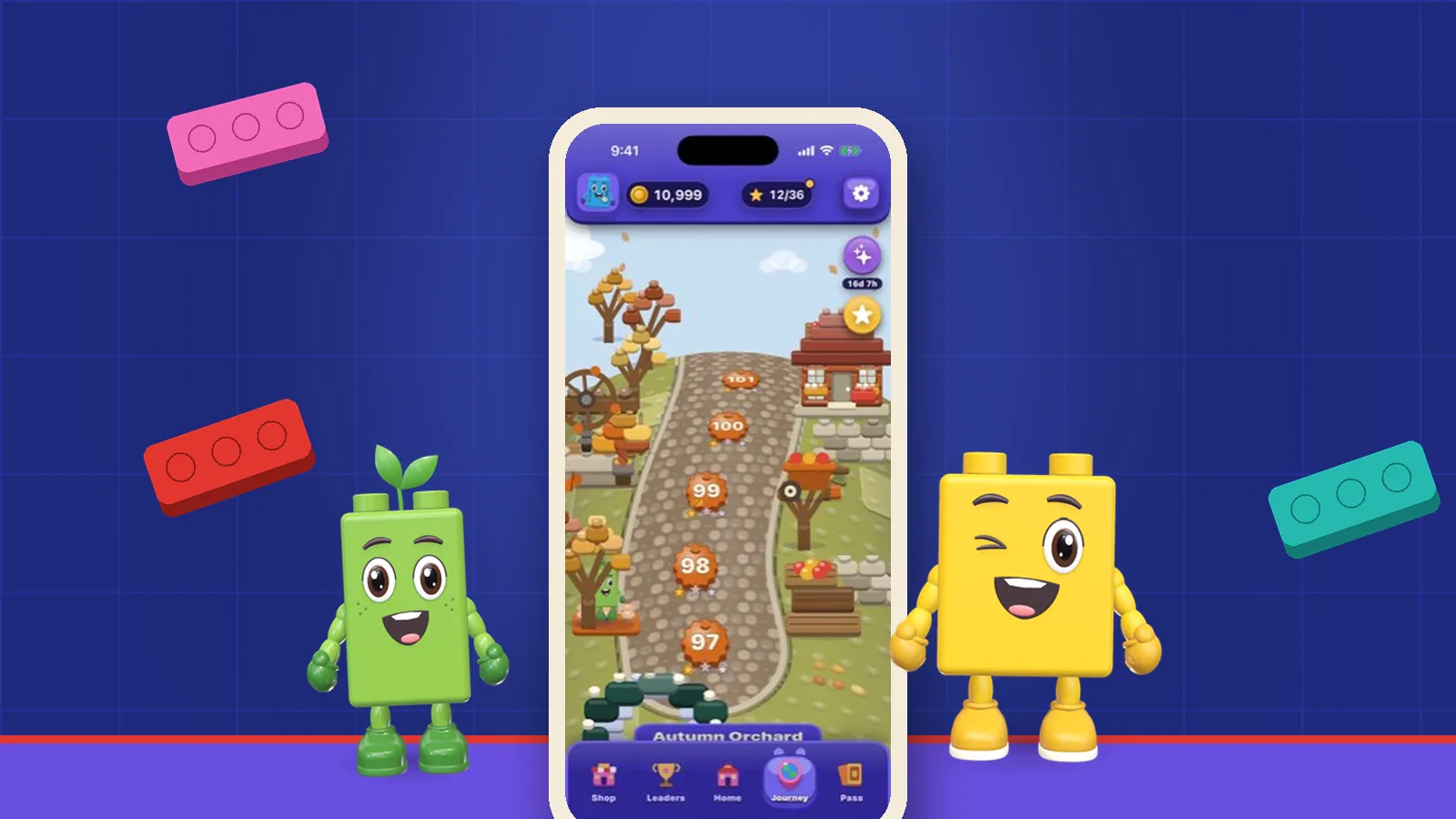
In OutBrick, the thing you collect is the road itself. The Journey runs through 167 brick-built villages, and each one you reach is a place you have actually been, board by board. There is no separate list of chores. The release notes describe how every village builds its ground, roads and landmarks from brick as you travel.
- Good: achievements that send you to parts of a game you might have missed.
- Good: collections that record what you have done, rather than asking for extra repetition.
- Watch out for: a “nearly there” bar that appears before you have done anything.
- Watch out for: rewards that expire unless you log in, turning a collection into a deadline.
Sources4Hamari, J., & Eranti, V. (2011). Framework for designing and evaluating game achievements. In Proceedings of DiGRA 2011 Conference: Think Design Play. Digital Games Research Association.2Nunes, J. C., & Drèze, X. (2006). The endowed progress effect: How artificial advancement increases effort. Journal of Consumer Research, 32(4), 504–512.
Knowing how the pull works makes it easier to enjoy. When you notice yourself racing towards the last item, ask whether you are still having fun or just closing a gap. If the answer is the gap, it is fine to leave the set at nine out of ten; the Ovsiankina pull fades once you consciously decide to stop.
And when a set is worth finishing, enjoy it properly. A completed collection is a small record of time well spent. For more on stopping points, read how games become habits, or start a small collection of your own with a board in your browser.
Sources3Ghibellini, R., & Meier, B. (2025). Interruption, recall and resumption: A meta-analysis of the Zeigarnik and Ovsiankina effects. Humanities and Social Sciences Communications, 12, 962.1Kivetz, R., Urminsky, O., & Zheng, Y. (2006). The goal-gradient hypothesis resurrected: Purchase acceleration, illusionary goal progress, and customer retention. Journal of Marketing Research, 43(1), 39–58.
Filed under
Questions, answered
A few useful answers
Why does completing a collection feel so satisfying?
People work harder as they approach a goal, a pattern called the goal gradient, and they tend to return to unfinished tasks. Finishing the set closes that open loop and marks visible progress.
Is the Zeigarnik effect real?
A 2025 meta-analysis found no reliable memory advantage for unfinished tasks, the classic Zeigarnik effect. It did find a general tendency to resume interrupted tasks, known as the Ovsiankina effect.
Do achievements in games increase motivation?
They can increase activity: a field experiment found users who could earn badges were more active. Surveys show some players find achievements motivating and others ignore them, and they work best when they point to genuinely interesting play.
What is the endowed progress effect?
It is the finding that people are more likely to complete a goal when they are given a head start. In one study, a ten-stamp car-wash card with two stamps already filled was completed more often than an eight-stamp card, though both needed eight washes.
APA 7
References
Where a source is a studio’s own history or a news account rather than a study, the article says so beside the claim.
- Kivetz, R., Urminsky, O., & Zheng, Y. (2006). The goal-gradient hypothesis resurrected: Purchase acceleration, illusionary goal progress, and customer retention. Journal of Marketing Research, 43(1), 39–58. doi.org/10.1509/jmkr.43.1.39 (opens in a new tab)
- Nunes, J. C., & Drèze, X. (2006). The endowed progress effect: How artificial advancement increases effort. Journal of Consumer Research, 32(4), 504–512. doi.org/10.1086/500480 (opens in a new tab)
- Ghibellini, R., & Meier, B. (2025). Interruption, recall and resumption: A meta-analysis of the Zeigarnik and Ovsiankina effects. Humanities and Social Sciences Communications, 12, 962. doi.org/10.1057/s41599-025-05000-w (opens in a new tab)
- Hamari, J., & Eranti, V. (2011). Framework for designing and evaluating game achievements. In Proceedings of DiGRA 2011 Conference: Think Design Play. Digital Games Research Association. doi.org/10.26503/dl.v2011i1.545 (opens in a new tab)
- Hamari, J. (2017). Do badges increase user activity? A field experiment on the effects of gamification. Computers in Human Behavior, 71, 469–478. doi.org/10.1016/j.chb.2015.03.036 (opens in a new tab)
- Cruz, C., Hanus, M. D., & Fox, J. (2017). The need to achieve: Players’ perceptions and uses of extrinsic meta-game reward systems for video game consoles. Computers in Human Behavior, 71, 516–524. doi.org/10.1016/j.chb.2015.08.017 (opens in a new tab)