
Motion sickness from games: why Reduce Motion matters
Why screen motion makes some players dizzy or queasy, who is most susceptible, and how the Reduce Motion setting and careful animation make games comfortable.
Most people never think about the motion in a game until it makes them feel ill. For a sizeable minority, a swooping camera, a parallax background or a screen that shakes on every success brings on dizziness, nausea or a headache, sometimes lasting well after they put the device down. This is not squeamishness. It is a well-studied response of the body’s balance system, and there is a simple setting that exists because of it. Here is what the research says, and what players and designers can do.
Your sense of balance draws on three sources: your eyes, the vestibular organs in your inner ear, and the feel of your body against the ground. Normally they agree. When a large area of your view moves as if you were moving, but your inner ear reports that you are sitting still, the signals conflict. For many people the result is a set of symptoms, including disorientation, eye strain, sweating and nausea, known as visually induced motion sickness, or cybersickness when it comes from digital displays.
Rebenitsch and Owen’s review gathered the evidence on what drives it. Much of that research concerns virtual reality and large displays, where the effect is strongest, but the ingredients carry over to phones and tablets: how much of the view moves, how fast, and in which direction, as well as rendering choices and how long you are exposed. A related sensation, vection, is the illusion of moving yourself, like the feeling that your stationary train is pulling out when the one beside it leaves. Keshavarz and colleagues reviewed how the two are related and concluded that the link is less straightforward than long assumed: vection and sickness often occur together, but not always.
Sources1Rebenitsch, L., & Owen, C. (2016). Review on cybersickness in applications and visual displays. Virtual Reality, 20(2), 101–125.2Keshavarz, B., Riecke, B. E., Hettinger, L. J., & Campos, J. L. (2015). Vection and visually induced motion sickness: How are they related? Frontiers in Psychology, 6, 472.
Not all movement is equal. In a pair of experiments, Keshavarz and colleagues varied the speed and density of a moving star field and then added rotation. Faster, denser motion made the illusion of self-motion stronger, but made little difference to sickness. Adding pitch, a tilting up-and-down rotation, produced the highest sickness scores and more disorientation. The practical reading is that rotation and camera movement are more troublesome than things simply moving across a still background.
That matches what motion-sensitive players commonly report about games: the trouble tends to come from the whole scene moving at once. Camera shakes, zooms that fill the screen, parallax layers sliding at different speeds, and transitions that swing the view around are the usual suspects. A single brick sliding across a steady board is a very different thing from the board itself lurching.
Sources3Keshavarz, B., Philipp-Muller, A. E., Hemmerich, W., Riecke, B. E., & Campos, J. L. (2019). The effect of visual motion stimulus characteristics on vection and visually induced motion sickness. Displays, 58, 71–81.
Susceptibility differs enormously between people. Golding, Rafiq and Keshavarz tested a short questionnaire on visually induced motion sickness with 30 adults watching a rotating, wobbling city scene. The questionnaire predicted about a third of the variation in how sick people became, and more than half once a history of ordinary motion sickness, migraine, fainting and the day-to-day impact of dizziness were added. Golding’s earlier work on the standard motion sickness questionnaire had already found migraine to be one of the clearest links between motion sickness and other kinds of nausea. In Rebenitsch and Owen’s study of individual differences, a past history of motion sickness was among the best predictors of cybersickness.
For some people the problem is more than occasional queasiness. Bronstein described a group of patients, most with a disorder of the inner-ear balance system, for whom busy or moving visual scenes reliably provoked vertigo, a condition he called visual vertigo. For them, a screen full of motion is not an annoyance but a real barrier. None of this is something a game can diagnose or treat, and persistent dizziness is worth raising with a doctor. What a game can do is avoid making it worse.
Sources4Golding, J. F., Rafiq, A., & Keshavarz, B. (2021). Predicting individual susceptibility to visually induced motion sickness by questionnaire. Frontiers in Virtual Reality, 2, 576871.5Golding, J. F. (1998). Motion sickness susceptibility questionnaire revised and its relationship to other forms of sickness. Brain Research Bulletin, 47(5), 507–516.6Rebenitsch, L., & Owen, C. (2014). Individual variation in susceptibility to cybersickness. In Proceedings of the 27th Annual ACM Symposium on User Interface Software and Technology (pp. 309–317). ACM.7Bronstein, A. M. (1995). Visual vertigo syndrome: Clinical and posturography findings. Journal of Neurology, Neurosurgery & Psychiatry, 59(5), 472–476.
On iPhone and iPad the setting is under Settings, Accessibility, Motion, Reduce Motion. When it is on, the system replaces zooming and sliding transitions with gentler fades, and it tells every app that the player has asked for less movement. It is then up to each app to listen. The web has an equivalent, and the W3C’s guidance on animation from interactions asks that motion triggered by interaction can be switched off unless it is essential.
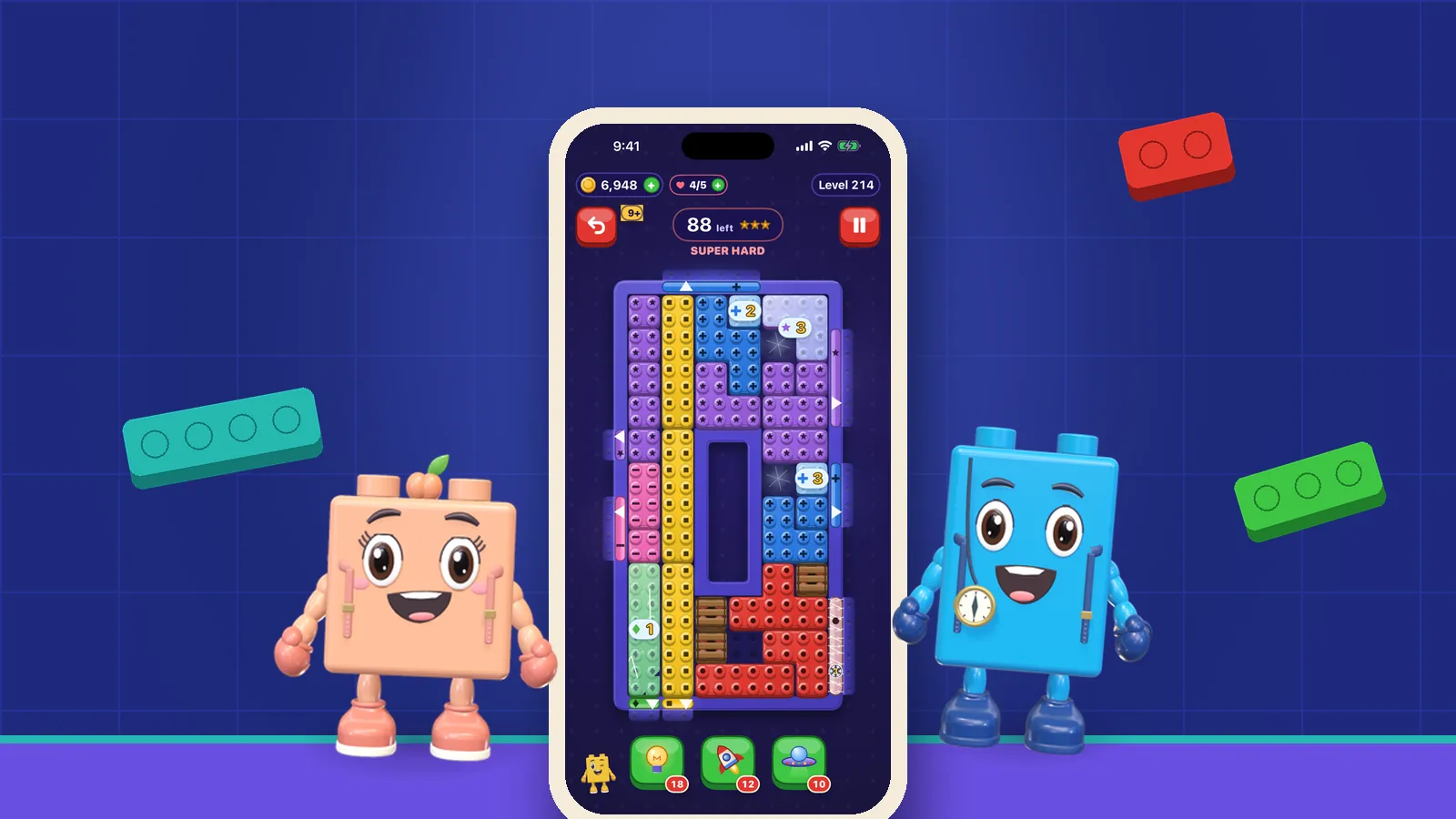
The word essential matters. In a sliding puzzle, the brick has to be seen to move, or the player cannot follow the board. But the confetti, the bouncing camera and the drifting background are decoration, and decoration can go. In OutBrick, Reduce Motion is honoured everywhere: with it on, the game reduces parallax, confetti and spring-heavy transitions, while the bricks themselves still show where they went. We describe the other comfort controls, for sound, music and haptics, on the accessibility page.
- Keep the camera still. Move the pieces, not the world.
- Avoid screen shake, full-screen zooms and rotating transitions, or turn them off under Reduce Motion.
- Keep parallax subtle and remove it under Reduce Motion.
- Never flash large areas of the screen, and keep celebrations short.
- Test with Reduce Motion on and check that nothing important disappears.
Turn on Reduce Motion before anything else, and in the same menu try Prefer Cross-Fade Transitions. Then look inside each game’s settings for its own options: camera shake, motion blur, field of view and screen effects are common in larger games. Play in a well-lit room, hold the device a little further away so it fills less of your view, and take breaks before symptoms build rather than after. Headsets are the most demanding case of all; we discuss comfort on Apple Vision Pro separately.
And choose games that are calm by design. A turn-based puzzle with a steady board is a far easier place to start than a game built on speed. Our guide to what makes a puzzle game relaxing covers the other things to look for, and sensory-friendly game design looks at sound, light and surprise more broadly.
If a game ignores Reduce Motion, tell its developer, and be specific: which screen, which effect, and what it did to you. Many teams test with the setting off and simply never see the problem. The same goes for us; if something in OutBrick still moves too much for you with Reduce Motion on, our support page is the place to say so, and it is the kind of report that gets fixed.
Filed under
Questions, answered
A few useful answers
Why do some games make me feel motion sick?
When a large part of your view moves as if you were moving, but your inner ear feels no movement, the conflicting signals can cause dizziness, eye strain and nausea. This is called visually induced motion sickness.
What does Reduce Motion do on iPhone?
It replaces zooming and sliding system transitions with gentler effects and tells apps you want less movement. Apps that honour it remove or soften their own animations too.
Who is most likely to get motion sick from screens?
Research links it most strongly to a history of motion sickness, migraine and ongoing dizziness, though susceptibility varies widely between people. Persistent symptoms are worth discussing with a doctor.
Does OutBrick support Reduce Motion?
Yes. With Reduce Motion on, OutBrick reduces parallax, confetti and spring-heavy transitions everywhere, while bricks still visibly slide so you can follow the board.
APA 7
References
Where a source is a studio’s own history or a news account rather than a study, the article says so beside the claim.
- Rebenitsch, L., & Owen, C. (2016). Review on cybersickness in applications and visual displays. Virtual Reality, 20(2), 101–125. doi.org/10.1007/s10055-016-0285-9 (opens in a new tab)
- Keshavarz, B., Riecke, B. E., Hettinger, L. J., & Campos, J. L. (2015). Vection and visually induced motion sickness: How are they related? Frontiers in Psychology, 6, 472. doi.org/10.3389/fpsyg.2015.00472 (opens in a new tab)
- Keshavarz, B., Philipp-Muller, A. E., Hemmerich, W., Riecke, B. E., & Campos, J. L. (2019). The effect of visual motion stimulus characteristics on vection and visually induced motion sickness. Displays, 58, 71–81. doi.org/10.1016/j.displa.2018.07.005 (opens in a new tab)
- Golding, J. F., Rafiq, A., & Keshavarz, B. (2021). Predicting individual susceptibility to visually induced motion sickness by questionnaire. Frontiers in Virtual Reality, 2, 576871. doi.org/10.3389/frvir.2021.576871 (opens in a new tab)
- Golding, J. F. (1998). Motion sickness susceptibility questionnaire revised and its relationship to other forms of sickness. Brain Research Bulletin, 47(5), 507–516. doi.org/10.1016/s0361-9230(98)00091-4 (opens in a new tab)
- Rebenitsch, L., & Owen, C. (2014). Individual variation in susceptibility to cybersickness. In Proceedings of the 27th Annual ACM Symposium on User Interface Software and Technology (pp. 309–317). ACM. doi.org/10.1145/2642918.2647394 (opens in a new tab)
- Bronstein, A. M. (1995). Visual vertigo syndrome: Clinical and posturography findings. Journal of Neurology, Neurosurgery & Psychiatry, 59(5), 472–476. doi.org/10.1136/jnnp.59.5.472 (opens in a new tab)