Block Blast!+ vs OutBrick: two kinds of block puzzle
Compare Block Blast!+ and OutBrick by their actual mechanics: placing shapes to clear lines, sliding bricks to exits, and choosing how to pay.
A grid full of colourful blocks can hide two very different puzzles. In one, you choose where a new shape belongs. In another, every piece already has a place and your job is to find its way out. Block Blast!+ and OutBrick make that distinction useful: both reward reading space, but they ask different questions about it. If you searched for a game like Block Blast, the most helpful answer is not a list of similar screenshots. It is an explanation of what you will actually do. This is a source-based mechanics guide, checked on 30 September 2026, written by the team behind OutBrick. We have not run a hands-on comparison or measured which game players prefer.
Apple describes Block Blast!+ as a game of fitting blocks on a grid, completing rows and columns and building combinations (Apple, 2026). Its core question is “Where should this shape go?” An empty patch is an opportunity to place something. A line near completion is a possible way to recover space. You are reading the footprint of a shape against the spaces still available.
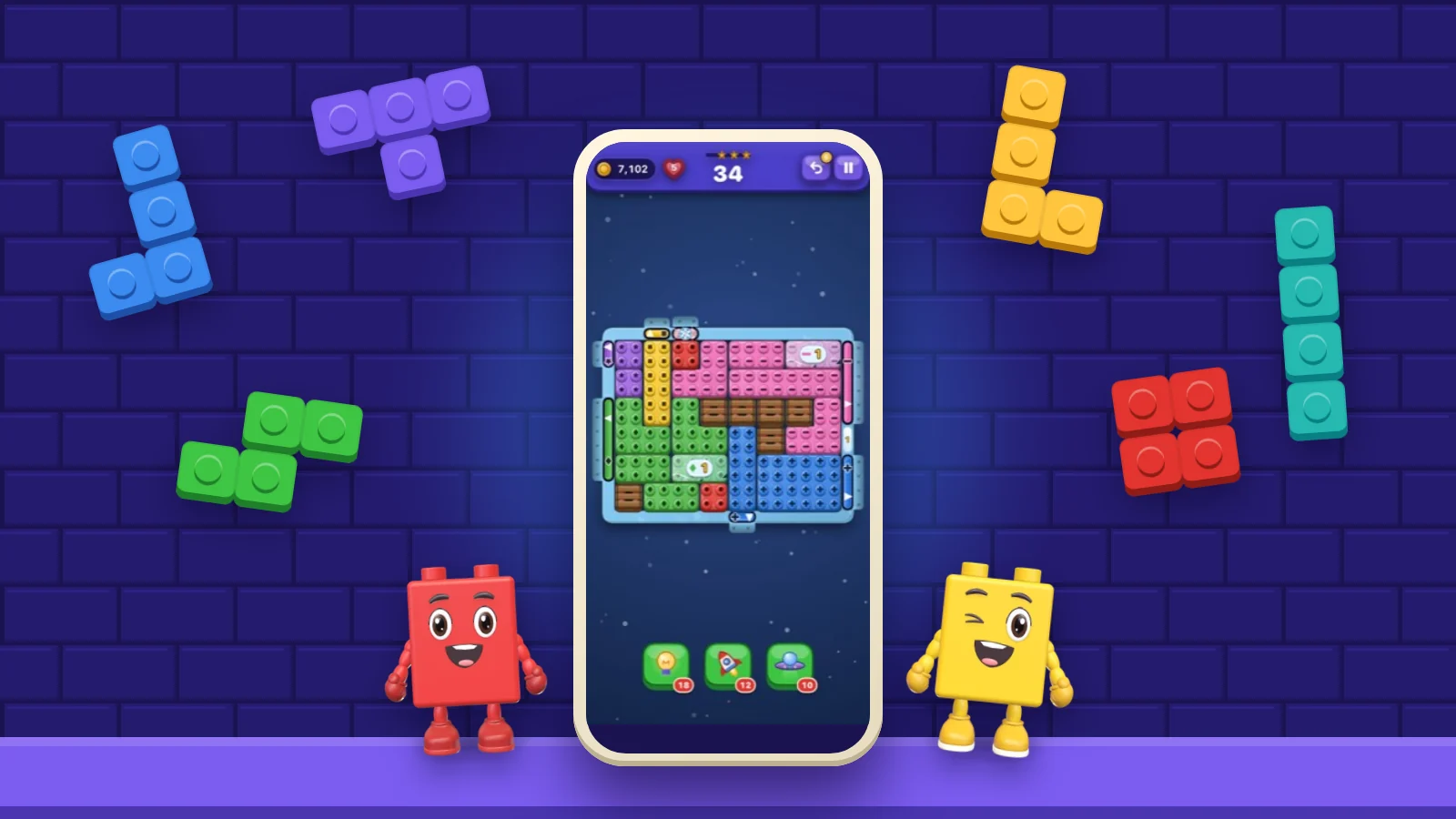
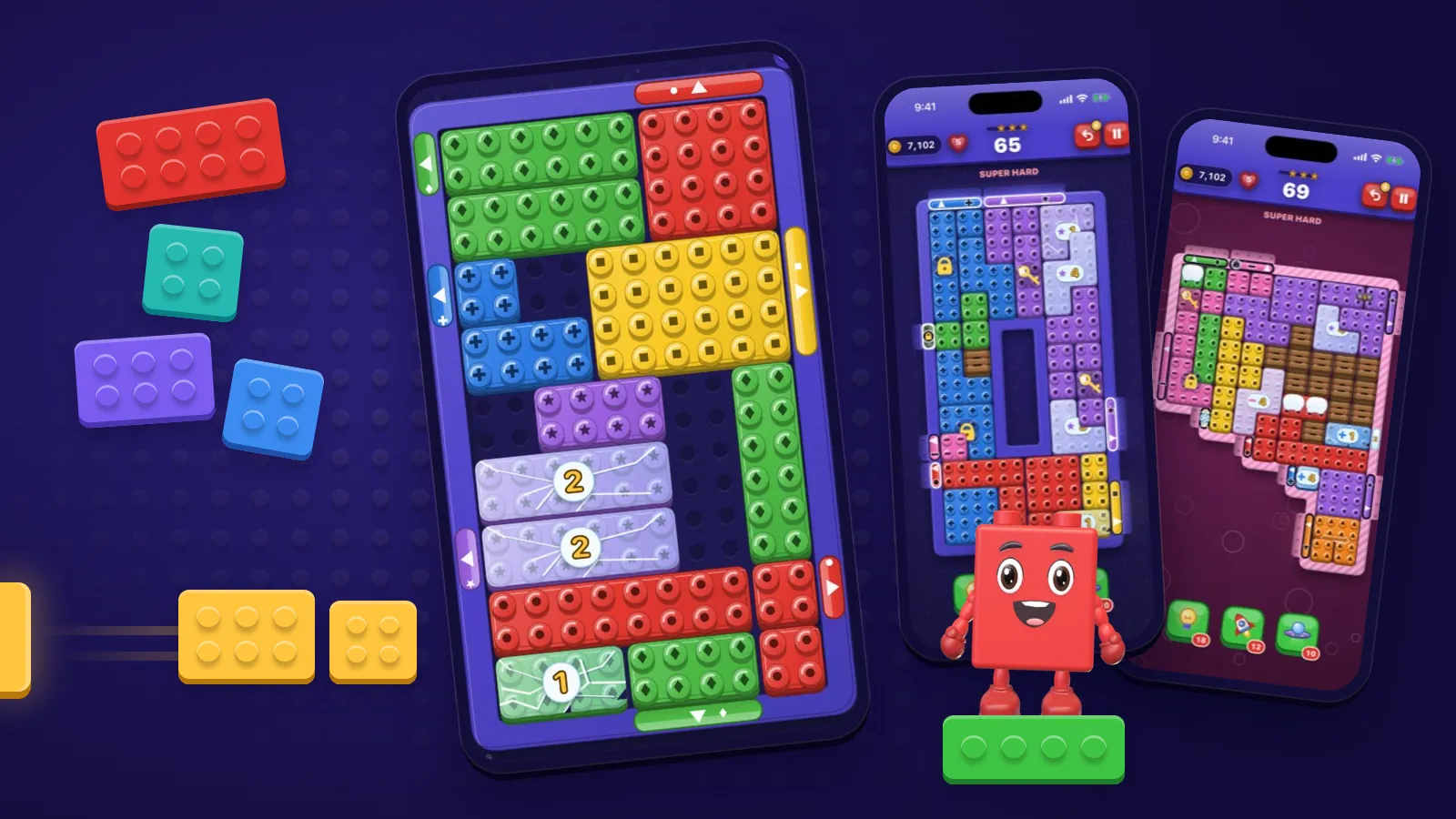
OutBrick’s question is “What must move before this brick can leave?” You select a brick already on the board and slide it. It stops where you let go, goes home through the gate of its own colour or swaps with a neighbour, and three or more of a colour in a line clear. On the classic boards still playable in the browser, a brick glides until something stops it, so an empty patch may be a route, but it may also let a brick travel farther than you wanted. More free space is not automatically the better position.
Consider a long straight lane. In a placement puzzle, keeping that lane open might preserve room for a long shape. In a gliding puzzle, an open lane could carry a brick past the turning point it needs. Another brick may have to sit in the lane as a temporary brake. The same visual feature has a different strategic meaning because the movement rule changes what you can do with it.
Our sliding-block puzzle introduction explains that movement rule in more detail. For a wider view of placement, falling pieces and routing, see what makes games like Tetris last. Neither mechanic is a more advanced version of the other. They are different ways of making limited space interesting.
In a placement puzzle, inspect the offered shape, its possible landing spaces and the board that remains afterwards. A position can be legal and still be inconvenient: it may leave an awkward small gap or consume the only space that fits another shape. Finishing a line can be attractive because it changes the amount and shape of available space. This describes a general placement problem, not an optimal strategy for every Block Blast mode.
On OutBrick’s classic gliding boards, inspect the selected brick’s whole travel path and final stopping point. Moving a blocker out of the way may open a gate route, but moving it too early may remove the stopping surface another brick needs. A useful plan therefore describes dependencies: blue must stop here before red can align with its exit. The board asks you to rearrange a system, rather than simply choose an empty destination.
Isaksen et al. (2017) separated strategic choice from execution demands in simulations of Tetris and Puzzle Bobble variants. Their work shows why a single difficulty label can conceal different requirements. It did not study Block Blast!+ or OutBrick. We use that distinction as a comparison tool: ask both whether you enjoy deciding on a move and whether you enjoy carrying it out.
That matters if you like thoughtful puzzles but dislike a particular input style. Dragging a shape to a location and giving an existing brick a direction are separate interactions. Screenshots will not settle which feels clearer to you. Try a simple example, read the instructions and observe what a refused move means before treating an unfamiliar control as evidence that the puzzle is too hard.
Sources3Isaksen, A., Wallace, D., Finkelstein, A., & Nealen, A. (2017). Simulating strategy and dexterity for puzzle games. In 2017 IEEE Conference on Computational Intelligence and Games (CIG) (pp. 142–149). IEEE.
Some players want the repeated satisfaction of a line disappearing. Others want a final board clear whose route they gradually uncover. You may enjoy both at different times. This distinction is about the shape of an enjoyable session, not a judgement that scoring is shallow or that finite boards are intellectually superior.
Ryan et al. (2006) examined gaming motivation across four studies and linked perceived competence and autonomy with enjoyment and preferences. Those findings do not rank these apps. They give a useful personal question: does this game let you understand what happened and make choices that feel like yours? A familiar mechanic can provide that feeling quickly; a new one may need a few boards before it becomes legible.
Abuhamdeh and Csikszentmihalyi (2012) studied challenge in Internet chess and everyday activities. Challenge related to enjoyment differently depending on motivation and activity type. Their result is a reason to avoid declaring the gentlest or hardest puzzle the universal winner. If you want to build a score, preserving space may be compelling. If you want to untangle a bounded arrangement, a matching-gate board may fit better.
Give yourself a concrete test. After a short session, name one decision you enjoyed: reserving a space, completing a combination, constructing a stopping point or finding an exit order. “I liked that decision” tells you more than “I ought to like this popular game”. You can also decide that neither is right for the moment and keep looking.
Sources4Ryan, R. M., Rigby, C. S., & Przybylski, A. (2006). The motivational pull of video games: A self-determination theory approach. Motivation and Emotion, 30(4), 344–360.1Abuhamdeh, S., & Csikszentmihalyi, M. (2012). The importance of challenge for the enjoyment of intrinsically motivated, goal-directed activities. Personality and Social Psychology Bulletin, 38(3), 317–330.
Apple announced that Block Blast!+ would join Apple Arcade on 3 September 2026, describing the Arcade edition as free of advertising and in-app purchases (Apple, 2026). That statement belongs to Block Blast!+. The standard Block Blast! app is a separate listing; a plus sign is not cosmetic when it identifies a different distribution model. Check which edition a recommendation, screenshot or review actually discusses.
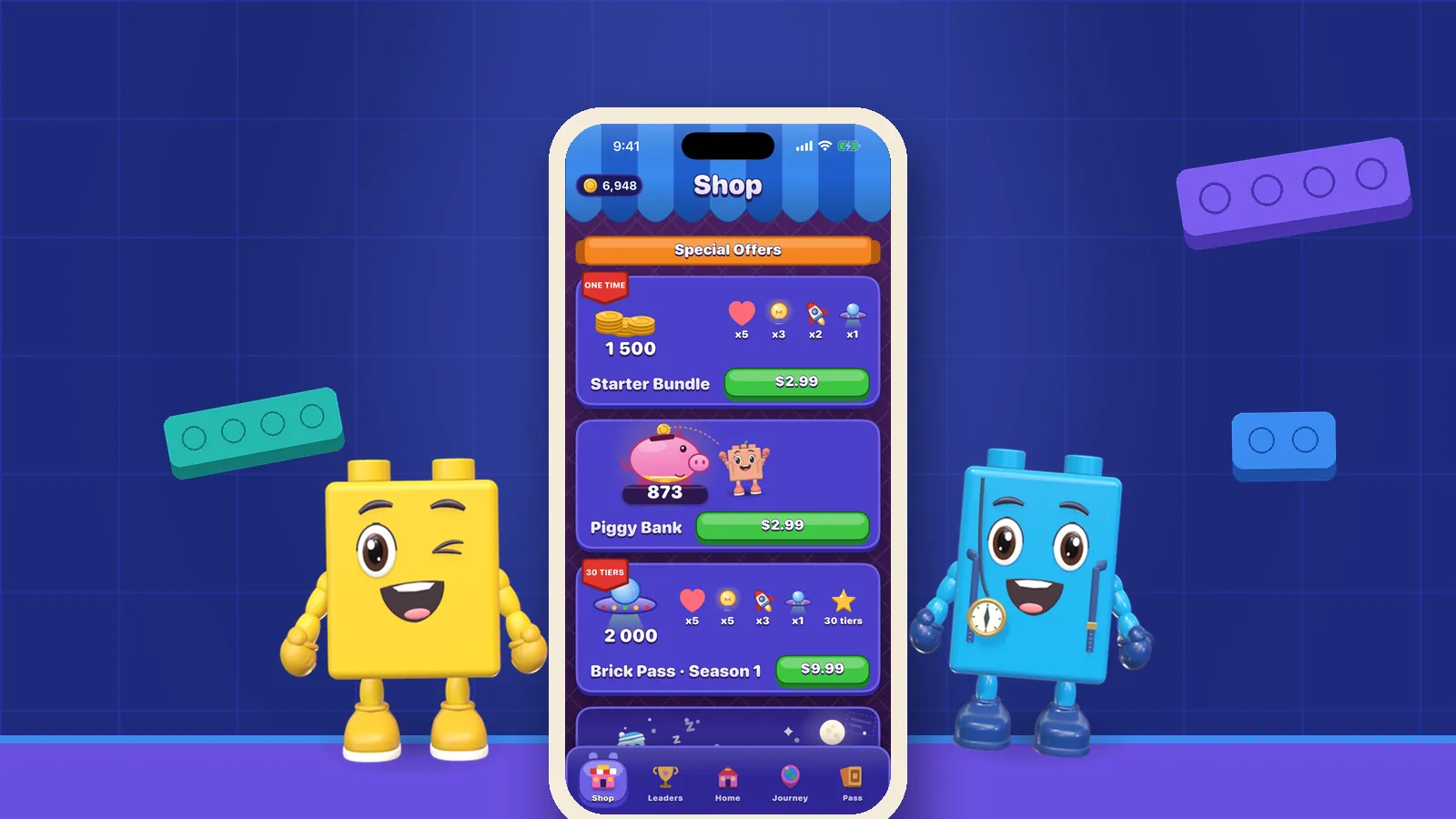
Arcade access depends on a subscription and its current terms. OutBrick is a standalone App Store download with in-app purchases and optional rewarded advertising. It also has lives and move limits. Do not turn “free to download” into a promise that all access, retries or extras are free, and do not assume a subscription puzzle’s conditions describe a standalone one.
If you already subscribe to Arcade, inspect the current Block Blast!+ listing to see whether it suits your device and preferences. If you do not, consider the wider catalogue and subscription terms before buying access for one game. For OutBrick, our fair-play explanation outlines its lives, undo and optional advertising arrangements. A comparison is useful when it makes those choices understandable.
OutBrick removed Rush in version 4.2; its current puzzle rule uses a move limit rather than a countdown. That does not establish the exact pacing of every Block Blast edition or mode. Read the current description of the edition you intend to install instead of inferring a clock from its name, score display or colourful presentation.
First, explain the rule back to yourself. For placement: put a shape into a legal space and work towards a complete line. For OutBrick: slide a brick towards its matching gate, or swap it into a line of three or more of its colour. Then play slowly enough to notice whether each action confirms that explanation. A comparison should help you enter the right puzzle, not persuade you to tolerate the wrong one.
Iacovides et al. (2015) used multiple case studies, including observation and interviews, to examine learning and involvement in games. Their accounts connected breakthroughs in understanding with involvement, especially when players felt responsible for progress. These are qualitative findings from other games. They support paying attention to your understanding without promising that one brief trial reveals a universal preference.
You can try an OutBrick board in the browser to inspect the classic glide-to-stop idea. That demonstration samples the older mechanic, without the App Store game’s swaps and matches; it does not reproduce every feature, cost or accessibility behaviour of the installed app. If you enjoy it, view OutBrick on the App Store and check current device requirements and purchase information before downloading.
The useful outcome may be a very ordinary sentence: “I like fitting new shapes more than rerouting old ones”, or the reverse. That is enough. Block puzzles share a visual vocabulary, but their verbs decide the experience. Choose the verb you want to keep doing.
Sources2Iacovides, I., Cox, A. L., McAndrew, P., Aczel, J., & Scanlon, E. (2015). Game-play breakdowns and breakthroughs: Exploring the relationship between action, understanding, and involvement. Human–Computer Interaction, 30(3–4), 202–231.
Apple. (2026, August 11). Apple Arcade’s lineup of hit puzzle games gets even bigger with the addition of Block Blast!+ and Art of Fauna: Cozy Puzzles+. Apple Newsroom. Official Arcade announcement. The studies below provide design and motivation context; none tested either game in this comparison.
Filed under
Questions, answered
A few useful answers
Is OutBrick the same kind of puzzle as Block Blast!+?
They use different core mechanics. Block Blast!+ asks you to place shapes to complete rows and columns; OutBrick asks you to slide existing bricks home through matching gates and swap them into matches of three or more.
Is Block Blast!+ the same app as standard Block Blast!?
Block Blast!+ is the Apple Arcade edition, with subscription access and the advertising and purchase conditions described by Apple. Check the separate standard app listing rather than assuming those conditions apply to it.
Which is better for planning?
Both can involve planning, but around different constraints. Placement asks how a shape affects remaining space, while OutBrick asks how movement order, swaps and gates affect routes.
Can I try OutBrick without installing it?
The browser board lets you try the classic glide-to-stop mechanic. Check the App Store listing separately for the installed app’s compatibility, features and costs.
APA 7
References
Where a source is a studio’s own history or a news account rather than a study, the article says so beside the claim.
- Abuhamdeh, S., & Csikszentmihalyi, M. (2012). The importance of challenge for the enjoyment of intrinsically motivated, goal-directed activities. Personality and Social Psychology Bulletin, 38(3), 317–330. doi.org/10.1177/0146167211427147 (opens in a new tab)
- Iacovides, I., Cox, A. L., McAndrew, P., Aczel, J., & Scanlon, E. (2015). Game-play breakdowns and breakthroughs: Exploring the relationship between action, understanding, and involvement. Human–Computer Interaction, 30(3–4), 202–231. doi.org/10.1080/07370024.2014.987347 (opens in a new tab)
- Isaksen, A., Wallace, D., Finkelstein, A., & Nealen, A. (2017). Simulating strategy and dexterity for puzzle games. In 2017 IEEE Conference on Computational Intelligence and Games (CIG) (pp. 142–149). IEEE. doi.org/10.1109/CIG.2017.8080427 (opens in a new tab)
- Ryan, R. M., Rigby, C. S., & Przybylski, A. (2006). The motivational pull of video games: A self-determination theory approach. Motivation and Emotion, 30(4), 344–360. doi.org/10.1007/s11031-006-9051-8 (opens in a new tab)