Sokoban vs sliding-block puzzles: push, glide, plan
Learn how Sokoban pushing differs from glide-to-stop block puzzles, with practical examples of corners, access routes and temporary stopping points.
A crate is one square from its goal. Moving it looks obvious, until you notice that the person who must push it cannot get behind it. A coloured brick is beside its exit. Moving that looks obvious too, until an open lane sends it beyond the place you intended. Sokoban and gliding-block puzzles share an interest in space and order, but the obstacle you are planning around is different. This guide compares classic Sokoban rules with the glide-to-stop rule of OutBrick’s classic boards, which its browser demo keeps. It is a mechanics explanation, not a difficulty ranking, and its examples are invented teaching positions rather than solutions to named levels.
Classic Sokoban places a character, crates, walls and storage goals on a grid. The character walks into empty space and pushes a crate when the square beyond it is empty. It cannot pull a crate, push a chain of crates or walk through walls. Completion means placing the crates on the goals. Individual implementations can add variants, so this description concerns the classic rule set, not every app using the name.
The character’s position is part of the puzzle. A crate with empty space to its right cannot necessarily be pushed right: the character must also reach its left side. Thinking only about the crate’s destination misses half the move. A short walking route that gets behind a crate may be essential even when it does not move any cargo towards a goal.
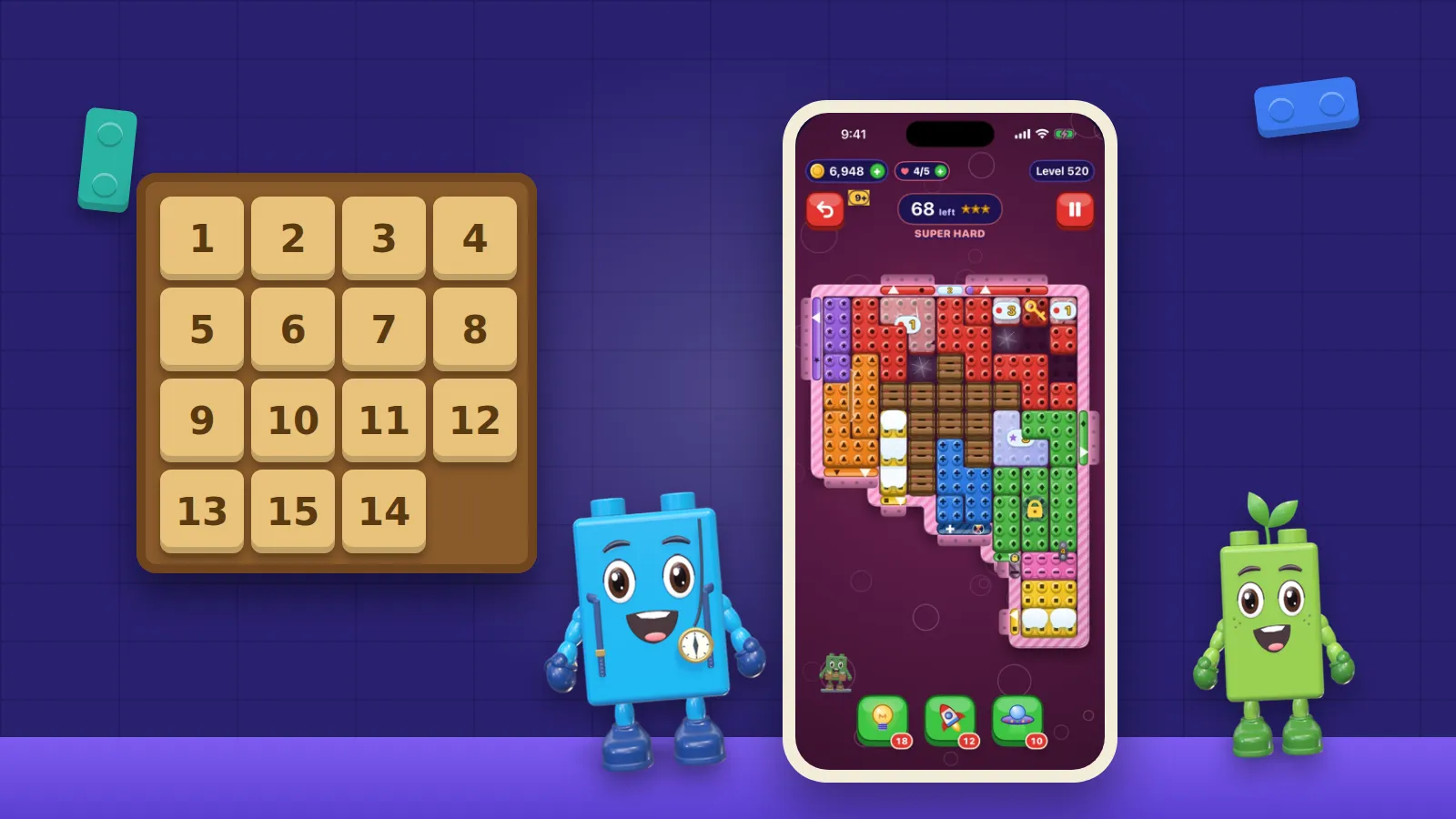
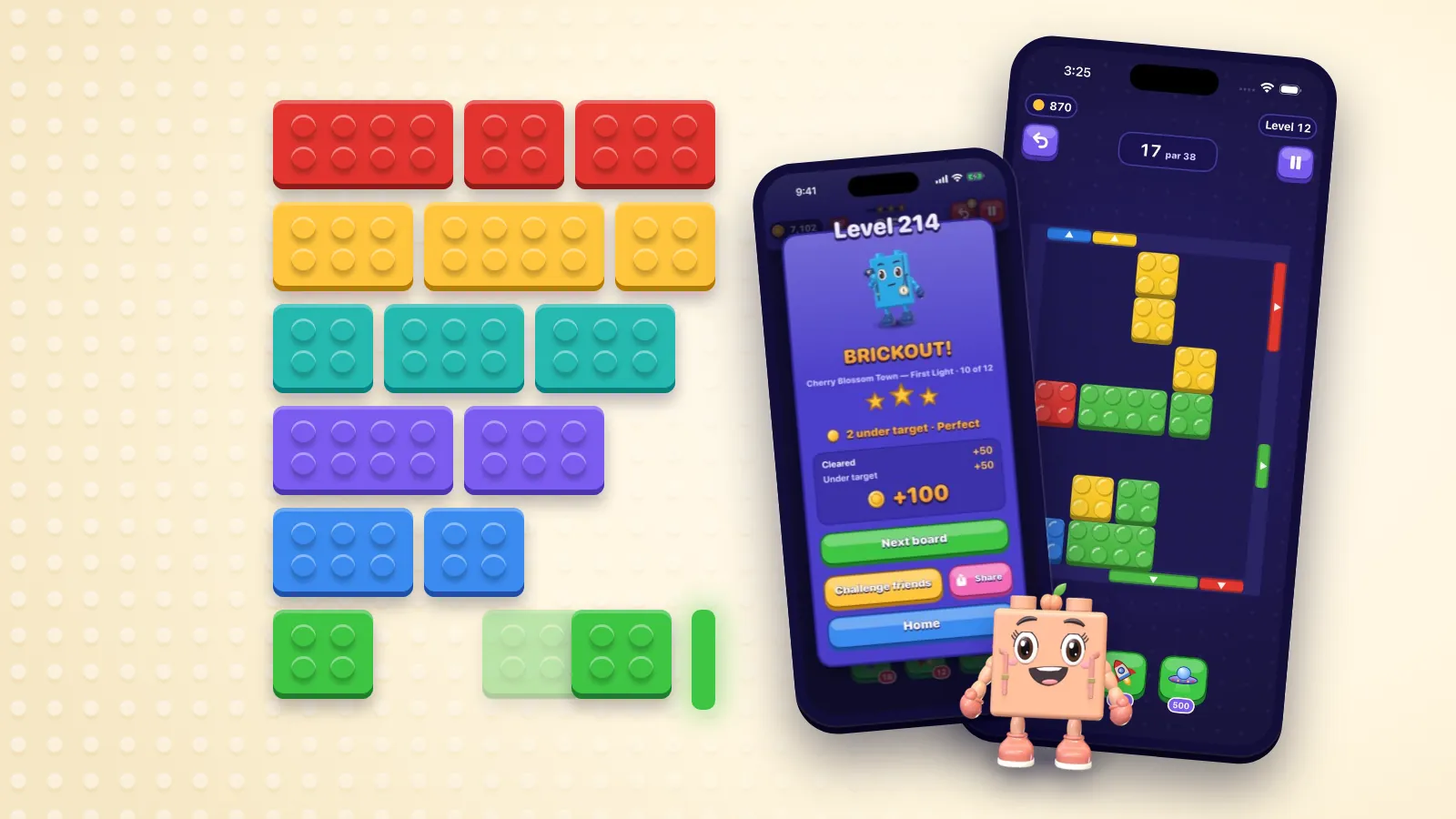
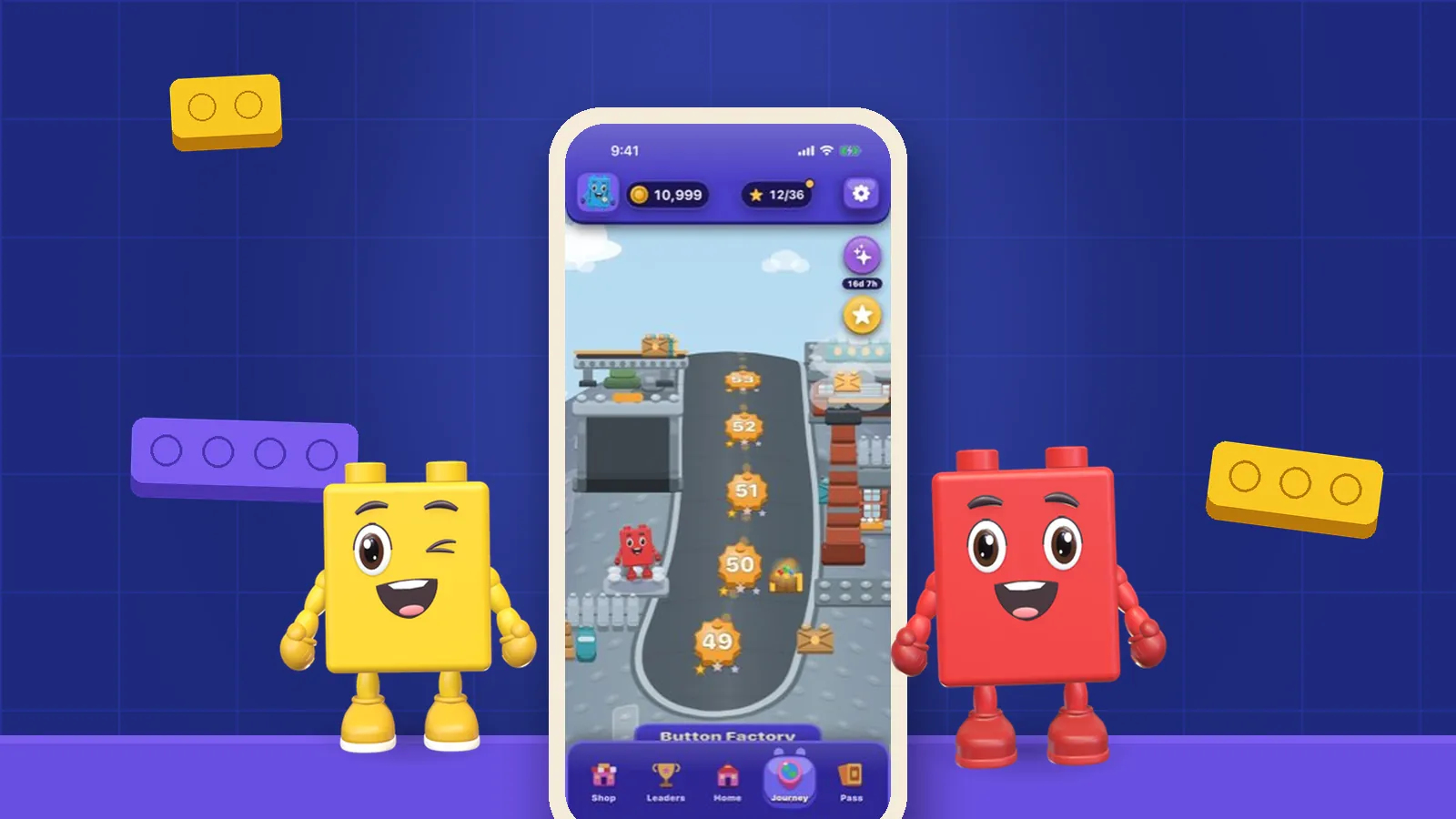
On OutBrick’s classic boards, still playable in the browser, you directly select a brick and give it a direction. It glides until something stops it, and each brick leaves through its matching-colour gate. (The App Store game now plays Slide & Match, where a brick stops where you let go and swaps make matches.) There is no warehouse worker whose walking route you must preserve. Your attention shifts to the brick’s trajectory, available stops and relationship to other bricks. Keys, locks and crates appear on later boards, but that does not make its core movement identical to Sokoban.
“Sliding-block puzzle” is a broad category. Some sliding games allow small increments or restrict a piece to one axis; others use gliding rules. Our history of sliding-block puzzles gives that wider context. Always identify the movement rule of the particular game before deciding that you already know how to solve it.
Imagine a Sokoban crate next to the bottom wall, with a wall immediately to its left. If it is pushed left into that corner and the corner is not a goal, it cannot get out under classic rules. To move it right, the character would need to stand inside the left wall. To move it up, the character would need to stand below the bottom wall. The crate is trapped even if the rest of the warehouse is spacious.
Junghanns and Schaeffer (2001) studied Sokoban as a demanding single-agent search problem. Their solver work describes the importance of domain knowledge, including detecting deadlocks and reducing unproductive search. This is computer-search research, not an experiment showing how people should train. It supplies an important distinction: a legal move can lead to a position from which the goal is unreachable.
Now imagine a gliding brick that must stop in a central column before travelling towards a gate. A second brick sits one square beyond the desired stop and acts as a brake. Moving that second brick away may appear to tidy the board, but it allows the first brick to glide past the alignment. The obstacle was doing a job. This illustrative position depends on a glide-to-stop rule and should not be generalised to every sliding puzzle.
Neither example says you should never move into a corner or never clear a lane. A goal in the corner can make the Sokoban push correct; a different stopping surface can make the gliding lane safe. The question is what remains possible after the move. A tidy-looking board and a solvable board are not the same thing.
Sources3Junghanns, A., & Schaeffer, J. (2001). Sokoban: Enhancing general single-agent search methods using domain knowledge. Artificial Intelligence, 129(1–2), 219–251.
Consider a Sokoban corridor connecting two rooms. Pushing a crate into its entrance may bring the crate closer to a storage square while cutting off the character’s route to the other room. You might later need to approach that crate from the far side, but have lost the only way to get there. Before a push, ask where the character can walk afterwards and which side of each remaining crate will still be reachable.
The comparable question on OutBrick’s classic boards concerns transit and stops. If a blue brick must cross a lane before a red brick exits, clearing red first may remove a useful brake or change the available route. Conversely, leaving red in place forever may block blue’s path. The dependency is temporary: keep the piece while it is useful, then remove it when its job is finished.
Write a plan in relationships rather than a long string of directions. In Sokoban: “Keep the doorway open until I can get behind the upper crate.” In a gliding puzzle: “Keep this brick as a stop until the other one is aligned.” Those descriptions make the reason for a move visible. If the board changes, you can check whether the reason still applies instead of trying to remember a vanished sequence.
For more on reading dependencies, see our guide to inspecting a board before moving. You do not need a perfect plan for the entire board. It is often enough to identify one access route that must survive and one useful position that should not be disturbed yet.
Checking the consequences of a move is useful in both families. So is recognising that a piece may need to move away from its destination before it can reach it. What transfers less reliably is a specific movement expectation. A Sokoban player may assume they can nudge a brick one square; a gliding player may forget that a warehouse character needs room behind a crate.
Iacovides et al. (2015) examined action, understanding and involvement through multiple case studies of play. Their qualitative accounts describe breakthroughs in understanding as an important part of involvement. They do not establish a measured transfer effect between Sokoban and OutBrick. Our practical application is to treat a surprising move as a possible rule misunderstanding before blaming your planning ability.
Hearn and Demaine (2005) analysed the formal computational complexity of sliding-block puzzles and other constrained problems. Their proof concerns mathematical problem families, not the difficulty of a particular consumer level. It reinforces a useful boundary for this comparison: the permitted moves define the problem. Two boards that look similar can require different reasoning when one movement rule changes; their paper does not rank Sokoban against OutBrick.
Try a simple board when changing puzzle families. Predict one legal action and its exact result, perform it and compare. Repeat with a blocked action if the game allows safe exploration. This small rule check is an editorial suggestion rather than a tested training programme, but it can prevent a familiar-looking board from quietly borrowing the wrong rules in your head.
Sources2Iacovides, I., Cox, A. L., McAndrew, P., Aczel, J., & Scanlon, E. (2015). Game-play breakdowns and breakthroughs: Exploring the relationship between action, understanding, and involvement. Human–Computer Interaction, 30(3–4), 202–231.1Hearn, R. A., & Demaine, E. D. (2005). PSPACE-completeness of sliding-block puzzles and other problems through the nondeterministic constraint logic model of computation. Theoretical Computer Science, 343(1–2), 72–96.
Sokoban is a strong candidate when you enjoy planning around a character’s access and the consequences of irreversible pushes. Gliding puzzles are worth trying when you enjoy constructing stops and rerouting pieces directly. Neither preference needs a claim that one genre improves your brain more. These mechanics can be enjoyable on their own terms.
Kotovsky et al. (1985) investigated why different presentations of formally equivalent Tower of Hanoi problems produced different difficulty. Their work concerns those experimental problems, not these two puzzle genres. It is a reason to distinguish the structure of a task from the ease of understanding its rules: an unfamiliar presentation can make a problem feel harder without adding more pieces. Difficulty and personal fit remain different questions.
You can play an OutBrick demonstration to see how a gliding rule changes a lane. Read our colour-sort puzzle tips when you want to connect that movement with matching gates. If the mechanic appeals, see OutBrick on the App Store for current compatibility and purchase information. The app has move limits, lives and optional rewarded advertising; an untimed puzzle is not unlimited access.
For either family, take one useful question to your next board: “What must remain available after this move?” In Sokoban the answer may be a square the character needs to stand on. On OutBrick’s classic boards it may be a stopping surface. Seeing that difference turns a vague similarity between colourful blocks into a much clearer choice about what you want to play.
Sources4Kotovsky, K., Hayes, J. R., & Simon, H. A. (1985). Why are some problems hard? Evidence from Tower of Hanoi. Cognitive Psychology, 17(2), 248–294.
Sokoban.jp. (n.d.). Rules. Classic Sokoban rules. Retrieved September 30, 2026. The examples above are original illustrations of those rules and OutBrick’s classic movement rule. The research below provides context about search, involvement and motivation; it does not independently evaluate OutBrick.
Filed under
Questions, answered
A few useful answers
Can you pull a crate in classic Sokoban?
No. Classic Sokoban allows the character to push a crate into an empty square, but not pull it or push a chain of crates; variants may introduce different rules.
Why is a corner dangerous in Sokoban?
A crate pushed into a non-goal corner can become immovable because the character cannot reach the sides needed to push it away. Check both the crate’s destination and the character’s future access.
Does OutBrick move one square at a time like Sokoban?
No. On OutBrick’s classic boards, bricks glide in the selected direction until something stops them; in the App Store game’s Slide & Match boards, a brick stops where you let go. Planning therefore includes stopping points and matching-colour exits, rather than a character’s pushing position.
Will Sokoban skills automatically make OutBrick easy?
Some habits, such as checking move order and preserving routes, may be useful. The movement rules differ, so familiar tactics need to be checked against the new game rather than assumed to transfer.
APA 7
References
Where a source is a studio’s own history or a news account rather than a study, the article says so beside the claim.
- Hearn, R. A., & Demaine, E. D. (2005). PSPACE-completeness of sliding-block puzzles and other problems through the nondeterministic constraint logic model of computation. Theoretical Computer Science, 343(1–2), 72–96. doi.org/10.1016/j.tcs.2005.05.008 (opens in a new tab)
- Iacovides, I., Cox, A. L., McAndrew, P., Aczel, J., & Scanlon, E. (2015). Game-play breakdowns and breakthroughs: Exploring the relationship between action, understanding, and involvement. Human–Computer Interaction, 30(3–4), 202–231. doi.org/10.1080/07370024.2014.987347 (opens in a new tab)
- Junghanns, A., & Schaeffer, J. (2001). Sokoban: Enhancing general single-agent search methods using domain knowledge. Artificial Intelligence, 129(1–2), 219–251. doi.org/10.1016/S0004-3702(01)00109-6 (opens in a new tab)
- Kotovsky, K., Hayes, J. R., & Simon, H. A. (1985). Why are some problems hard? Evidence from Tower of Hanoi. Cognitive Psychology, 17(2), 248–294. doi.org/10.1016/0010-0285(85)90009-X (opens in a new tab)