No-timer block-sort puzzles for iPhone: a fit guide
Compare OutBrick, Block Buster - No Timer and Color Block Jam by their published constraints. Learn what untimed play does and does not promise.
You have seen the move you want to make, but would like another moment to check what happens afterwards. A countdown makes that moment expensive. A move budget lets you keep thinking, then charges you when you act. That difference is the real reason to search for a no-timer block-sort puzzle on iPhone. It is not a search for a game with no challenge. Here we compare the published promises of OutBrick, Block Buster - No Timer and Color Block Jam, and offer a way to choose without confusing untimed play with unlimited moves, lives or free purchases. The listings were checked on 30 September 2026; this is not hands-on performance testing.
An untimed board allows a pause between decisions without consuming a displayed countdown. It can still penalise the wrong move, cap the number of actions, limit retries or offer paid help. Those are separate constraints. If you search by a single phrase, you can find the right pacing and still dislike the way a game handles failure.
Picture a corridor blocked by two pieces. You need to move one aside, slide the other out, then restore a stopping point. Under a move budget, the question is whether that sequence spends too many actions. Under a countdown, the question also includes how quickly you can identify and execute it. The same spatial arrangement can therefore support two different experiences.
Isaksen et al. (2017) modelled strategy and dexterity separately in simulations of Tetris and Puzzle Bobble. Their work gives a useful vocabulary for separating a plan from its execution. It is computational design research, not a human trial demonstrating that untimed games are healthier or improve reasoning. We use it here to clarify the choice, not to assign scientific scores to apps.
Write down the constraint you want removed. “I want time to inspect the board” is more actionable than “I want something relaxing.” You may also want generous retries, a readable interface or no connection requirement, but each needs its own check. Our guide to what makes a puzzle feel calm considers those other ingredients.
Sources3Isaksen, A., Wallace, D., Finkelstein, A., & Nealen, A. (2017). Simulating strategy and dexterity for puzzle games. In 2017 IEEE Conference on Computational Intelligence and Games (CIG) (pp. 142–149). IEEE.
Block Buster - No Timer, by Lion Studios Plus, makes the no-timer promise explicit in its title. Its description also advertises offline-friendly play, boosters and a dark mode. It is a relevant alternative when time to think is your first requirement; OutBrick is not the only game in this area worth considering (Lion Studios Plus, n.d.).
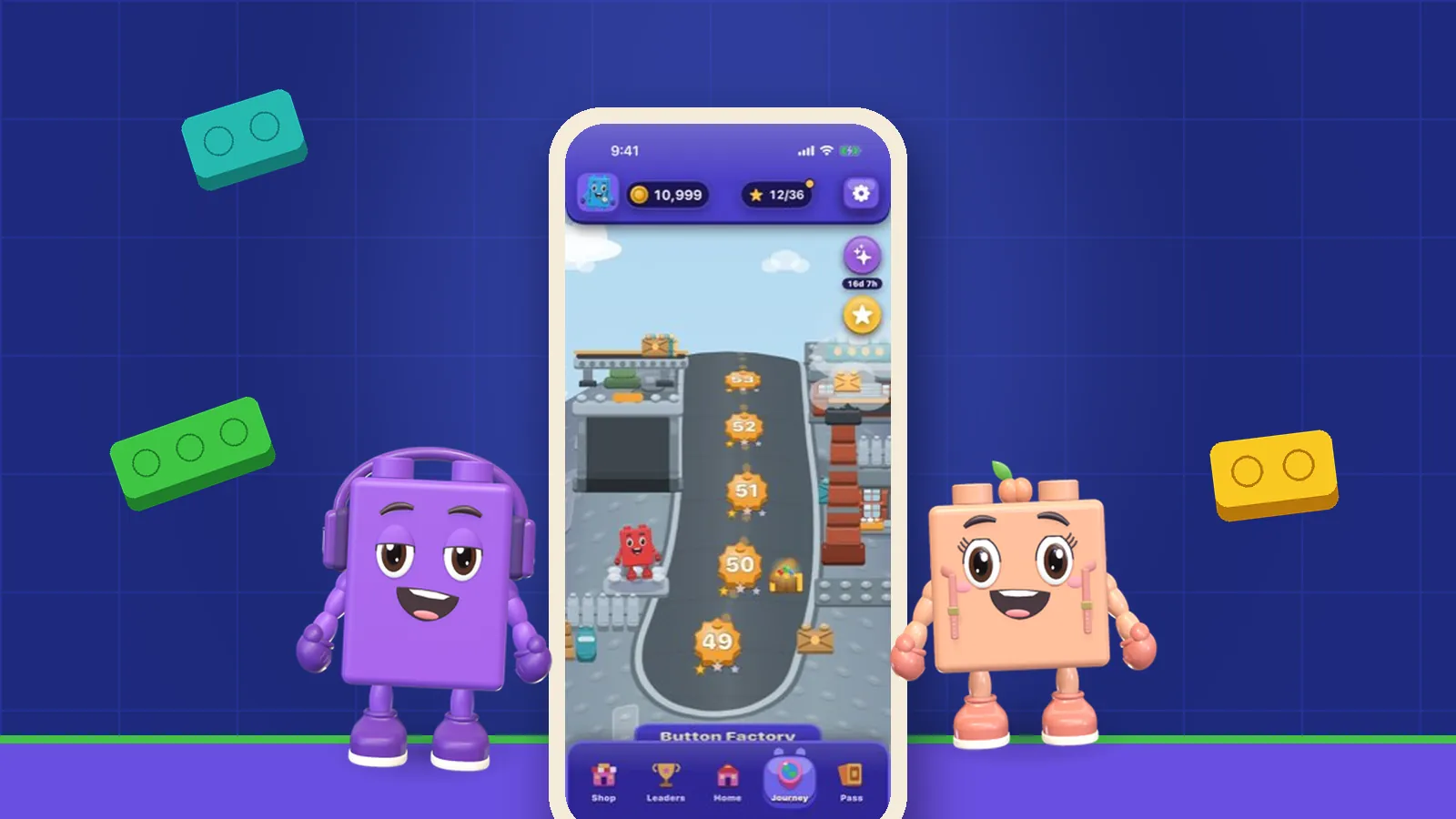
OutBrick offers matching-gate sliding boards, move constraints and a solver-checked collection. Its current version 4.2 release notes say Rush was withdrawn throughout the game and the per-board move limit remains. That is a published promise of untimed play, alongside constraints on actions and retries (Hamdi, n.d.).
Color Block Jam, by Rollic Games, describes moving blocks to matching doors and planning before time runs out. That makes it a useful timed reference for this decision. If carrying out a plan quickly is part of the fun, its published description may sound more appealing than a no-timer promise. We are not claiming that every screen or level follows one identical constraint (Rollic Games, n.d.).
These descriptions are starting points, not an exhaustive feature matrix. We have not tested every level, version, device or interruption scenario. Before deciding that an app matches your search, inspect the actual board header and failure conditions. A mode name or screenshot alone cannot tell you the full cost of a restart.
A common frustration is being asked to move before you understand what the movement will do. In a sliding puzzle, you may need to discover whether a piece stops at an empty square, against another piece or only at an edge. Removing the countdown gives you room to investigate that question. It does not solve the puzzle for you.
Iacovides et al. (2015) explored breakdowns and breakthroughs through multiple game-play case studies. Their findings connect involvement with developing understanding and feeling responsible for progress. This is qualitative evidence about experience, not proof that any one pacing system causes better learning. It does give a reason to value the moment when “I do not know what happened” becomes “I know what to try.”
For a move-limited board, use the thinking time to name the purpose of an action. “This puts a brake behind the long brick” is a plan; “perhaps this will help” is an experiment. Both can be useful. The distinction lets you decide whether to spend a move on testing a rule or on executing a route. Our guide to reading a board before moving offers a fuller method.
A countdown can also be enjoyable once the rule is familiar. Repeating a known sequence efficiently is a different pleasure from discovering it slowly. Do not mistake a personal preference for a verdict on game design. If you want both experiences, a game with optional modes can make sense; check whether the mode you want is available when and where you intend to use it.
Sources2Iacovides, I., Cox, A. L., McAndrew, P., Aczel, J., & Scanlon, E. (2015). Game-play breakdowns and breakthroughs: Exploring the relationship between action, understanding, and involvement. Human–Computer Interaction, 30(3–4), 202–231.
“Untimed” often gets treated as a synonym for “easy”, but a difficult spatial plan can remain difficult for an entire evening. You can have unlimited thinking time and still need to see a dependency you missed. Conversely, a simple plan can become demanding when you must execute it rapidly. The relevant preference is the source of the demand.
Abuhamdeh and Csikszentmihalyi (2012) found that enjoyment’s relationship with challenge depended on motivation and activity type across studies involving Internet chess and experience sampling. That is a useful counterweight to the idea that pressure is always bad. Their work did not compare these mobile games, and cannot establish a universal ideal level of challenge.
Ryan et al. (2006) associated perceived autonomy and competence with enjoyment and preferences across four studies of games. For this choice, ask whether the rules let you pursue the experience you came for. If you want to inspect a board slowly, a compulsory countdown may work against that intention. If you want to test fast execution, removing the clock may remove something you value.
Consider a small personal trial: play a few boards without buying help, then note what made you want to continue or stop. Was it the puzzle itself, the speed requirement, an unclear rule, or the interruption after a failed attempt? This is a practical observation exercise, not a clinical assessment. One session can clarify a preference without proving anything about long-term wellbeing.
Sources1Abuhamdeh, S., & Csikszentmihalyi, M. (2012). The importance of challenge for the enjoyment of intrinsically motivated, goal-directed activities. Personality and Social Psychology Bulletin, 38(3), 317–330.4Ryan, R. M., Rigby, C. S., & Przybylski, A. (2006). The motivational pull of video games: A self-determination theory approach. Motivation and Emotion, 30(4), 344–360.
First, verify the clock. Is the board untimed by default, or does the app ask you to select a mode? Can you pause and return? We have not tested backgrounding or resume behaviour, so do not infer it from a no-timer label. A board without a countdown can still be inconvenient if a session does not survive the interruptions you actually encounter.
Second, verify what a mistake costs. Look for move limits, lives, restarts and the terms of any booster. All three listings disclose in-app purchases. OutBrick also has lives and optional rewarded adverts (Hamdi, n.d.). This article does not promise unlimited retries, uninterrupted access or free help. Decide whether you are content to wait or stop before an offer appears.
Third, check the environment. OutBrick and Block Buster advertise offline play, but that does not guarantee every connected feature works offline (Hamdi, n.d.; Lion Studios Plus, n.d.). Download before travelling and consult our offline iPhone puzzle guide. If colour recognition, motion or speech output is essential, read our accessibility information and test on your own device.
Finally, sample the mechanic. Play an OutBrick board in your browser to see the classic glide-and-stop rule (the App Store game now adds swaps and matches), then download OutBrick on the Apple App Store if that kind of planning appeals to you. Native modes and accessibility require separate checks in the installed app. For someone whose first priority is an explicit no-timer product promise, Block Buster deserves a place on the shortlist too.
The most useful result is a game whose constraints you understand before committing time or money. You can prefer untimed planning today and a faster challenge tomorrow. Make that choice deliberately, with the current listing and the actual board in front of you.
The following dynamic US App Store pages were retrieved on 30 September 2026. This comparison describes published promises rather than independent tests. The scholarly references below inform the decision criteria and do not endorse any named game.
Lion Studios Plus. (n.d.). Block Buster - No Timer [Mobile app]. App Store. Retrieved September 30, 2026, from the Block Buster listing.
Hamdi, M. (n.d.). OutBrick: Block Sort Puzzle [Mobile app]. App Store. Retrieved September 30, 2026, from the OutBrick listing.
Rollic Games. (n.d.). Color Block Jam [Mobile app]. App Store. Retrieved September 30, 2026, from the Color Block Jam listing.
Filed under
Questions, answered
A few useful answers
Which block-sort game explicitly advertises no timer?
Lion Studios Plus’ Block Buster - No Timer makes that promise in its official App Store title. Check the current installed version and its other constraints before deciding it fits your sessions.
Does no timer mean unlimited moves or lives?
No. Thinking time, move budgets and retries are separate constraints. Read the board rules and any purchase terms rather than inferring them from the absence of a countdown.
Is OutBrick entirely timer-free?
According to its current version 4.2 App Store release notes, Rush was withdrawn and nothing in the game is timed. Move limits, lives and purchases remain separate constraints.
Why include Color Block Jam in an untimed-game guide?
Its official description mentions planning before time runs out, making it a useful timed comparison. Players who enjoy quick execution may prefer that kind of challenge.
APA 7
References
Where a source is a studio’s own history or a news account rather than a study, the article says so beside the claim.
- Abuhamdeh, S., & Csikszentmihalyi, M. (2012). The importance of challenge for the enjoyment of intrinsically motivated, goal-directed activities. Personality and Social Psychology Bulletin, 38(3), 317–330. doi.org/10.1177/0146167211427147 (opens in a new tab)
- Iacovides, I., Cox, A. L., McAndrew, P., Aczel, J., & Scanlon, E. (2015). Game-play breakdowns and breakthroughs: Exploring the relationship between action, understanding, and involvement. Human–Computer Interaction, 30(3–4), 202–231. doi.org/10.1080/07370024.2014.987347 (opens in a new tab)
- Isaksen, A., Wallace, D., Finkelstein, A., & Nealen, A. (2017). Simulating strategy and dexterity for puzzle games. In 2017 IEEE Conference on Computational Intelligence and Games (CIG) (pp. 142–149). IEEE. doi.org/10.1109/CIG.2017.8080427 (opens in a new tab)
- Ryan, R. M., Rigby, C. S., & Przybylski, A. (2006). The motivational pull of video games: A self-determination theory approach. Motivation and Emotion, 30(4), 344–360. doi.org/10.1007/s11031-006-9051-8 (opens in a new tab)