Water sort vs block sort: which puzzle style fits you?
Compare water-sort capacity puzzles with sliding-block routes, using concrete examples, practical selection tips and clear limits to the research.
A nearly sorted tube can still be the wrong place to pour. A brick beside its matching exit can still be in the wrong position to leave. Water sort and block sort both make colour matching look straightforward while hiding the interesting decision in the order of moves. But the resource you manage differs: room inside containers in one, routes and stopping places in the other. This guide compares those decisions rather than declaring a winner. For water sort, we use the published rules of IEC Global’s Water Sort Puzzle; for sliding block sort, we use the glide-to-stop rule of OutBrick’s classic boards, which its browser boards keep. Other games using either name may behave differently. We make OutBrick, so our examples come with that perspective rather than a claim to independent testing.
IEC Global’s Water Sort Puzzle description says you tap a glass to pour into another, with matching colour and enough receiving space required. The goal is to group each colour into its own glass. That is the rule set discussed here, rather than a promise about every water-sort app. The listing also describes restarting a level and untimed play. Those details establish a useful starting point, but do not settle every edge case, such as exactly how much liquid a particular tap transfers (IEC Global Pty Ltd, n.d.).
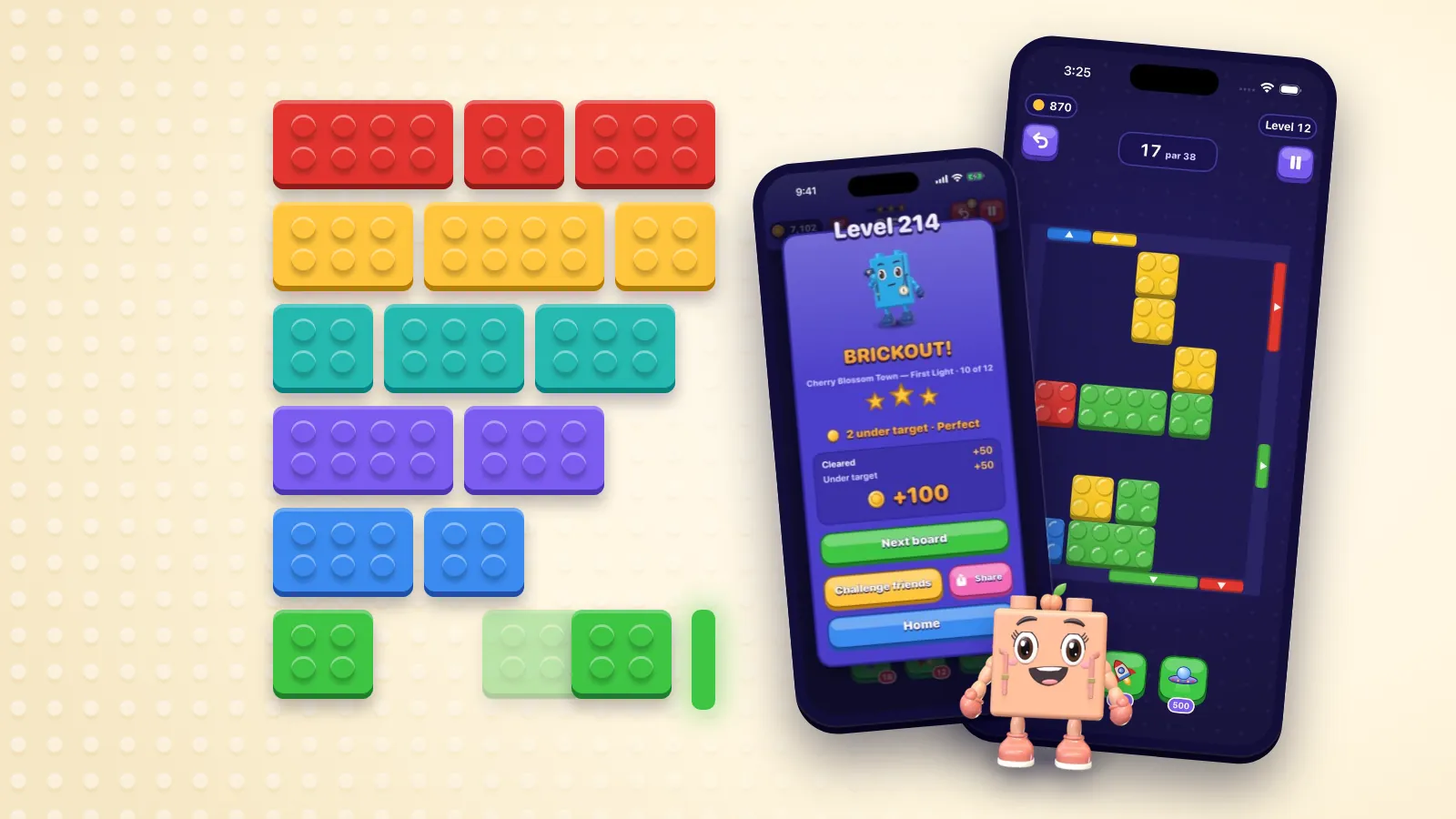
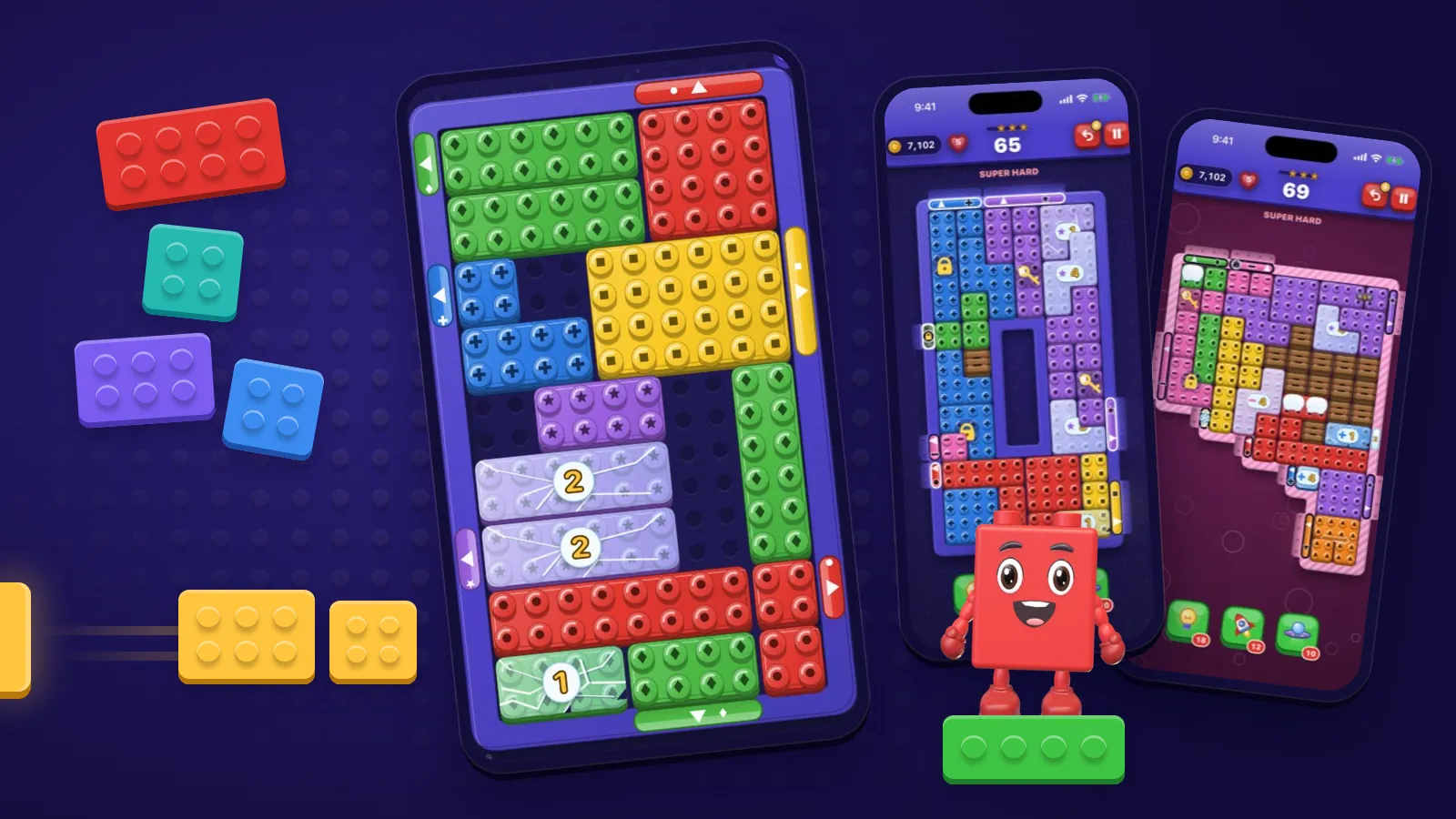
On OutBrick’s classic boards, you move the brick directly. It glides until something stops it, and it leaves through a gate of its own colour. You do not drag a brick to any square you choose. A clear corridor may let it travel further than you intended; another brick can provide the stopping point you need. (The App Store game now plays Slide & Match, where a brick stops where you let go and can swap into matches.) Our guide to sliding-block puzzles explains that distinction with a broader solving approach.
Both are colour-sort puzzles, but that label describes the destination rather than the entire journey. Pouring changes which layers can be reached at the top of a container. Sliding changes the arrangement of obstacles on a shared board. Before judging a game as confusing, try stating its movement rule aloud. A correct prediction is a better first milestone than a quick clear.
Other variants can use different movement rules, restrictions or containers. Begin with the game’s own tutorial before transferring advice from a similar-looking puzzle.
Here is an illustrative arrangement for a common water-sort variant that accepts a pour into an empty tube. Tube A has a blue top layer hiding red beneath it. Tube B has blue on top but is already full. Tube C is empty. Pouring A into B is not available merely because the top colours match: B needs room. Moving A’s blue into C can expose red, creating a different opportunity elsewhere. The example explains a dependency; it is not a promised layout in IEC Global’s app.
The temptation is to treat every empty tube as a place to put something immediately. Instead, ask which buried colour you want to uncover, and where the top layer must go to make that possible. A free container is valuable because it permits an intermediate arrangement. Filling it with an unrelated layer may use up the only workable destination for the move you were preparing.
Now change the example: B has space for blue, so A can pour there directly under the stated matching rule. C can remain available for a later rearrangement. The visible move is simpler, but the question stays the same: what will become accessible afterwards? Our colour-sort puzzle tips develop this habit of thinking beyond the most obvious match.
Ito et al. (2023) formalised ball-sort and water-sort puzzles, demonstrating equivalence in solvability under their model and proving the generalised problems NP-complete. That result concerns specific stack-based rules, not every commercial variant. It explains why simple pouring rules can permit demanding planning, without proving that the illustrated board is difficult or that OutBrick shares the same complexity. The practical question remains whether you enjoy managing access to buried colours and spare capacity.
Sources1Ito, T., Kawahara, J., Minato, S.-i., Otachi, Y., Saitoh, T., Suzuki, A., Uehara, R., Uno, T., Yamanaka, K., & Yoshinaka, R. (2023). Sorting balls and water: Equivalence and computational complexity. Theoretical Computer Science, 978, Article 114158.
Imagine a red brick needs to line up with a red gate on the right-hand edge. Sliding upwards along an empty column carries it past the row where it should turn. A blue brick placed above that row could stop it at the useful height. The immediate task is therefore positioning blue, even though red looks nearer to an exit. This is an illustrative situation on OutBrick’s classic boards, not a walkthrough for a numbered board.
Once red is aligned, a second dependency can appear: blue may also need that corridor to reach its own gate. Removing red too soon could erase a stopping point blue still needs. Unlike the spare tube in the previous example, the relevant resource is a location and its relationship to a route. More empty space does not automatically mean a better position. Sometimes the arrangement becomes useful precisely because something occupies the right square.
Kirsh and Maglio (1994) studied Tetris and distinguished actions that progress towards a goal from actions that reveal information difficult to work out mentally. They did not test OutBrick or water-sort apps. We borrow the distinction as a way to read an attempt: a move can show you where a brick stops even when it does not improve the route. “It stopped one row too high” is an observation you can use, rather than a verdict on your ability.
Try a board on our browser play page and predict where a brick will stop before moving it. Then compare prediction and result. If you want to read the arrangement more deliberately, the before-you-move guide suggests a way to identify exits and dependencies first. This test is about your interest in spatial routes, not how quickly you can master an unfamiliar game.
Sources2Kirsh, D., & Maglio, P. (1994). On distinguishing epistemic from pragmatic action. Cognitive Science, 18(4), 513–549.
A mechanics preference can be undermined by an interface that makes the pieces difficult to read. For liquid puzzles, can you distinguish the top layers and judge remaining capacity at your normal viewing distance? For block puzzles, can you identify the intended brick, its matching gate and the obstruction that will stop it? Try using the actual phone you expect to play on rather than judging enlarged promotional images.
Larkin and Simon (1987) compared diagrammatic and sentential representations through models and illustrative mathematics and physics problems. Their analysis showed why location and explicit grouping can change the work needed to find information, even when the information itself is equivalent. This was not a test of game screenshots. Our application is to inspect what a board makes easy to see: the top colour and capacity in a tube, or the relationship between a brick, blocker and gate.
Likewise, untimed play describes pacing rather than the whole commercial model. OutBrick’s current version has move limits and targets, with lives and optional rewarded adverts. The first undo on each app board is free. Our fair-play explanation describes those costs. IEC Global’s listing describes a free download with in-app purchases; that alone does not establish the frequency or form of every advertising placement. This guide does not compare prices or interruptions from hands-on testing.
Kotovsky et al. (1985) investigated why versions of the Tower of Hanoi problem differed in difficulty, considering factors such as rules, representation and memory demands. These were different tasks from either app here. The relevant caution is that a shared abstract goal does not make two presentations equally easy to understand. If one puzzle feels clearer, examine the specific decisions and cues that support you rather than declaring its entire genre superior. Neither this study nor the others establishes a medical or cognitive advantage from playing these apps.
Sources4Larkin, J. H., & Simon, H. A. (1987). Why a diagram is (sometimes) worth ten thousand words. Cognitive Science, 11(1), 65–100.3Kotovsky, K., Hayes, J. R., & Simon, H. A. (1985). Why are some problems hard? Evidence from Tower of Hanoi. Cognitive Psychology, 17(2), 248–294.
Give each style a chance to teach its basic rule, then ask three concrete questions. Can I predict an ordinary move? Do I enjoy the question left by a failed attempt? Would I willingly try one more board? These questions separate initial unfamiliarity from a lasting mismatch. They also avoid using the first difficult level as an all-purpose verdict on the genre.
For water sort, watch whether you enjoy uncovering colours and preserving receiving space. For block sort, watch whether you enjoy arranging routes and temporary brakes. You may prefer the clearer visual stacks of a tube puzzle, the tactile movement of bricks, or simply whichever controls feel more comfortable. Choosing the problem you want to think about is enough.
Compare both styles in similar circumstances and without a timed contest. A few deliberately observed moves can reveal more about fit than pushing through a game you already dislike.
If the sliding example sounds inviting, start with OutBrick’s browser boards. For the wider app experience, find OutBrick on the App Store, then check the current listing for device requirements and purchase details. If you prefer pouring, use the named water-sort listing below to identify the actual app. The useful outcome is a puzzle you want to return to, including the entirely reasonable choice to enjoy both.
Product source: IEC Global Pty Ltd. (n.d.). Water Sort Puzzle [Mobile app]. App Store. Retrieved September 30, 2026, from the Water Sort Puzzle listing. The rules comparison uses this developer-provided description; the planning examples are our own illustrations.
Filed under
Questions, answered
A few useful answers
What is the main difference between water sort and block sort?
Water-sort puzzles organise coloured liquid between containers under capacity and matching rules. OutBrick’s classic block sort moves bricks through a shared board to matching gates, with each slide continuing until something stops it; the App Store game now adds swaps and matches.
Is an empty tube the same as an empty space in a block puzzle?
Both can enable a later move, but they serve different purposes. An empty tube receives liquid; an empty board square helps define a route, while an occupied square may provide a useful stopping point.
Which puzzle style is better for the brain?
The research cited here does not establish cognitive superiority for either puzzle style. Choose by the mechanics, readability, pacing and costs that suit your preferences.
Can I try OutBrick before downloading it?
The OutBrick play page offers a small set of browser boards. It demonstrates the classic sliding rule without representing the full app or promising shared app progress.
APA 7
References
Where a source is a studio’s own history or a news account rather than a study, the article says so beside the claim.
- Ito, T., Kawahara, J., Minato, S.-i., Otachi, Y., Saitoh, T., Suzuki, A., Uehara, R., Uno, T., Yamanaka, K., & Yoshinaka, R. (2023). Sorting balls and water: Equivalence and computational complexity. Theoretical Computer Science, 978, Article 114158. doi.org/10.1016/j.tcs.2023.114158 (opens in a new tab)
- Kirsh, D., & Maglio, P. (1994). On distinguishing epistemic from pragmatic action. Cognitive Science, 18(4), 513–549. doi.org/10.1207/s15516709cog1804_1 (opens in a new tab)
- Kotovsky, K., Hayes, J. R., & Simon, H. A. (1985). Why are some problems hard? Evidence from Tower of Hanoi. Cognitive Psychology, 17(2), 248–294. doi.org/10.1016/0010-0285(85)90009-X (opens in a new tab)
- Larkin, J. H., & Simon, H. A. (1987). Why a diagram is (sometimes) worth ten thousand words. Cognitive Science, 11(1), 65–100. doi.org/10.1111/j.1551-6708.1987.tb00863.x (opens in a new tab)