




Quick reference
Everything that is not a plain brick is listed here. Their look changes with the village (flower pots in Garden City, hay bales on the farm, sandcastles by the sea), but the rules never do. Tap any blocker, lid or gate on the board and it wiggles and tells you in one line what it is and what clears it.
| Obstacle | Stops a slide? | How to clear or open it |
|---|---|---|
| Crate | হ্যাঁ | A line beside it, or a blast. One layer each time. |
| Brick in ice | Yes, and it cannot move | A line beside it, or a blast. One layer each time. |
| Locked brick | Yes, and it cannot move | A line through it, or a blast. |
| Moss | হ্যাঁ | A line beside it, or a blast. |
| Statue | হ্যাঁ | It stays. Find another lane. |
| Face-down brick | It is a brick: it moves | Turns over when a brick next to it leaves the board. |
| Lids | হ্যাঁ | Each of the five opens by its own rule. |
| Gates | Wrong colour or shut: yes | Open gates take bricks of their colour. |
| Portal | No: a brick goes through | Slide a single brick into it. |
Checked against version 5.1.1
Crates, ice, locks, moss, statues, gates and the clock lid appear all along the Journey. In this version the other four lids, face-down bricks, staged gates and portals appear on some boards up to level 408; later updates may bring them further along.
Obstacles
A board where nothing falls, three rows of four. Top row: green, blue, red, yellow. Middle row: red, red, blue, and a crate with 2 layers on the right. Bottom row: yellow, green, yellow, blue. An arrow swaps the red at the top of the third column down with the blue under it. Result: three reds clear in the middle row, and the crate beside the end of the line loses a layer: it now has 1 layer. The blue is at the top of the third column; the rest is unchanged.
Crate
A box that fills one cell. A sliding brick stops against it, nothing can be swapped with it, and on boards where bricks fall it stays put while the bricks above rest on it. It has one or two layers: a two-layer crate looks sturdier, and a tap or VoiceOver always tells you how many are left.
Make a line right beside it (the cell above, below, left or right of any brick in the line): each line takes one layer, however many of its bricks touch the crate. A blast that reaches it also takes one layer, and a bomb’s double blast can take two. The last layer breaks it open and frees the cell.
- First appears
- Level 5, Pots and Ice. Two-layer crates from level 20.
- Goal
- “Break” crates: every layer you knock off counts once.
- Looks like, but isn’t
- A statue, which never breaks, and a lid, which covers bricks and shows a sign.
- VoiceOver says
- “Crate, 2 layers”. Tapped: “Crate, 2 layers. A line beside it breaks a layer”.
The UFO booster takes one layer off a crate wherever it is.
A board where nothing falls, three rows of three. Top row: blue, a green brick frozen in ice, yellow. Middle row: red, red, blue. Bottom row: green, yellow, red. An arrow swaps the red at the bottom right up with the blue above it. Result: three reds clear in the middle row, and the ice on the green brick above the line breaks, leaving a plain green brick that can move again. The blue is now at the bottom right.
Brick in ice
A coloured brick held in a block of ice, one or two layers thick. While it is frozen it cannot slide, swap, fall or count in a line, and a sliding brick stops against it.
Make a line right beside it, or reach it with a blast: each takes one layer. When the last layer breaks, the brick is an ordinary brick again and can be moved and matched.
- First appears
- Level 5, Pots and Ice.
- Looks like, but isn’t
- An iced gate, which is on the edge of the board and thaws differently. See Iced gate.
- VoiceOver says
- The brick, then its ice, for example “Red brick, in gel, 1 layer”. Tapped: “… A line beside it breaks the gel”.
An iced brick of a goal colour is worth freeing early: until it is free it cannot reach its gate.
A board where nothing falls, three rows of three. Top row: green, yellow, red. Middle row: red, a locked red brick, blue. Bottom row: yellow, green, yellow. An arrow swaps the red at the top right down with the blue below it. Result: three reds line up in the middle row, running through the locked brick. The two outer reds clear; the lock opens and the middle red stays, now a plain brick. The blue is at the top right.
Locked brick
A brick held by a lock. It cannot slide, swap or fall, and a sliding brick stops against it. It still counts in a line of its colour.
Make a line through it: the line clears the bricks around it, opens the lock and leaves the freed brick where it is. A line merely beside it does nothing. A blast that reaches it also opens the lock.
- First appears
- Level 9, Locks and Moss.
- Goal
- “Undo” locks: each lock opened counts once.
- VoiceOver says
- “Yellow brick, locked, a line through it frees it”.
Look for the locked brick’s own colour on both sides of it, or above and below: one slide or swap that completes the line frees it.
A board where nothing falls, three rows of three. Top row: yellow, a clump of moss, blue. Middle row: red, red, green. Bottom row: blue, yellow, red. An arrow swaps the red at the bottom right up with the green above it. Result: three reds clear in the middle row and the moss above the line is cleared too, leaving an empty cell. The green is now at the bottom right.
Moss
A clump of moss that fills a cell. A sliding brick stops against it. On Locks and Moss boards it spreads: in the game’s words, it creeps onto a brick after any move that clears none, taking over one plain single brick next to it.
Make a line right beside it, or reach it with a blast: one hit clears it. Moss that has grown over a brick clears the same way.
- First appears
- Level 9, Locks and Moss.
- Goal
- “Clear” moss: every clump cleared counts, including ones that grew during play.
- VoiceOver says
- “Moss, spreads after a move that clears none”. Tapped: “… A line beside it clears it”.
Clear a little moss whenever you can: a move that clears some moss never lets it grow. Boosters never count as a move, so using one does not let moss spread.
A board where nothing falls, three rows of five, with a red gate on the right edge of the middle row. Top row: empty. Middle row: a red brick at the left, an empty cell, a statue in the middle, then two empty cells. Bottom row: blue at the left, three empty cells, green at the right. An arrow slides the red brick right. Result: it stops in the second cell, against the statue, and cannot reach the red gate along this row.
Statue
A garden statue, or another ornament of the village, standing in a gap inside the board. It is scenery, not a piece: nothing slides through it, nothing can land on it, and it never breaks. On boards where bricks fall, bricks above it rest on top, and single bricks slide round it diagonally to fill the cells beneath.
It cannot be cleared. Plan around it: use the open lanes, or bring the brick round by another row. A line blaster’s blast passes right over it.
- First appears
- Level 10, Stone Lanes.
- Looks like, but isn’t
- A crate, which breaks; a statue never does.
- VoiceOver says
- Its name, for example “Statue: part of the scenery. Pieces fall round it”.
Bricks with their own rules
A board of two rows of four, with a red gate on the top edge above the second column. Top row: a face-down brick showing a question mark, a red brick, two empty cells. Bottom row: green, blue, yellow, empty. An arrow slides the red brick up, out through the red gate. Result: the red has left the board, and the face-down brick beside it turns over: it was yellow. The bottom row is unchanged.
Face-down “?” brick
A slate-grey brick with a white “?” and no colour symbol. It hides its colour, but it is a real brick of a real colour and plays by it: it slides, swaps, matches and goes home through its own colour’s gate exactly as that colour would.
It turns over when a brick next to it (above, below, left or right) leaves the board: out through a gate, cleared in a line or cleared by a blast. It never turns over because it moved, or because a neighbour slid or fell away.
- First appears
- Level 49.
- Fair play
- No hint, teaching hand, rotor, row sound or VoiceOver word ever gives its colour away. The hint will not suggest a move that moves, swaps or clears a face-down brick, so on a board full of them it may show no hint at all.
- VoiceOver says
- “Face-down brick, turns over when a brick next to it leaves the board”. Its swaps never say “no match”, and a lane that ends at a gate is offered as “Slide left into the gate”. Voice Control calls it “face-down”, as in “Slide face-down 14 left”.
Clear the bricks around a cluster of “?” bricks first: each brick that leaves can turn over up to four of them, and then you can plan.
Key brick
A brick of its colour with a key on it. It only appears on boards with a keyhole lid, outside the lid and usually high on the board.
It plays exactly like a brick of its colour: slide it, swap it, match it. The moment it leaves the board, matched in a line, cleared by a blast, or slid out through a gate of its colour, the keyhole lid opens.
- VoiceOver says
- “Red key”.
- বর্ণান্ধ
- It wears a corner badge with its colour’s symbol.
If its gate is far away, a line of three is quicker: a key matched anywhere opens the keyhole just the same.
Long and big bricks
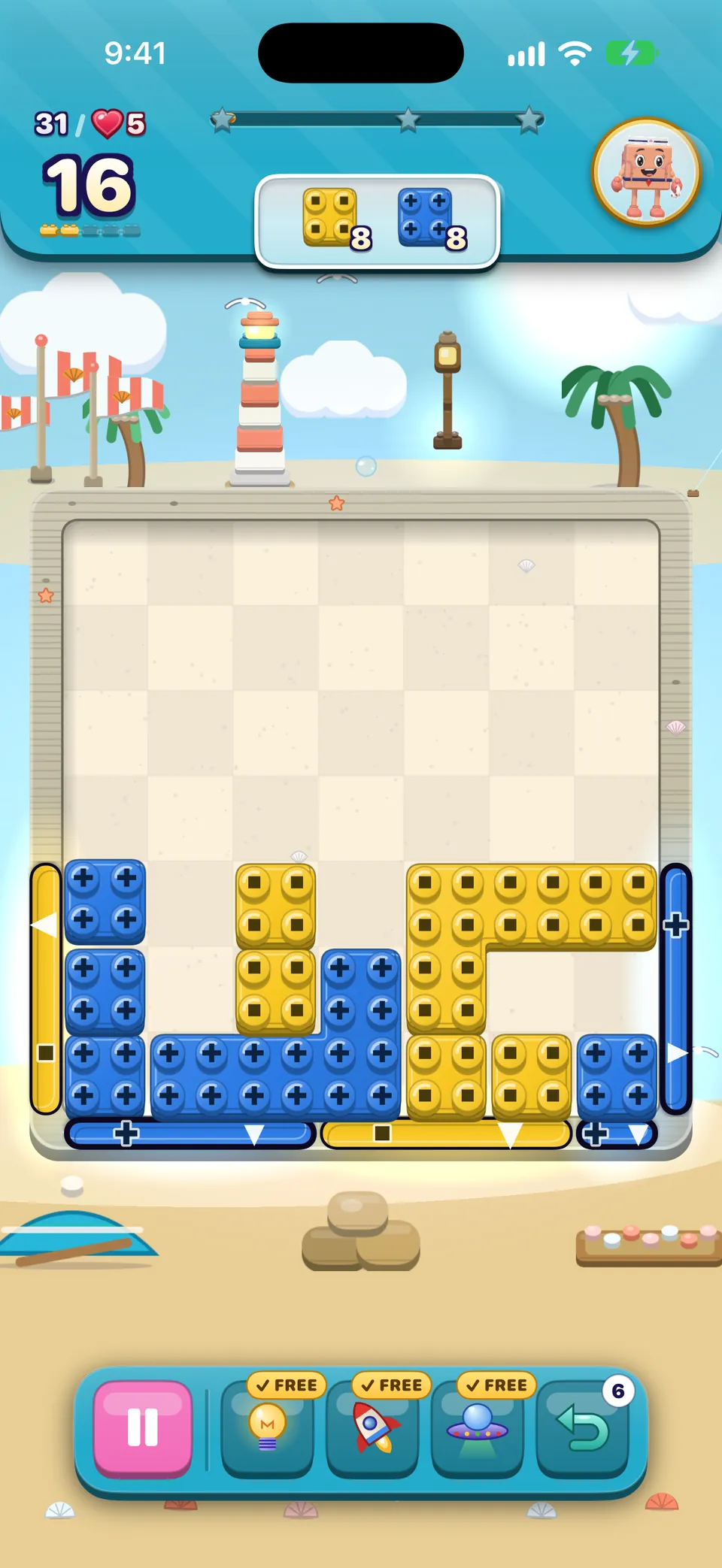
One moulded piece covering two or three cells in a row (1×2, 2×1, 1×3, 3×1) or a 2×2 square. It slides as one piece and stops as soon as any of its cells meets something.
Slide it into a gate of its colour that is as wide as the brick across its lane: a brick two cells tall sliding sideways needs a side gate two cells long, and a 2×2 needs a gate two cells long. The cells behind it must be free to follow it out. It is never swapped, never counts in a line, and no blast or booster can take it, so sliding it home is the only way. It counts every cell for your goals: a 2×2 red is four red.
- First appears
- Level 6, Long Bricks.
- Where bricks fall
- It falls as a unit, one row at a time, and only when every cell beneath it is free: one crate under one of its cells holds the whole piece up.
- VoiceOver says
- “Red long brick, 2 tall”, “Blue big square brick”. Its actions name it: “Slide the red long brick left, out through the red gate”.
Before you clear a lane, check the gate’s width. A gate one cell long will never take a long brick, however well it is lined up.
L and T bricks
Bent pieces of four cells in the shape of an L or a T. They follow the same rules as long bricks: one piece, never swapped, never in a line, never blasted.
Line the piece up with a gate of its colour that spans the whole piece across its lane, then slide it home. Whichever of its cells meets something first stops the whole piece.
- First appears
- Level 7, Corner Pieces.
- VoiceOver says
- “Red L brick”, “Blue T brick”.
Sealed rooms and their five lids
A sealed room is a block of one to four cells under a lid. Until the lid opens, the bricks underneath are frozen: they cannot slide, swap, match or fall, and no blast, booster or shuffle can reach them. Each lid shows a sign for its kind, and most also show a number: how many more they need. When it opens, the lid lifts away and its bricks join the game.
| Lid | Sign | Opens when… |
|---|---|---|
| Counter | A grid of squares and a number | That many more bricks, of any colour, have left the board. |
| Colour counter | A stack of squares and a number, in its colour | That many more bricks of its colour have left the board. |
| Stained-glass key | A key, in its colour; no number | You make a line of its colour right beside it. |
| Clock | A clock and a number | You have made that many more moves. |
| Keyhole | A padlock | The key brick leaves the board. |
Counter lid
A lid with a grid sign and a number that counts down.
Every brick that leaves the board, of any colour, takes one off: matched in a line, cleared by a blast or sent out through a gate. A long or big brick counts once. Sliding bricks around the board does not count. On the boards so far it asks for 5 to 9 bricks.
- VoiceOver says
- On each covered brick: “sealed under a lid, opens after 6 more bricks are cleared”. Opening: “The counter lid opened. Its bricks can move”.
Colour counter lid
A lid in one colour, with a stack sign and a number.
Only bricks of its own colour leaving the board count: matched, blasted or sent through a gate. Other colours do nothing for it. On the boards so far it asks for 3 or 4.
- First appears
- Level 65.
- VoiceOver says
- “sealed under a red lid, opens after 3 more red bricks are cleared”. Opening: “The red counter lid opened. Its bricks can move”.
Its colour is usually one your goals want as well, so every brick you send home works twice.
Stained-glass key lid
A lid in one colour with a key sign and no number.
Make a line (or a 2×2 square) of its colour with at least one brick right beside the lid: above, below, left or right of one of its cells. A line of another colour, a line further away, or a blast does not open it.
- VoiceOver says
- “sealed under a red key lid, opens to a red line beside it”. Opening: “The red glass lid opened. Its bricks can move”.
Look for two bricks of the lid’s colour already touching it: one slide or swap of a third brick next to them opens it.
Clock lid (the sealed bed)
A lid with a clock sign and a number of moves. On The Big Day it often covers the two bottom cells of one corner; the game calls that one the sealed bed.
It opens by itself after that many moves: every slide, swap or tap counts one. Boosters do not count. On the boards so far it asks for 3 to 6 moves.
- First appears
- Level 11, The Big Day, as the sealed bed.
- VoiceOver says
- “sealed under a clock lid, opens in 3 moves”. Opening: “The clock lid opened. Its bricks can move”.
Nothing you do opens it sooner, so play elsewhere and plan for the bricks underneath.
Keyhole lid
A lid with a padlock sign. Somewhere outside it is a key brick of a goal colour.
Get the key brick off the board: match it in a line, clear it with a blast, or slide it out through a gate of its colour. The lid opens at once.
- VoiceOver says
- “sealed under a keyhole lid, opens to a key brick”. Opening: “The keyhole lid opened. Its bricks can move”.
টিপ
The first time you meet each lid, a teaching card explains it. A lid that will not open never makes a board impossible: every board in the game has been checked to be winnable, lids included.
Gates
Gates are coloured doors set into the board’s frame, one, two or three cells long. A gate whose colour your goals still want glows gently; a gate that cannot take bricks right now does not. A gate of any other colour, or one that is shut, is simply part of the wall.
A board of three rows of four, with a red gate on the left edge of the middle row. Top row: blue, empty, yellow, green. Middle row: three empty cells, then a red brick at the right. Bottom row: green, yellow, blue, empty. An arrow slides the red brick left along the empty middle row. Result: it travels to the edge and out through the red gate. The middle row is now empty; the other bricks are unchanged.
Open gate
A door that takes bricks of its own colour: plain bricks, keys and line blasters. Bombs, homing darts and colour bombs stop at it.
Three ways in. Slide a brick along its lane and carry it right into the gate: let go short of it and the brick stays where you let go. Match a brick of its colour on the edge cell in front of it. Blast a brick of its colour on that edge cell. Each one counts as sent home.
- Width
- A single brick can use any cell of the gate. A long or big brick needs the gate to span it, and the cells behind it must be free.
- Goal
- “Send or match” a colour: bricks matched or blasted anywhere count as well as bricks sent through the gate.
- VoiceOver says
- “Red gate, 2 cells wide, left side, rows 3 to 4”, and its state: “open”.
A board of two rows of three, with a red counted gate showing 2 on the left edge of the top row. Top row: red, empty, green. Bottom row: blue, yellow, empty. An arrow slides the red brick left, out through the gate. Result: the red has gone home and the gate now shows 1: it will take one more red brick, then close.
Counted gate
A gate with a number: how many more bricks it will take.
Each brick that goes through it, by slide, match or blast in front of it, takes one off. At zero it closes for good and becomes a wall. It counts only bricks that pass through it; bricks of its colour matched elsewhere still count for a “Send or match” goal but leave the gate’s number alone.
- First appears
- Level 11, The Big Day.
- VoiceOver says
- “open, takes 3 more”, then “closed for good”. Tapped: “Red gate: takes 3 more red bricks, then closes”.
On The Big Day the counted gate takes a little more than its goal asks for. Long bricks of its colour can only leave through a gate, so save its room for them.
A board of three rows of four, with a blue gate on the left edge of the top row and an iced red gate on the right edge of the bottom row, one brick away from thawing. Top row: blue at the left, two empty cells, yellow. Middle row: empty, green, empty, empty. Bottom row: red, empty, yellow, empty. An arrow slides the blue brick left, out through the blue gate. Result: the blue has gone home, and the red gate on the right has thawed and is open.
Iced gate
A gate covered in ice. Until it thaws it takes nothing and is part of the wall.
It thaws one step at a time in two ways: every brick that goes home through any gate thaws every iced gate by one, and every piece cleared on the edge cell right in front of it thaws it by one. When the ice is gone, slide its colour in.
- First appears
- Level 5, Pots and Ice.
- Looks like, but isn’t
- A brick in ice inside the board. Counted and iced gates are drawn differently, so they never look alike.
- VoiceOver says
- “iced, clear 2 more in front of it to thaw it”, then “open” when it thaws.
Send an easy brick home early, whatever its colour: it starts the thaw while you set up the rest.
Staged gate
A gate behind a dark shutter with a padlock and a stage number. It belongs to a board whose goals come in two stages, shown as “Stage 1 / 2” in the order panel.
Finish the first stage’s goals and the second stage begins: the shutter opens and the gate takes its colour. Until then it is part of the wall.
- First appears
- Level 54, on boards where nothing falls.
- VoiceOver says
- “locked until a later stage”, and “New gates open” when the stage changes.
During stage 1, move the second stage’s bricks toward their sealed gate, so they are ready the moment it opens.
অ্যাক্সেসিবিলিটি
Every gate wears its colour’s symbol. With High-contrast board on, a gate whose colour sits close to the frame’s gets a two-tone outline. See Vision, hearing and motion.
Portals
Portal
A pair of swirling rings set into the board’s frame on two different sides, both marked with the same letter.
Slide a single brick (a plain brick, a key or a special) along its lane to the edge cell in front of one ring, and it goes in and comes out of the twin, travelling inward until it meets something. It costs one move. The cell in front of the twin ring must be free, and if a gate of the brick’s colour takes it at that edge, it goes home instead. Long, big, L and T bricks cannot use portals.
- First appears
- Level 58, on boards where nothing falls.
- VoiceOver says
- The action “Slide left, through the portal”, then “Through the portal, out at row 3, column 5”.
Portals are shortcuts to a far gate: a brick walled in on one side of the board can come out right in front of the gate it needs.
Telling look-alikes apart
| If you see… | It is… | Because… |
|---|---|---|
| A sturdier-looking crate | A two-layer crate | Tap it: it says how many layers are left. |
| A panel over several bricks, with a sign | A lid | Lids cover bricks; crates fill one cell on their own. |
| Ice inside the board | A brick in ice | Ice on the frame is an iced gate. |
| A grey brick with “?” | A face-down brick | It has no colour symbol; a lid never shows “?”. |
| A coloured door with a number | A counted gate | An iced gate shows ice, a staged gate a dark shutter with a padlock. |
| A swirl in the frame | A portal end | Gates are coloured; portal ends come in lettered pairs. |
| An ornament in a gap | A statue | It is scenery: tap it and it says so. |
Blockers with VoiceOver
- Blockers and fixtures read as text and pieces you can move as buttons, so you can tell at once what can move. Choosing one that cannot move says, for example, “Crate, 2 layers. It cannot move”.
- Each covered brick reads its lid, and each gate is its own element with its width, side, rows or columns, and state.
- The Blockers rotor jumps between crates, ice, locks, moss and the rest; the Gates rotor between gates.
- Each piece’s More Content includes the blocker on it and whether a goal needs it.
- A face-down brick’s colour is never spoken until it has turned over; then you hear “Turned over:” and its colour.
Everything else is in Playing with VoiceOver.
প্রশ্ন
Why did my brick stop at the gate instead of going home?
Check five things: the gate is the brick’s colour; it is not iced, full or sealed for a later stage; the brick is not a bomb, homing dart or colour bomb; a long or big brick has a gate as wide as it is; and you carried the brick all the way in. A brick let go just short of its gate stays where you let it go.
I moved a face-down brick and it stayed face-down. Is that a bug?
No. A face-down brick turns over only when a brick next to it leaves the board, never when it moves or a neighbour slides away. This is the same rule the original game always had.
Why is there no hint on this board?
On boards with face-down bricks the hint never suggests a move that would give a hidden colour away. If every good move involves a face-down brick, no hint is shown rather than a hint that cheats.
The moss keeps growing. What can I do?
Moss spreads only on Locks and Moss boards, onto one brick next to it after a move that clears none. Clear a clump with a line beside it as often as you can, and use the UFO booster on moss in an awkward spot: boosters never let it grow.
Can a lid or a blocker make a board impossible?
No. Every board has been checked to be winnable. If nothing at all can move, the board reshuffles for free; if moss has choked every column it wilts, and as a last resort the ice or lock on one brick gives way. See Playing a board.
এই গাইডটি কি কাজে এসেছে?
Keep reading
Special bricks and combos: the complete guide
How to make every special brick, exactly what each one clears, the three ways to set them off, every combination of two specials, and how cascades, score, stars and the leftover-moves finish fit together.The twelve kinds of board
Every village’s twelve boards follow the same pattern of twelve kinds, from Send Them Home to Quiet Puzzle. What each kind brings, how boards where bricks fall differ from boards where nothing falls, and what Hard, Super Hard, Boss and Night boards change.Special bricks, blockers and board kinds
How to make every special brick and combo, what each blocker, lid and gate does, face-down bricks, portals, long bricks, and the twelve kinds of board in every village.একটি বোর্ড খেলা
Every part of the board screen, how sliding and swapping work, what counts as a move, how stars and score work, and what Hard, Super Hard, Boss and Night boards mean.Boosters, hints and Pause
What Hint, Rocket, UFO and Undo do, the free ones you get on every board, how to get more, and everything in the Pause menu.VoiceOver দিয়ে খেলা
How the board reads, how to slide and swap with actions, the rotors, every gesture, what you hear after a move and how to get a free hint.
টিমের একজন মানুষ প্রতিটি বার্তা পড়েন। আমরা দুই কর্মদিবসের মধ্যে উত্তর দেওয়ার চেষ্টা করি।
এখনও আটকে আছেন?
এখনও আটকে আছেন?
কমিউনিটিতে জিজ্ঞেস করুন। টিম আর অন্য খেলোয়াড়রা সবার সামনে উত্তর দেন, আর আপনার ইমেল ঠিকানা কখনও দেখানো হয় না।
কমিউনিটিকে জিজ্ঞেস করুনগোপনে লিখতে চান?
যোগাযোগ ফর্মটি গোপনে একই টিমের কাছে পৌঁছায়। কেনাকাটা আর ব্যক্তিগত যেকোনো বিষয়ে এটি ব্যবহার করুন।
সাপোর্টে যোগাযোগ করুন